While OEMs are seemingly hell-bent on creating an electric transportation future, there is one Everest-sized speedbump between now and then: the lack of a robust charging infrastructure for those vehicles.
Although companies like Shell and bp talk about peak oil and changing their business models to less carbon-intensive approaches, how many of their stations provide electric chargers? Probably far fewer than offer gasoline, beef jerky and lottery tickets.
The European Automobile Manufacturers Association, the European Consumer Organisation and Transport & Environment have jointly written a letter to the commissioners responsible for the European Union’s Green Deal detailing the necessity for specific regulations rather than a nice-to-achieve directive, regulations that will “set binding national targets for all vehicle segments” vis-à-vis charging.
The authors write: “the following minimal targets should be set in stone: one million charging points in 2024 and three million in 2029 for passenger cars and vans, as well as around 1,000 hydrogen stations by 2029.”
And the boldface font is in their letter.
Apparently there are some 225,000 charging points in the EU right now. If they’re going to have one million charge points by January 1, 2024, then this means they need to install 258,000 additional chargers per year. Or 33,000 more per year than currently exist.–gsv
No, this is not predicated on some prognostication wrapped in a Tweet by Elon Musk, nor by the potential that Syd Mead fans may actually get their Cybertruck before the end of 2021.
No, this is not predicated on Joe Biden’s plan recommendation to transform the government’ fleet of ~650,000 vehicles from gasoline and diesel to electric as part of the “Buy American” initiative.
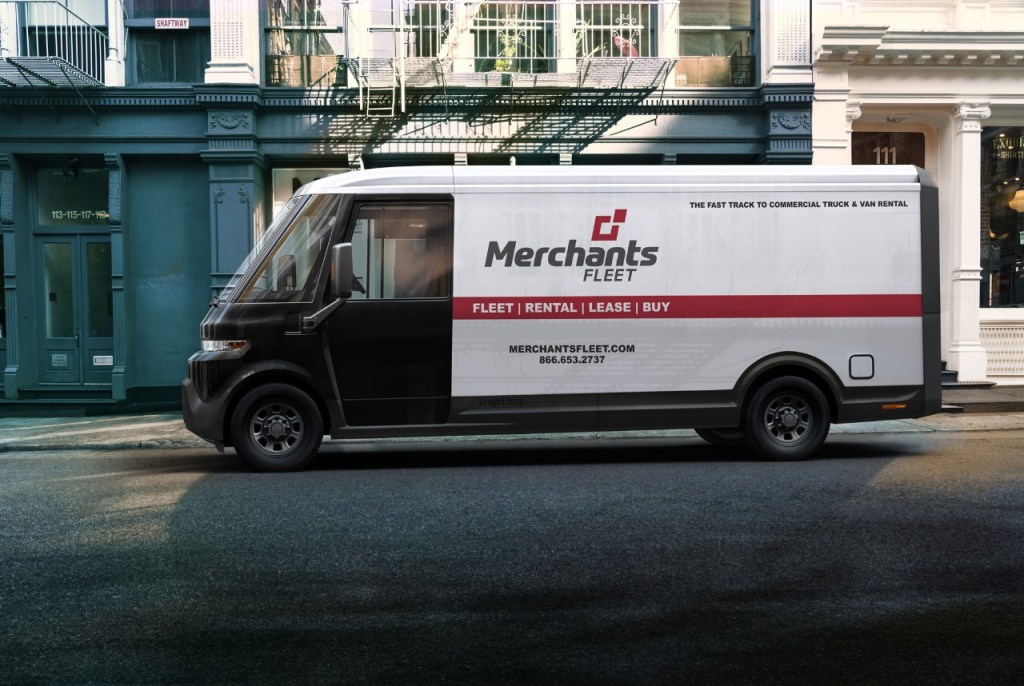
Merchants Fleet has ordered 12,600 BrightDrop EV600s, an all-new, electric light commercial vehicle purpose-built for the delivery of goods and services over long ranges. (Image: GM)
No, this is not even predicated on GM CEO Mary Barra’s statement last week that the vehicle manufacturer intends to become completely (i.e., product and process) carbon-neutral by 2040, including an “aspiration” to eliminate tailpipe emissions by 2035.
No, this is because of three other data points that all came out on the same day this week, all of which indicate that electric vehicles are taking on some significant substance.
1
BrightDrop Gets Second Order
BrightDrop, the company that GM recently established for business deliveries that is predicated on EVs and logistics software, has obtained an order for 12,600 BrightDrop EV600s, from Merchants Fleet, a company that describes itself as “the nation’s fastest growing fleet management company.” Deliveries of the EV600, a light commercial vehicle with some 600 cubic feet of cargo capacity and a range of up to 250 miles, are to start in 2023. The first customer for the trucks is FedEx. The importance of cargo vehicles for EVs can’t be overstated. Not only has Amazon invested a few hundred million in Rivian, but it has ordered 100,000 electric trucks, with deliveries starting later this year.
2
Edmunds Declares “Pivotal Year”
“After years of speculation and empty promises, 2021 is actually shaping up to be a pivotal year for growth in the EV sector. We’re not only about to see a massive leap in the number of EVs available in the market; we’re also going to see a more diverse lineup of electric vehicles that better reflect current consumer preferences.” That’s Jessica Caldwell, Edmunds’ executive director of insights. While the projected growth of EV retail sales is still small—according to Edmunds, they were 1.9% in 2020 and are expected to reach just 2.5% of the market in 2021—the firm anticipates that the greater number of available products in 2021, 30 vehicles including 13 SUVs and six trucks, should start making a big difference.
3
EY Sees “Massive Evolution” in Transport
“Electrifying transport is critical for Europe to meet its tough emissions targets and create a decarbonized future. Transitioning fleet first will pave the way and generate new commercial opportunities, including vehicle-to-grid and electric vehicle charging solutions among others. In order to achieve this, a fleet-centric approach is needed across both government and industry, which aims to remove barriers in areas including common standards and investment,” says Serge Colle, EY Global Power & Utilities Leader. While he is specifically talking about Europe, where the CO2 emissions standards are demanding and becoming more so, the focus on fleets (think things like EV600) is key because as EY research indicates: “the lessons learned from accelerating fleet electrification such as the development of sustainable business models that support charging infrastructure investment and integration of smart charging capability, will enable the wider secondary and passenger vehicle market to transition quicker.” First the fleet. Then the driveway.–gsv
Polestar is a brand that you may not be familiar with at the moment. But that is likely to change, as it is dedicated to producing electric vehicles (EVs) that combine Swedish style with performance.
Polestar was established in 2017 as an independent brand by Volvo Cars and Geely Holding. (This is a little complicated because Volvo Cars in under the Geely umbrella, so the way to think about it is that it is a company that Volvo developed and that Geely is underwriting.)
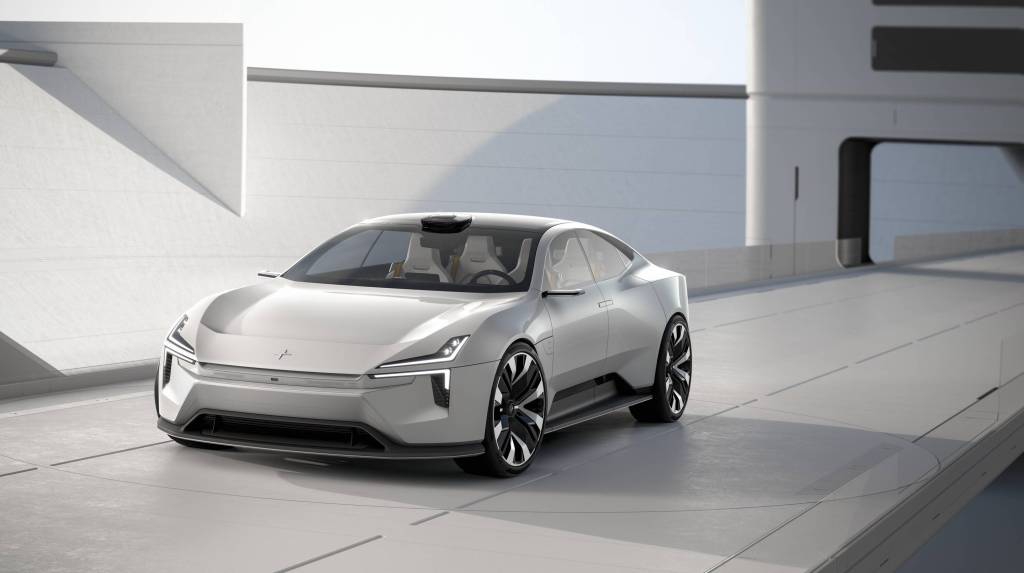
The forthcoming Polestar Precept. Stylish. Electric. (Images: Polestar)
There are presently two models, that the company has on offer, the Polestar 1, a hybrid that is exceedingly limited in production, and the Polestar 2, a 2020 model that is a high-volume sedan that offers AWD and 300 kW from the motor. There will then be the Polestar 3, an SUV, and then the Precept, a car that emphasizes three definitional aspects of the brand: sustainability, digital technology and design.
Polestar has a factory in Chengdu, China. It calls it the “Polestar Production Centre.”
Inside the Polestar factory. Yes, factory.
But there’s something interesting about what they’re doing there: operating the plant on 100% renewable electricity. Some 65% of all of the electricity powering the factory comes from hydroelectric with the balance from solar, wind and other renewables.
What’s more, there is no industrial water discharge from the plant and they are establishing a circular approach to waste handling (including carbon fiber) so as to reduce landfill demands.
The factory, designed by Norwegian architecture firm Snøhetta, has earned Gold status in the Leadership in Energy and Environmental Design (LEED) rating system, the only automobile plant in China to do so.
Said Fredrika Klarén, Head of Sustainability at Polestar, “For Polestar, sustainability is not just about the electric powertrain. It impacts everything we do. We want to promote sustainable manufacturing in China. This objective entails a relentless pursuit of circular and climate-neutral solutions, and also being a responsible employer and presence in the area.”–gsv
Kia, up until January 15, was officially known as “Kia Motors.” At least the “Motors” part of Kia Corporation was.
Now the company is just “Kia.” Which is pretty much what everyone calls it, anyway.
According to the company, by dropping the “Motors” there is an indication that it is “breaking away from its traditional manufacturing-driven business model.” I would have thought that were the company named “Kia Manufacturing” that could be the case. Somehow I don’t figure how the elimination of “Motors” means that the company “will expand into new and emerging business areas by creating innovative mobility products and services to improve customers’ daily lives.”
For one thing, aren’t the vehicles that Kia manufactures things that “improve customers’ daily lives”? Odds are, when you need to make a Costco run you’re not going to want to call an Uber.
Second, aren’t those “innovative mobility products” things that are going to need to be. . .manufactured?
While announcing the name change Kia execs stressed that the company is “focused on popularizing battery electric vehicles (BEVs)” and that it will introduce seven BEVs by 2027, encompassing various types of configurations.
In addition, it will develop what it calls “Purpose-Built Vehicles” for corporate customers that will be based on “skateboard” platforms. That term has pretty much come to mean BEV.
In one sense, it is perhaps not a good move to remove “Motors” from the name. While a Camry or an F-150 has an “engine” under its hood, a Tesla or a Taycan has a “motor” under its hood.
So a BEV-centric company might want the word “motor” associated with it.
But then there’s the “Lincoln Motor Company,” a name that Ford brought back to its luxury division in 2012 to help bring to mind a classy Lincoln of yore, not electric vehicles as it has none at this point. “Electrified”—a.k.a., hybrids—yes, but purely motor-driven, no.
And while GM has changed its logo, it has hung on to its “Motors.”
Baidu is somewhat like Google, inasmuch as it operates a search engine, by far the leading search engine in China. But there are other services as well, including maps (Google), an encyclopedia (Wikipedia) and cloud storage (AWS).
So it is fair to simply describe it as a significant tech company.
Like other tech companies, it is expanding its operations. And so it should come as no surprise that it is moving into automotive.
But it isn’t like the company just discovered the space. It has been operating Baidu USA since 2011 and has been conducting autonomous driving operations in Silicon Valley for more than five years.
In 2017 Baidu announced Apollo, the autonomous driving platform that it garnered an array of partners to participate with in on the development, partners ranging from Intel to Toyota.
It is running an autonomous taxi service in a few cities in China.
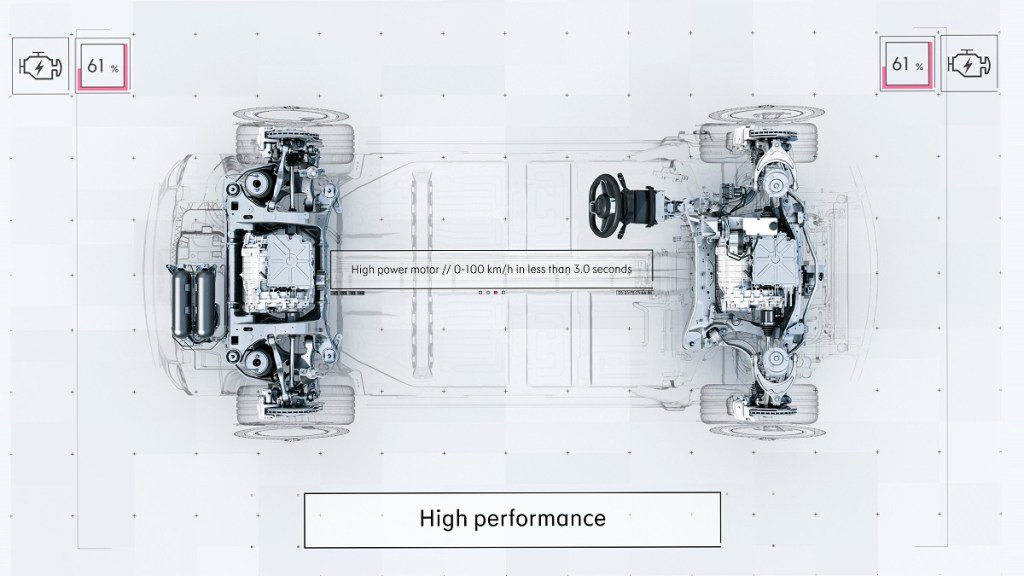
Geely SEA electric vehicle platform: EVs for everyone! (Image: Geely)
Geely Holding–parent company of brands including Volvo Cars, Lynk & Co and LEVC, and lead shareholder in Geely Auto, Proton and Lotus—and Baidu have announced the creation of a partnership for the development of highly automated electric vehicles.
Geely is going to be providing the platform—the Sustainable Experience Architecture, which it announced in September 2020 as an “open source” electric vehicle platform that it would offer to other global OEMs—and Baidu the digital horsepower.
Manufacturing vehicles is a different kind of hard than the challenges associated with developing AI systems.
It makes absolute sense that a digital company would partner with a hardware manufacturer—in this case, the hardware being a vehicle, not a smartphone.
In a market where there are some 21-million passenger vehicles sold per year, where there is a comparatively low penetration rate of vehicle ownership (on the order of 173 vehicles per 1,000 people, compared with 837 in the U.S.), even a small slice of the market is still damned large.
And neither Geely nor Baidu seems to be focused on the small.–gsv
The Cadillac LYRIQ, which is to become available in the first half of 2022, certainly looks promising as an electric, luxury SUV, one that may help the brand, which, let’s face it, has been struggling in the market for the past few years—here’s something that is not well known: although Acura is generally considered to be having a tough time of it in the U.S. market, in 2020 it outsold Cadillac, 136,983 vehicles to 129,495 vehicles; Acura also outsold Cadillac in 2019.
The Cadillac CELESTIQ, an electric sedan that takes luxury to levels that Cadillac hasn’t had on offer for, arguably, ever, combining hand-crafted materials with technology, such as a four-quadrant glass roof that allows individual selection of the level of transparency, is another arrow in the quiver of a transforming brand. Although it is still a concept vehicle, it is unlikely that General Motors would draw as much attention to it as it has (it was part of Mary Barra’s CES 2021 keynote) were it—or something damn close to it—not going into production.
That said, even though General Motors is investing $27-billion in vehicle electrification and automation, the most important launch, revealed during Barra’s presentation, is of a vehicle that none of us will individually own:
The EV600, an all-electric, purpose-built light commercial vehicle.
The LYRIQ and the CELESTIQ may be sexy, but logistics is where it is at and will drive the proliferation of electric vehicles in a way that it will take the consumer market a long time to catch up to.
The GM EV600, a purpose-built electric delivery van. The company has even started a logistics support business, BrightDrop. (Image: GM)
The owners of fleets of commercial vehicles—like FedEx, which GM worked with on the development of the EV600 (and the EP1, an electric rectangle on wheels that has a capacity of 200 pounds and a top speed of 3 mph)—do the math when it comes to vehicle acquisition. If it is going to be to their financial advantage to get EVs, then they’re not going to worry about things like available infrastructure, because they’ll build their own. They’re not going to have range anxiety, because they know precisely where their trucks are going and when.
(And it probably doesn’t hurt that it provides a green sheen to their brands by going EV.)
Consider:
–Amazon, which owns a piece of it, is having Rivian build electric delivery vans that are to be on the road next year at a number of about 10,000, perhaps going to 100,000 by 2030.
–Ford has announced the 2022 E-Transit delivery van that is going to be available later this year, and emphasized the benefits of the electric propulsion system vs. its own internal combustion offerings (with the scheduled maintenance of the E-Transit being an estimated 40% less over eight years/100,000 miles).
–And there are start-ups like Arrival, which companies including Hyundai and UPS have invested in.
Sure, we pay attention to LYRIQs and CELESTIQs.
But consider this: in an industry that seems to be shedding operations, General Motors has established a new business, BrightDrop, that is dedicated to delivery, not only vehicles like the EV600 and EP1, but even logistical software services.
This is a non-trivial commitment—and likely to be a prosperous one, as Mary Barra and her colleagues know that commercial companies do the math and need a whole lot less persuading to go electric.–gsv
U.K. electric vehicle buyers—both full-electric and plug-in hybrids—love their vehicles. That’s according to the annual EV Charging Survey conducted in the U.K. by Zap-Map, a mapping service that provides an app that shows where charging stations are located.
The firm surveyed 2,132 EV owners—52% of whom got their vehicles in 2020, 73% of whom are first-time owners of this type of tech—and found that 91% said they wouldn’t trade their vehicle for a more conventionally powered one.
The survey says that on a scale of 0 to 100, full battery electric vehicles score 92, plug-in hybrids are at 84, and vehicles with internal combustion engines are at 72.
And only 1% indicate that they “miss my petro/diesel/hybrid.”
However, it needs to be pointed out that the number of U.K. vehicle owners with battery electric vehicles and plug-in hybrid vehicles is comparatively low compared to the other categories.
According to the Society of Motor Manufacturers and Traders (SMMT), through November, battery electric vehicles have a 5.8% of the total market; plug-in hybrids have 3.9% of the market.



 shinymetalboxes