No, that’s not a problem with the caps-lock on the keyboard…
By Gary S. Vasilash
Like many Western brands, Audi is having a bit of a struggle in China, a market it has been in since 1988.
After all, not only are native Chinese brands offering an array of compelling vehicles at all price points, including the upper end where Audi resides, but there is probably something of a bit of nationalism, as Chinese consumers are turning toward Chinese brands.
Consequently Audi is making a shift in its strategy in China and has developed the “Advanced Digitized Platform” with Chinese company SAIC.
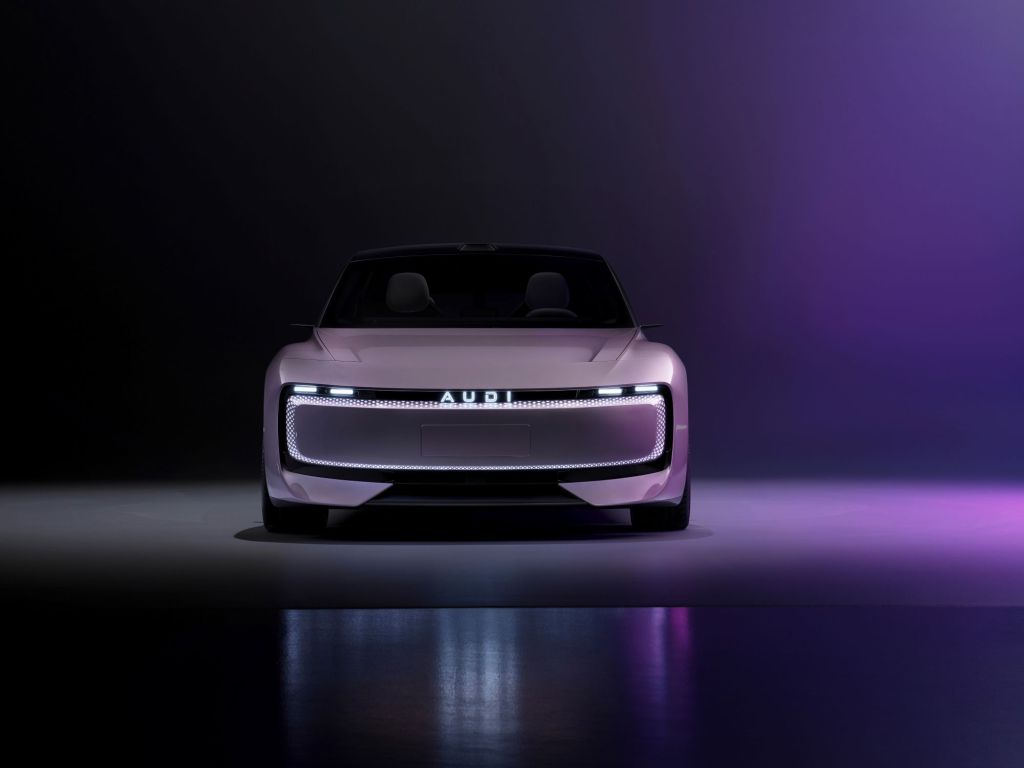
AUDI E concept introduced at the Shanghai Motor Show. All caps. No rings. Is it going to shift perceptions of the brand in China? (Image: Audi. Or maybe AUDI)
According to Audi CEO Gernot Döllner: “The joint platform will be the basis for a new generation of state-of-the-art intelligent connected vehicles exclusive to China. The upcoming models are aimed at a promising and simultaneously demanding new customer segment. The cooperation will further expand the Audi portfolio of battery electric vehicles in China and accelerate the company’s transformation in the world’s largest market.”
The platform will be used to develop three models that fall within the midsize and full-size segments, with the first model becoming available next year.
Audi says the collaboration with SAIC allows a >30% decrease in the time required to get a model in market.
In addition to which, Audi has created a new brand for the China market:
AUDI
That’s right: an all-cap version of the existing name.
Also, the famous four-right logo is jettisoned.
Döllner:
“By launching this new brand for electric and intelligent models in China, Audi is breaking new ground to tap into new and more tech-savvy customer segments.”
Seems like Audi in China becoming AUDI is China is the sort of change that a company that is afraid of making a major change would do.
Given that the average price of a Bentley is on the order of $300,000, when the company announces that it is going to “create an entirely new segment, the world’s first true Luxury Urban SUV,” you’ve got to give it to them.
After all, while we may think of “luxury” in the context of something from Mercedes—which, of course, has SUVs—it is that rarefied air that Bentley is in that Mercedes—even with its Maybach brand—is without.
The new SUV, which is to launch in 2026, is a battery electric vehicle. Presumably that explains the “Urban” part, as in the company figures this will not be a vehicle to take on some sort of grand tour.
Bentley plans to be fully EV by 2035.
Presently its Continental GT coupe, convertible and Flying Spur models are plug-in hybrids; the V8-based propulsion system replaces the W12 engine that had once been under the bonnets of the cars coming out of Crewe.
One of the things that European companies are superlative at is developing mopeds. Presumably this is because whether it is London, Paris or Rome, there tends to be considerable congestion so zipping through the gridlock on a scooter is ideal.
A new scooter was announced this week, the E-Moped 500, which is built by Platum, a company that focuses on micromobility solutions, and was designed by Pininfarina with the cooperation of Centro Stile FIAT.
The Fiat 500e is cute, but the E-Moped 500 is cool. (Image: Pininfarina)
The scooter has a range of 115 km (71 miles) and a top speed of 80 km/h (50 mph).
One of the features of the E-Moped 500 is a large front wheel that is described as being “a good ally against potholes and cobblestones.”
Certainly the former is familiar in U.S. cities, but cobblestones not so much.
The E-Moped 500 is influenced by the styling of the Fiat 500e electric vehicle.
Presumably Platum is hoping that the scooter does better than the car is doing: the Mirafiori plant in Turin where the car is built has been idled for several weeks given lack of demand for the 500e.
EV company is launching a second brand. . .perhaps
By Gary S. Vasilash
If there was an ROI for persistence, Faraday Future would have a market cap that would rival Tesla’s.
The company—which says it is developing AIEVs, as in “advanced intelligent electric vehicles”—first showed off a vehicle at CES, the FFZERO1, in 2016.
The following year, again at CES, the FF 91, its first “production” model was shown.
Apparently, what happens in Vegas really does stay in Vegas, because it has taken a long time for there to be any Faraday Future product on roads not associated with a glitzy intro.
In 2023 the company reportedly sold four FF 91s and leased six.
For the entire year.
The Faraday Future website allows the preordering of the FF 91 2.0 Futurist Alliance, a name that sounds like it comes out of some Star Wars knockoff.
It has a range of 381 miles, a top speed of 155 mph, and there will be just 300 produced. Globally.
The base price?
$309,000.
Although it is not an AIEV, I suspect that the Rolls-Royce Wraith might be an even more exotic expenditure of ~$300K.
But back to persistence.
Faraday Future has announced that it is hiring for a second brand, Faraday X.
Positions including production planning director and head of vehicle engineering.
The second brand is meant to create vehicles that offer “twice the performance at half the price”—but half the price of things that aren’t the FF 91 2.0 Futurist Alliance.
The FX 5 model will have an “expected price range” of $20,000 to $30,000. The FX 6 will be at $30,000 to $50,000.
There will be two powertrain types: a range-extended EV and a battery electric.
Faraday Future anticipates the vehicles will be in production by the end of 2025—“subject to securing necessary funding.”
At some point will it be analogous to buying Duracell, Eveready or Kirkland. . . ?
By Gary S. Vasilash
Compared with GM and Ford, the other company in the “Detroit 3,” Stellantis North America, which is still simply referred to as “Chrysler” in southeastern Michigan, is behind the curve when it comes to electric vehicles.
You can buy or lease an EV from GM or Ford.
But so far, with the exception of the exceptionally limited Fiat 500e (limited as in having a range of 149 miles, which is about half of what many people are interested in when thinking about an EV), there is no mainstream EV available from Chrysler, Dodge, Jeep, Ram, or Alfa Romeo.
But earlier this week it announced that NextStar Energy, a joint venture between Stellantis and LG Energy Solution, has started battery module production in its plant in Windsor, Ontario. Next year it plans to launch cell manufacturing.
The Dodge Charger, electric version. (Image: Dodge)
And the company also announced that it will be operating a demo fleet of Dodge Charger Daytona EVs with solid-state batteries from Factorial, a battery company that it has invested $75-million in.
What is interesting about the Factorial battery is that the company claims they’re working for a range of 600+ miles from a battery that is 33% smaller and 40% lighter than a conventional lithium-ion battery.
However, that fleet won’t go into operation until 2026.
So presumably if all goes well, it would still take some time before the Factorial tech makes its way into production vehicles, which explains why there is the production at NextStar Energy: they’re going to need something sooner rather than later.
Factorial is also working with Mercede-Benz. The two companies announced last month the development of a new solid-state battery technology, about which Markus Schäfer, Chief Technology Officer and Member of the Board of Management at Mercedes-Benz Group AG, said: “The Solstice solid-state battery technology represents another landmark milestone in our partnership with Factorial, which is a cornerstone of Mercedes-Benz’s strategy and commitment to leading the charge in battery development. Solstice offers further improvements in energy density and safety features that will help us develop electric vehicles that set new standards in range, cost, and performance.”
Note the future tense of “will.” Not now. But sometime.
In the meantime Mercedes gets batteries from companies including LG Energy Solution and CATL.
Mercedes, like Stellantis, has had a joint-development arrangement with Factorial since 2021.
So at some point in the future will the situation be that multiple OEMs will have access to the same battery technology and so there will be differentiators required other than charging time and range?
Carvana, the purveyor of used vehicles, has discovered that EV investigators are spending more time searching based on a 226% increase in the number of page views on its site for the vehicles compared to Q3 2023.
The top five vehicles, according to its “EV Trends Report,” searched for are:
Tesla Model 3
Ford Mustang MACH-E
Hyundai IONIQ 5
Kia EV 6
Nissan LEAF
Given that there are hundreds of thousands of Model 3s out there right now, it shouldn’t come as much of a surprise that people are looking, perhaps, to score a deal on a pre-owned one.
The LEAF’s long time in market probably helps explain its presence.
But it is somewhat surprising that given that the IONIQ 5 and EV 6 are comparatively new (the Hyundai came out in December 2021 and the Kia in January 2022), they are on the list, not the Chevy Bolt, which was launched in December 2016, so there are undoubtedly more of them available on the used market.
But that is clearly ICE thinking.
Carvana found that the average model year search range for EVs was from 2020 to 2023. The average search range for ICE vehicles was 2018 to 2023.
So potential used EV buyers are interested in what’s newer.
What are the features EV searchers are interested in?
Third-row seat
Heated steering wheel
Apple CarPlay
Sunroof
Adaptive cruise control
Features that indicate EVs are being generally perceived as being a “regular vehicle”: ICE searchers were also interested in third-row seating and a sunroof. Rather than a heated steering wheel, it is heated seats. And Apple CarPlay and adaptive cruise are replaced by a rear-view camera and a tow hitch. (Perhaps the last-named has something to do with why the F-150 Lightning was knocked off the list and the MACH-E on it: towing with an EV is not particularly good, so EV intenders probably are no longer interested in that possibility.)
Often EVs are made with steel. And steel production means CO2 emissions. . .
By Gary S. Vasilash
When people think about reducing vehicular emissions, the first—and likely only—thought is about either what comes out of the tailpipe or whether there is a tailpipe (i.e., the first in the hybrid category and the second in the EV category).
But consider what most cars, crossovers and trucks are made with: steel.
And steelmaking is a carbon-intensive process. It is estimated that steel-making accounts for about 8% of global CO2 emissions, which is just a couple of percentage points behind the auto industry (though that’s both production and use: steel is calculated on the basis of just production).
Volkswagen Group in Germany is doing something to reduce its Scope 3 (things it buys from the supply chain emissions).
It signed a memorandum of understanding with Thyssenkrupp Steel under which the latter will provide the former with low-carbon steel.
Thyssenkrupp Steel is to open a direct reduction steel plant in 2027 that will use hydrogen and green electricity to produce what it calls “bluemint Steel.”
This will be certified under various organizations as being low carbon.
Volkswagen group calculates that 15 to 20 percent of an EV’s CO2 emissions are related to the steel used in its production.
So in order to reach carbon neutrality by 2050 it has to start vigorously reducing its CO2 emissions across the board.
Opens recycling plant in Germany. But given the longevity of its vehicles, it may take a while for there to be an ROI, even with the cost of battery materials. . .
By Gary S. Vasilah
As is well known the battery in an electric vehicle is the priciest part of the vehicle.
That’s because of the raw materials that the battery is made of. Things like lithium, nickel and cobalt.
Contrast that with an internal combustion engine, which has a block made out of an aluminum alloy or an iron variant. The cost of a pound of nodular iron to produce an engine block is about 10 cents and an aluminum alloy for a block about twice that.
The cost of the aforementioned battery materials are much, much higher.
So while recycling of iron and aluminum is common—after all, there are literally billions of light-duty vehicles that have been built in the last 20 years alone, so there’s a lot of recycle—it is still early stages for recycling electric vehicle batteries.
To that end, Mercedes-Benz has just opened a battery recycling plant in Kuppenheim, Germany.
Inside the Mercedes battery recycling plant in Germany. (Image: Mercedes-Benz)
It is based on something called “an integrated mechanical-hydrometallurgical process” that is said to have a material recovery rate of >96%.
Apparently the mechanical part includes shredding, sorting and separating. The hydrometallurgical process separates out the cobalt, nickel and lithium.
Compared to the pyrometallurgic process that is used by others in Europe, the Mercedes’ approach is said to be less energy-intensive and because green electricity is used to power the plant, it is also net carbon-neutral.
The plant has an annual capacity of 2,500 tonnes that results in materials that can be used to produce 50,000 battery modules.
According to Mercedes it has invested “tens of millions of euros” to build the plant.
In reporting its 2024 third-quarter earnings the company noted: “The market environment for battery electric vehicle (BEV) sales remained subdued with competitive pricing in important markets.” Globally, the group has sold 148,500 electric vehicles so far this year.
Clearly this integrated mechanical-hydrometallurgical process is part of the long game, because it will take a while for the Mercedes EVs to be taken to the scrap yard in considerable numbers.
Its passenger vehicle competitors make big rigs. BMW doesn’t. . .
By Gary S. Vasilash
Although Mercedes and Audi (well, as in its owner, Volkswagen Group) make semitrucks, BMW doesn’t.
BMW announced that to bring components to its battery production operation at BMW Group Plant Leipzig, it is using two trucks to shuttle between the factory and a logistics center.
To make this appropriate, the trucks are electric.
BMW uses e-truck to deliver e-components. (Image: BMW)
The company was founded in 2008. Its first vehicle launched in 2009: a three-wheel mail delivery vehicle.
It began work on commercial trucks in 2018 and now has models ranging from 18 to 44 tons.
However, the trucks are based on Volvo FM, Volvo FMX and Volvo FH series chassis.
Designwerk also offers one based on “the low-entry chassis of the Econic from Daimler Trucks AG.”
The trucks in the BMW application are based on the Volvo chassis.
An interesting thing: Volvo Group—the company that builds commercial vehicles, not the Volvo that makes passenger vehicles—bought 60% of Designwerk in 2021.
Honda and Acura Go Electric with Ultium and Then Some. . .
By Gary S. Vasilash
As is widely known, when it comes to the contemporary electric vehicle, Honda was a bit late to the party. Given that the company has extensive experience in electrified vehicles. It is often forgotten (or unknown), for example, that the first hybrid on the U.S. market wasn’t the Toyota Prius, but the Honda Insight, which was launched in December 1999, edging out the Prius by a few months.
(This gives rise to another consideration. Toyota has also been criticized for its approach to the EV market, being tagged as a laggard. One could argue that this isn’t a mistake, given the still rather small number of EVs being sold in the U.S. market. According to Kelley Blue Book, for Q3 2024 there were 346,309 EVs sold, a number that will undoubtedly help the number of EVs sold in the U.S. to exceed the 1.2-million sold in 2023. But here’s something to think about: if you take away the Tesla sales from the Q3 numbers this means that 27 brands cumulatively sold 179,386 vehicles. That would be 6,644 if the number was evenly distributed. But no matter how you look at it, there is a long way to go in order to achieve the necessary scale to have a profitable production operation.)
Anyway, I’ve just been driving the Honda Prologue and the Acura ZDX, the two contemporary EVs from the company.
A sign of the times is that in order to get these vehicles on the market, Honda worked with a company that it has been collaborating on for some time (on things ranging from the engine for the Saturn Vue Red Line to hydrogen fuel cells).
The two vehicles are based on the GM Ultium platform (yes, even though GM is going to stop calling them “Ultium,” the platforms were Ultium when the Prologue and the ZDX were developed).
Just as the Saturn Vue Red Line was a Saturn through and through, not a Honda, the Prologue isn’t a Chevy Blazer EV, which it shares the platform with, just as the ZDX isn’t a Cadillac LYRIQ.
In the case of the Prologue—which is available with a single-motor (212 hp) front-drive setup that provides a range of up to 296 miles or as a dual motor (288 hp) with a 281-mile range (although there is the Elite trim package that goes 273 miles); all have an 85-kWh battery pack—the design inside and out are characteristic of the brand.
The design-speak for the exterior design—which was executed in L.A.—is “Neo Rugged.” It is, after all, an crossover. Arguably, it is a simple, straightforward design with a sufficient number of creases in the sheet metal to keep it from looking innocuous or as something that it isn’t (i.e., like something you’d take on the Rubicon).
Inside there is the clean, straight-forward Honda approach to ergonomic instrumentation. However, I have two quibbles with the interior design:
An excessive use of piano black plastic on the IP. Whereas the Civic Hybrid (a hatchback was recently released) has an interior that looks of the moment, the piano black in the Prologue is dated.
The distance from the top front edge of the instrument panel to the bottom of the windshield is a tremendous amount of real estate. Someone had better have a Swiffer on a long handle to be able to keep that surface clear because it is a reach.
But while on the inside it should be noted that there is as much as 57.7 cubic feet of cargo space, so it can handle a reasonable haul.
Of the two cars, the ZDX is the one that I find to be most impressive. (Of course, the starting MSRP for the Prologue is $47,400 and it is $64,500, so there has to be some bandwidth there.)
The ZDX comes as a rear-drive vehicle with 358 hp and a range of 313 miles from its 102-kWh battery. Or there is an all-wheel drive version (A-Spec) that provides 490 hp and 304 miles of range from the same battery pack. Or there is another AWD version (Type S) that generates 499 hp and will take you 278 miles with some alacrity.
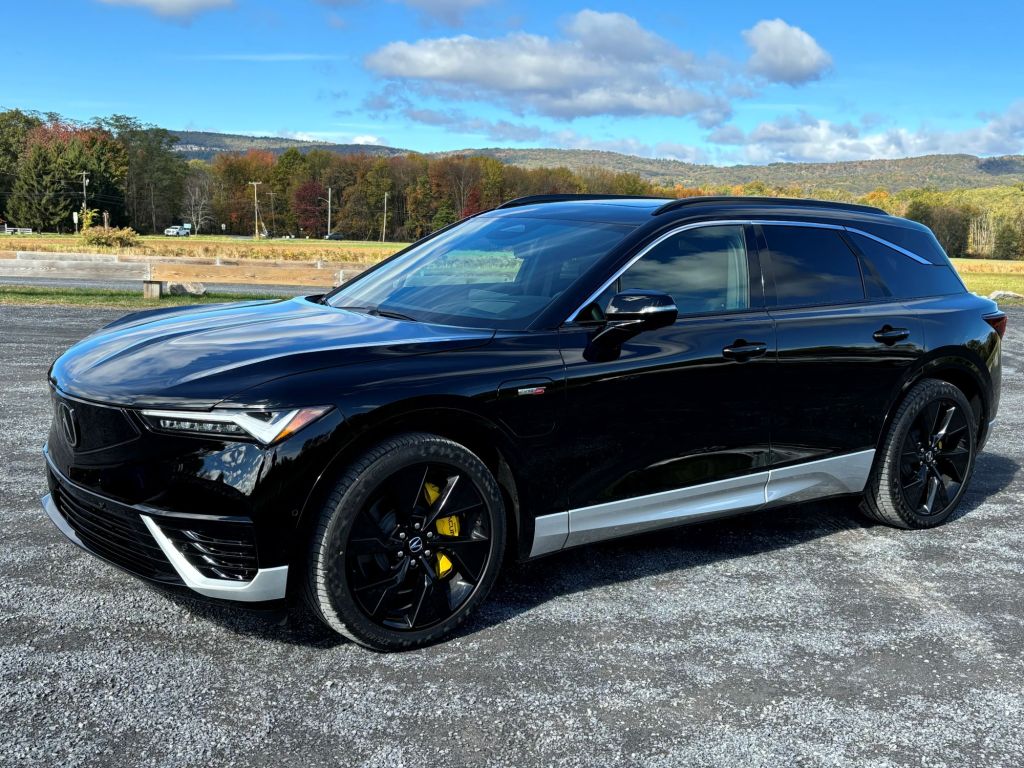
2024 Acura ZDX Type S. Wicked quick. And you can shop for groceries with it, too. (Image: gsv)
Although Acura does have two cars in its lineup—the TLX and Integra—its two crossovers—the MDX and RDX—are focal points. In terms of powertrain performance, the ZDX smokes the other crossovers (or maybe that should be it “ozones the other crossovers”).
It, too, was styled in LA. And although it is a crossover, its exterior body style resembles for me more of a contemporary station wagon, with a lower, longer, more angular sideview than many other crossovers.
While it seems as though all vehicles today have some sort of light signature up front, credit should be given to the Acura designers for the sharp styling they’ve brought to the lighting of this vehicle.
On the inside the seats in the front are bolstered in keeping with the type of vehicle it is, and the layout of the instruments and gauges are intuitive. A cowl over the gauge screen provides something of a cockpit feeling when sitting behind the wheel.
Both are solidly engineered vehicles that go well beyond the propulsion systems.
The Prologue seems like a Honda (presumably because it is) and the response from the market is good: According to numbers from KBB, through the third quarter there have been 12,644 Prologues sold—more than the 7,998 Blazer EVs sold, and closing in on the popular Mustang Mach-E, which had sales of 13,392.
The ZDX, which is essentially a new nameplate (yes, Acura built a ZDX until 2013, but its sales were so tiny that it isn’t likely remembered by many (outside those who smacked their heads getting into or out of the rear seat on the C-pillar)) has had sales through Q3 of 2,647—which is not far from the Lexus RZ’s 2,742, which has been available for longer.
In 2026 Honda will roll out its 0 Series, which it is developing sans GM.
But neither the Prologue nor ZDX are placeholders until then.




 shinymetalboxes