Tesla Q1 Quotes Considered

By Gary S. Vasilash

During its Q1 2024 earnings call, there were some interesting comments made by Elon Musk, CEO and Product Architect (previously Technoking).

So here are some of Musk’s remarks prefaced with some thoughts.

Of course he thinks they’re doing the right thing because otherwise, why are they doing it?

Musk: “As we all have seen, the EV adoption rate globally is under pressure and a lot of other order manufacturers are pulling back on EVs and pursuing plug-in hybrids instead. We believe this is not the right strategy and electric vehicles will ultimately dominate the market.”

In vaguely describing the more-accessible models that will be coming, he described what sounds to be like some sort of kluge, possibly because they want to do something new while using the equipment already installed—something that traditional OEMs have been doing for years.

Musk: “These new vehicles, including more affordable models, will use aspects of the next-generation platform as well as aspects of our current platforms, and we’ll be able to produce on the same manufacturing lines as our current vehicle lineup.”

This leads to a question of what gasoline cars that are autonomous will be analogous to:

Musk: “And I go back to something I said several years ago that in the future, gasoline cars that are not autonomous will be like riding a horse and using a flip phone.”

If an autonomous car has half the accident rate of a human-driven car, while that is safer, is it safe enough for regulatory change or should that accident reduction be less than 50%?

Musk: “I think if you’ve got at scale, a statistically significant amount of data that shows conclusively that the autonomous car has, let’s say, half the accident rate of a human-driven car, I think that’s difficult to ignore because at that point, stopping autonomy means killing people. So, I actually do not think that there will be significant regulatory barriers provided, there was conclusive data that the autonomous car is safer than a human-driven car.”

The key phrase in the following is “when that day happens” because he’s been talking about that day, in effect, since 2016 or, to be generous, 2019, when he said: “We expect to have the first operating robotaxis next year.”

Musk: “But really, the way to think of Tesla is almost entirely in terms of solving autonomy and being able to turn on that autonomy for a gigantic fleet. And I think it might be the biggest asset value appreciation history when that day happens when you can do unsupervised full self-driving.”

Yes, he earlier discovered that making cars is hard, but he managed to get through and is making EVs at a rate other OEMs can only dream of. But this seems to indicate that those who have invested in the company because they figure that their will be an ROI predicated on vehicles are making a mistake. Huh? What’s more, also during the call Vaibhav Taneja, Tesla CFO, said: “We are also getting hyper-focused on capex efficiency and utilizing our installed capacity in a more efficient manner. The savings from these initiatives, including our cost reductions will help improve our overall profitability,” which is all about making solid objects that will carry the promised autonomy.

Musk: “If you value Tesla as just like an auto company, you just have to–fundamentally, it’s just the wrong framework and if you ask the wrong question, then the right answer is impossible. So, I mean, if somebody doesn’t believe Tesla is going to solve autonomy, I think they should not be an investor in the company.”

Here he comes up with a notion that could be useful in a future advertising campaign—yes, Tesla doesn’t advertise like traditional OEMs do, but it seems that of late—with price cuts and dictates to its analogue to “dealers” that they work to upsell people on FSD—it seems that the company is on the road to the traditional. In addition to which, why the regular references to horses?

Musk: “I mean, we’re putting the actual auto in automobile. So, sort of we go like, well, sort of like tell us about future horse carriages you’re making. I’m like, well, actually, it doesn’t need a horse that’s the whole point.”

Here he is talking about not only the self-driving tech that will (someday) be in Teslas but in achieving another revenue stream by licensing it to other OEMs. What he doesn’t seem to address is the cost of making a car a smart car. Which is in line, perhaps, with the $25,000 Tesla that seems to be taken off the table.

Musk: “The people don’t understand all cars will need to be smart cars, or you will not sell, or the car will not–nobody would buy it. Once that becomes obvious, I think licensing becomes not optional.”

EV Evidence: Not Good

By Gary S. Vasilash

Think of it as validation of what everyone seems to know about the electric vehicle market in the U.S.:

The AlixPartners 2024 International Electric Vehicle Consumer-Sentiment Survey found that compared to a similar survey it ran in 2021 U.S. interest in EVs is flat.

Yes, despite the additional years of Tesla, Tesla, Tesla. Despite products like the Chevy Bolt and the Ford Lightning, which have increased familiarity with EVs, AlixPartners found that the number of respondents who said they are “very” or “moderately” interested in acquiring an EV is 35%. The same number as back in 2021.

Growth? What growth?

(While the 35% number seems robust, know that the share of market in the U.S. for EVs is 7.6%. . .and may hit 10% this year.)

What are people in the U.S. turning to?

Arun Kumar, global co-leader of the Advanced Mobility Practice at AlixPartners: “In the U.S. and Europe, BEV-intentioned buyers are turning their interest to PHEVs, seeing them as a completely legitimate substitute for meeting near-term needs and addressing charging and range concerns.

“This shift in preference presents a monumental challenge for traditional automakers, suppliers and dealers as they deploy resources to compete in the BEV transition.”

Or said differently: the OEMs and suppliers have been shoveling money into the BEV transition and are now discovering that returns seem exceedingly elusive.

2024 Hyundai IONIQ 5 Limited AWD

By Gary S. Vasilash

Although Tesla seems to be in the sort of fix that one might expect a traditional OEM to have rather than it, maybe that is because Tesla is turning into something of a traditional OEM, yet it isn’t quite capable of making the transition, which exacerbates the problem.

Now to be fair, the EV market in the U.S. is still pretty much in two categories:

  • Tesla
  • Everybody Else

So when you look at the increase in sales of Everybody Else’s EVs you have to recognize that in terms of overall numbers, there are certainly models that have internal combustion engines in their lineup that may have percentage decreases yet, in terms of the overall number delivered, well above the EV.

However, one of the issues that Tesla faces and doesn’t seem to be particularly interested in addressing is that the technological heat seekers, those who are constantly on the lookout for What’s Next, have likely purchased a Tesla or two. Now this is not to say that they’re suddenly going to go buy an EV from someone else but, rather, to say that there is a set of those people and they’ve pretty much been saturated.

The upside in the EV market will be people who are interested in something advanced but not completely challenging.

Let’s face it: Although driving an EV is pretty much like driving any a vehicle with a combustion engine, there are differences that require some adjustment on behalf of the driver. So at this stage in the proliferation of the technology it is probably a good thing for OEMs to provide prospective EV owners with vehicles that progressive without being perplexing.

Which brings me at last to the Hyundai IONIQ 5, an EV crossover that could draw plenty of customers into Hyundai stores and if they drive off the lot with one they’re not going to have to study how to use it.

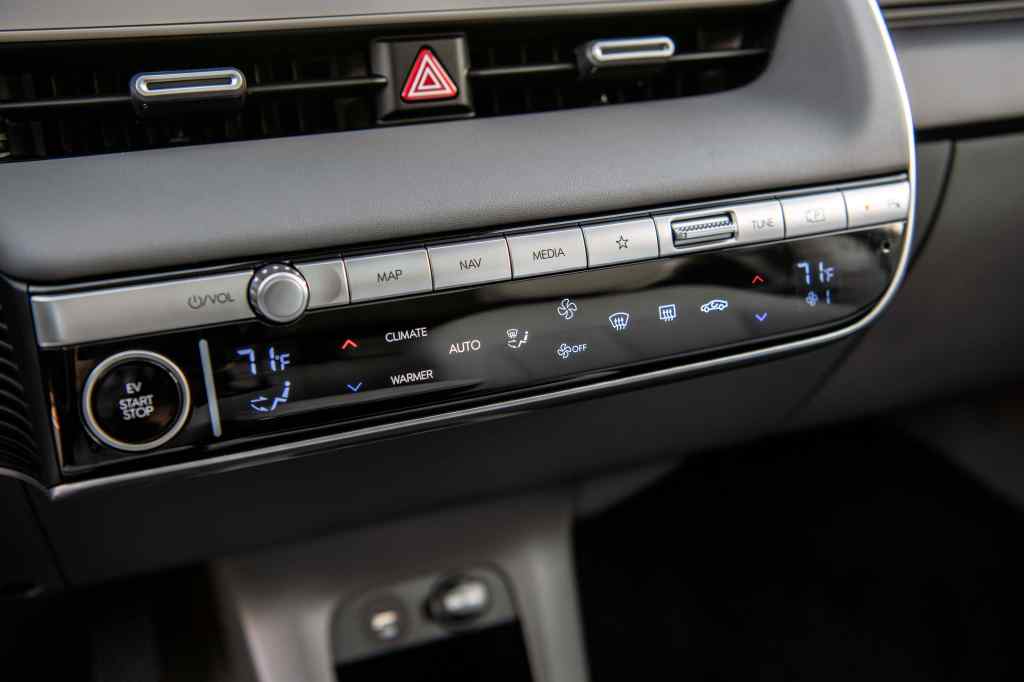
Quick: how do you adjust the temperature in the IONIQ 5? Some things make superior ergonomic sense. (Images: Hyundai)

For example: Want to adjust the HVAC? Yes, there is a 12.3-inch touchscreen. . .but more familiar, on a conductive surface, are red and blue arrows: touch them to get the job done. No searching required through the screen.

Yes, there are buttons and switches. A minimal but familiar assortment of things that can be adjusted.

The design of the IONIQ 5 is superb. There is the now seeming obligatory minimalism, but, more to the point, there is the addition of artistry in the patterns on some of the surfaces that are subtle and provide an overall sense of freshness. This is in contrast to the near-Brutalist approach that is taken inside a Tesla.

The exterior of the IONIQ 5—from the LED lighting up front to the LEDs around back—provides an appearance that is purposeful yet futuristic. I am puzzled by the apparent appeal of the bland front fascia of the Tesla Model Y: the front end of the IONIQ 5 appears as though it was created by a team of innovative engineers and artisans; the Model Y front appears as though the objective was to make a shape that could be readily released from the injection molding tooling.

The exterior is fresh and forward.

And the creases in the body side of the IONIQ 5 speak to a knowledge of forming metal in an aesthetic manner, something that, arguably, is lacking in something like the—admittedly not a competitor—Cybertruck which, again, seems to have been designed so that it could be formed with a press brake rather than a servo press.

The IONIQ 5 comes in RWD and AWD versions, with different motor and battery sizes.

The vehicle driven here is an AWD model; its permanent magnet synchronous motors (one in the front, one in the rear) produce a combined 320 hp. It has a SK Innovation 77.4 kWh lithium-ion battery that provides the vehicle with a range of 260 miles. The on-board charger is capable to being charged at a station with up to 800 v/350 kW; that means the battery charge can go from 10% to 80% in as little as 18 minutes.

People are catching on to the IONIQ 5. In March sales were up 58%. There were 3,361 delivered. The sales of the Hyundai Palisade—a bigger vehicle with an internal combustion engine—were also up 58% in March. There were 9,785 delivered.

The point being, there is a ways to go before there is greater consumption of EVs.

The IONIQ 5 is a vehicle that will help get more people there.

EVs in Europe (The Brits Like Them)

The populations of Germany, the U.K. and France are 83.26 million, 67.96 million and 64.86 million, respectively.

So when it comes to the purchase of EVs in those three countries, it might seem to be the case that they’d rank in that order.

Not so.

Schmidt Automotive Research has found that the U.K. is led EV acquisition in Q1 2024 for the first time ever.

The Q1 numbers for EV sales are:

  • U.K.: 84,314
  • Germany: 81,337
  • France: 79,823

This means EVs represent 15.5% of the U.K. new car market.

And in the U.S. in Q1 2024?

EVs represented 7.15% of the new car market, less than half the take in the U.K.

And demographically, the population of the U.S. is 341.81 million, or 125.73 million more people than the Germany, the U.K. and France combined.

Try to Buy a “Car”

By Gary S. Vasilash

Let’s say that you are interested in buying a car.

A car as a sedan. Not a crossover. A bread-and-butter car. (Yes, maybe you want to add some spicy tomato jam to it—spoiler, alloy wheels, etc.)

You go to the local Ford dealer.

And discover that the only car is a Mustang, which doesn’t qualify (i.e., two doors).

There happens to be a Lincoln store across the parking lot.

There are no cars, only crossovers of stair-step sizes.

You visit a Chrysler dealership and learn that Stellantis has stopped production of its long-in-the-market 300 at the end of last year, but they’ve got a Pacifica minivan, if you’re interested.

Buick perhaps? Again, no. Only crossovers.

Over at Cadillac things are better: of its seven models, two are sedans, the CT4 and the CT5. Given that the Q1 2024 sales for those are down 36.1% and 34.2%, respectively, how long they’ll be around may be in some question.

Chevy? An impressive array of crossovers and trucks. And one car, the Malibu.

The point is, buying a car is not as easy as it once was.*

Which leads to a thought about electric vehicles.

What if you went into one of these dealerships and discovered that they didn’t have anything on the showroom floor that didn’t have a plug?

What if that was pretty much the case up and down the street of the auto mall?

Clearly there would be an increase in the number of EVs sold out of those dealerships.

Maybe the numbers would be that good.

But they would be better.

Just as they’ve increased the number of models that aren’t cars and so have made buying a car tough, it could be that to help recoup some of the billions being spent on EVs they make buying an ICE tough.

Something’s got to move more of that lithium-powered metal.

(Of the 593,997 vehicles GM sold to customers in Q1, 16,169 were EVs. Not much of a business case there. And it sold twice as many Malibus ((32,749).))

*Interestingly, the Asian and European brands, in general, all have cars in their lineups.

Mercedes USA Q1 & EVs

“Mercedes-Benz EVs accounted for 13% of our total group sales volume in Q1,” Dimitris Psillakis, president and CEO of Mercedes-Benz USA, said, reporting how the marque is doing so far in 2024.

Which, on a percentage basis, is quite good.

Ford, which describes itself as “America’s No. 2 electric vehicle brand,” had Q1 EV sales of 3.9%.

Mercedes has three EVs in its U.S. showrooms:

  • EQB, of which it sold 671
  • EQE, 5,113
  • EQS, 2,552

That is a total of 8,336 of the 66,570 passenger vehicles it sold in Q1.

(To be fair to Ford, it sold 508,083 vehicles in Q1, of which 20,233 were EVs.)

But here’s something interesting about the Mercedes sales: It sold 15,096 GLE SUVs.

That’s about 23% of total sales.

EVs Mainly Elsewhere

By Gary S. Vasilash

According to stats from EV Volumes, in February the top-selling vehicles with a plug (PHEVs and EVs) were:

  1. Tesla Model Y
  2. Tesla Model 3
  3. BYD Qin Plus
  4. BYD Song
  5. AITO M7
  6. BYD Seagull/Dolphin Mini
  7. Wuling HongGuang Mini EV
  8. BYD Yuan Plus/Atto3
  9. BYD Dolphin
  10. VW ID.4
  11. Li Xiang L7
  12. Wuling Bingo
  13. BYD Han
  14. MG 4/Mulan
  15. BYD Destroyer 05 PHEV
  16. Jeep Wrangler PHEV
  17. VW ID.3
  18. Audi Q4 e-tron
  19. Li Xiang L9
  20. Chery Fengyun A8 PHEV

Here’s the thing: outside of the Teslas, VW ID.4, Wrangler, and Audi Q4 e-tron, how many of those vehicles do you have even the vaguest concept of?

There’s nothing from Toyota, Mercedes, Ford, GM BMW, Honda, or Hyundai.

This should be a reminder that when you look at EV (and PHEV) sales numbers, the world is a bigger place.

A Billion Here, a Billion There

By Gary S. Vasilash

“A cumulative national capital investment of $53-$127 billion in charging infrastructure is needed by 2030 (including private residential charging) to support 33 million PEVs.” That’s according to a report from National Renewable Energy Laboratory (NREL), “The 2030 National Charging Network: Estimating U.S. Light-Duty Demand for Electric Vehicle Charging Infrastructure.”

The ”PEV” is for “plug-in electric vehicle.”

The way the NREL figures it, there will be:

  • 26.8 million Level 1 and Level 2 chargers at single-family homes, multifamily properties and workplaces
  • 182,000 fast-charging ports on highways and within local communities
  • 1 million Level 2 ports in high-density neighborhood, office buildings and retail outlets.

That is quite a span in the estimated spend to put in all those chargers.

Note that much of the investment will be made by individual homeowners. There is the cost of the equipment, the cost of an electrician, the cost of things an electrician will find when making the installation, and, if there is Level 2 rather than Level 1, then the probable need to get 240-Volts to the garage, and. . . .

It is likely to be more than a grand.

But let’s say all of that is done. Let’s say that the $53-$127 billion has been spent.

All good, right?

Well, there is something else in the report that probably deserves considerably more attention:

“The cost of grid upgrades and distributed energy resources have been excluded from these estimates. While these excluded costs can be significant in many cases and will ultimately be critical in building out the national charging network, they tend to be site specific and have been deemed out of scope for this analysis.”

“Significant” means “a whole, whole lot” on top of the aforementioned billions.

Hyundai’s Boyle: Going Beyond the Singular Transaction

By Gary S. Vasilash

One thing that Olabisi Boyle, senior vice president, Product Planning & Mobility Strategy, Hyundai Motor North America, points out that is probably something that many people don’t know is this:

  • On a global basis Hyundai Motor Group (including Genesis and Kia) is the third-largest OEM. Not General Motors. Not Stellantis. Hyundai. Behind Toyota and Volkswagen Group.

In the U.S., the company’s sales have been growing with consistency:

  • In 2023 it had total sales of 801,000 vehicles, up 11% over 2022 sales (724,000)
Hyundai’s Boyle is working to expand ways that customers interact with the company’s products, well beyond the drive. (Image: Hyundai)

One of the areas that Boyle is keen on is the development of the market for what she terms the “early majority” for electric vehicles, moving beyond the “early adopters.”

Hyundai has long (comparatively speaking) been in the EV space and at present the brand offers the Kona Electric, IONIQ 5 and IONIQ 6.* (It also has the Nexo—which is a fuel-cell based EV.)

Massive & Flexible

Hyundai Motor Group is constructing what it calls “Metaplant America” near Savannah, Georgia, a complex on a 2,923-acre site that includes a vehicle assembly plant as well as a battery plant. Plans call for the $7.59-billion plant to go into production early in 2025. It will build the IONIQ 5, IONIQ 6, Genesis GV60 and Electrified GV70 vehicles, as well as the XCIENT class 8 fuel-cell truck.

Boyle says that the Metaplant, which will have an annual capacity of 300,000 vehicles, is sufficiently flexible such that if the demand dictates, it can also produce combustion engine-equipped vehicles.

Beyond Vehicles

But Boyle’s view of Hyundai’s efforts in the mobility space go well beyond particular vehicles to something that can be thought of as an entire infrastructure. If it’s a gas-powered vehicle, then the ability to pay through the touchscreen of the Hyundai. If it is an electric vehicle, then the ability to work through the Hyundai Home Marketplace to get what’s needed for home charging. If it is a question of obtaining an EV for a short period (e.g., month-to-month), there is Evolve+ that makes this real. If it is a matter of finding and paying for parking, there’s an app for that.

Hyundai Home helps EV customers get what they need to equip their residences for seamless electric vehicle operation. (Image: Hyundai)

In other words Boyle and her colleagues are looking at a consumer’s engagement with Hyundai as something more than a transaction that occurs at a dealership once every few years. Rather, it is something that they are building out so that the company can provide things that are helpful, not intrusive, things that facilitate everyday activities, not complicate them.

They certainly want to grow the number of vehicles that are purchased.

But they recognize that there is a market shift going on, one that they are helping propel.

==

*And it also has “electrified” vehicles including hybrid versions of the Elantra, Sonata and Tucson, with the Tucson also as a plug-in hybrid.

EV Ennui

By Gary S. Vasilash

U.S. dealers are not particularly keen on electric vehicles (EVs).

So indicates the Cox Automotive Dealer Sentiment Index (CADSI) released this year.

When asked how EV sales were doing in Q1, the index score was 42. That’s off from 50 in Q1 in 2023.

And while 42 may not be particularly meaningful, know that it is the lowest score since the question was included in CADSI in Q2 2021.

The outlook among dealers regarding EV sales going forward isn’t good, either.

In Q1 2023 the index score was 53. Back then, a majority of dealers saw EV sales growing.

In Q1 2024 that index score is down to 36.

That’s the lowest score for EV outlook since that question was asked.

Seems things are no longer anticipated to be growing for EVs.

It seems as though this is not simply a U.S. phenomenon, either.

While Cox was looking at new vehicle sales, over in the U.K. and outfit that specializes in used vehicles—going from consumers to dealers rather than the more conventional vice-versa—found that sales are not particularly robust.

Compared with last year, HonkHonk found 38.5% of dealers are “much less interested” in EVs and 12.3% are “a bit less interested.”

Or 50.8% of dealers are not all that keen on putting EVs in stock.

Sebastien Duval, CEO of HonkHonk, said, “Right now, dealers can’t get enough small or medium petrol cars, medium diesels and even hybrids, since the market began recovering in 2024. But less than one in ten of them want to snap up a battery EV car more than they did than a year ago.”

That’s right: Diesels are more appealing than EVs in the U.K. used market.

Diesels.