One of the issues that consumers face in the new-car market in the U.S. is the non-trivial sticker price. According to Kelley Blue Book, the average transaction price for a new vehicle was $48,397 in September.
Charlie Chesbrough, Cox Automotive Senior Economist, said of the number, “One reason transaction prices are lower in 2024 is that many buyers are choosing smaller, less expensive vehicles. The subcompact and compact SUV segments are outperforming the market this year, and by no coincidence, they’re also two of the lowest-priced product segments in the market.”
Two points about that:
It is surprising to think that prices are “lower in 2024” when that number is above $48K.
Subcompact and compact SUVs are growing in popularity, but it seems the likes of GM and Ford are still more interested in the other end of the spectrum, which helps with their earnings now, but perhaps not for the long run, when people simply can no longer accept high monthly payments. (Given the number of large, expensive vehicles that are still being sold, it is clear many people continue to be accepting. But at some point other bills are going to take precedence. After all, when the average monthly car payment is on the order of $750, and the Bureau of Labor Statics found that car insurance premiums increased an average 20% between June 2023 and June 2024, something’s got to give.)
This phenomenon of going for the upper end of the market is not just one in the U.S.
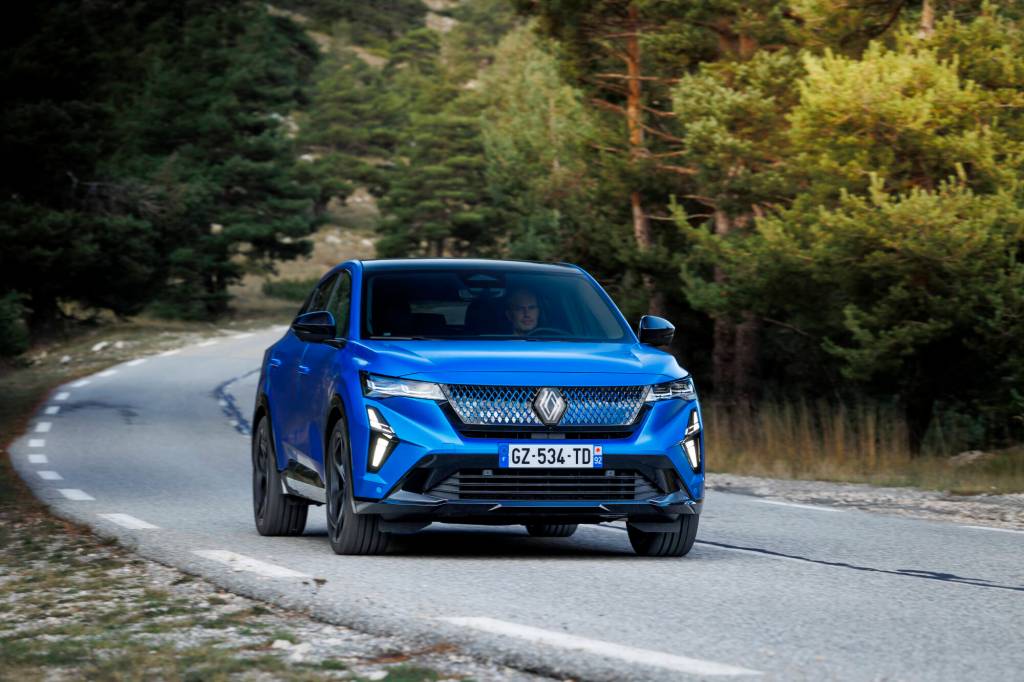
Renault Rafale E-Tech 4×4 with the Atelier Alpine features a chassis and agility control system developed by the engineers of Alpine Cars. There is a self-adjusting ting smart suspension with a camera for predictive control. (Photo Clément Choulot / DPPI)
Renault just introduced a new plug-in hybrid crossover, the Rafale E-Tech 4×4. It is a 300-hp vehicle that has a 22-kWh battery that the company says can power the car some 105 km (65 miles) on the European WLTP schedule (which is different than the EPA).
What did Bruno Vanel, VP, Renault Brand, Product, Revenue & International Markets Expansion, say of the new vehicle represents? It “symbolizes our move upmarket and our legitimacy to conquer all customers with a high-performance version.”
When you think of European vehicles that are (1) upmarket and (2) high performance, odds are something from BMW comes to mind. And this is probably the case in France, as well.
But Renault wants some of those higher margins, too.
Honda and Acura Go Electric with Ultium and Then Some. . .
By Gary S. Vasilash
As is widely known, when it comes to the contemporary electric vehicle, Honda was a bit late to the party. Given that the company has extensive experience in electrified vehicles. It is often forgotten (or unknown), for example, that the first hybrid on the U.S. market wasn’t the Toyota Prius, but the Honda Insight, which was launched in December 1999, edging out the Prius by a few months.
(This gives rise to another consideration. Toyota has also been criticized for its approach to the EV market, being tagged as a laggard. One could argue that this isn’t a mistake, given the still rather small number of EVs being sold in the U.S. market. According to Kelley Blue Book, for Q3 2024 there were 346,309 EVs sold, a number that will undoubtedly help the number of EVs sold in the U.S. to exceed the 1.2-million sold in 2023. But here’s something to think about: if you take away the Tesla sales from the Q3 numbers this means that 27 brands cumulatively sold 179,386 vehicles. That would be 6,644 if the number was evenly distributed. But no matter how you look at it, there is a long way to go in order to achieve the necessary scale to have a profitable production operation.)
Anyway, I’ve just been driving the Honda Prologue and the Acura ZDX, the two contemporary EVs from the company.
A sign of the times is that in order to get these vehicles on the market, Honda worked with a company that it has been collaborating on for some time (on things ranging from the engine for the Saturn Vue Red Line to hydrogen fuel cells).
The two vehicles are based on the GM Ultium platform (yes, even though GM is going to stop calling them “Ultium,” the platforms were Ultium when the Prologue and the ZDX were developed).
Just as the Saturn Vue Red Line was a Saturn through and through, not a Honda, the Prologue isn’t a Chevy Blazer EV, which it shares the platform with, just as the ZDX isn’t a Cadillac LYRIQ.
In the case of the Prologue—which is available with a single-motor (212 hp) front-drive setup that provides a range of up to 296 miles or as a dual motor (288 hp) with a 281-mile range (although there is the Elite trim package that goes 273 miles); all have an 85-kWh battery pack—the design inside and out are characteristic of the brand.
The design-speak for the exterior design—which was executed in L.A.—is “Neo Rugged.” It is, after all, an crossover. Arguably, it is a simple, straightforward design with a sufficient number of creases in the sheet metal to keep it from looking innocuous or as something that it isn’t (i.e., like something you’d take on the Rubicon).
Inside there is the clean, straight-forward Honda approach to ergonomic instrumentation. However, I have two quibbles with the interior design:
An excessive use of piano black plastic on the IP. Whereas the Civic Hybrid (a hatchback was recently released) has an interior that looks of the moment, the piano black in the Prologue is dated.
The distance from the top front edge of the instrument panel to the bottom of the windshield is a tremendous amount of real estate. Someone had better have a Swiffer on a long handle to be able to keep that surface clear because it is a reach.
But while on the inside it should be noted that there is as much as 57.7 cubic feet of cargo space, so it can handle a reasonable haul.
Of the two cars, the ZDX is the one that I find to be most impressive. (Of course, the starting MSRP for the Prologue is $47,400 and it is $64,500, so there has to be some bandwidth there.)
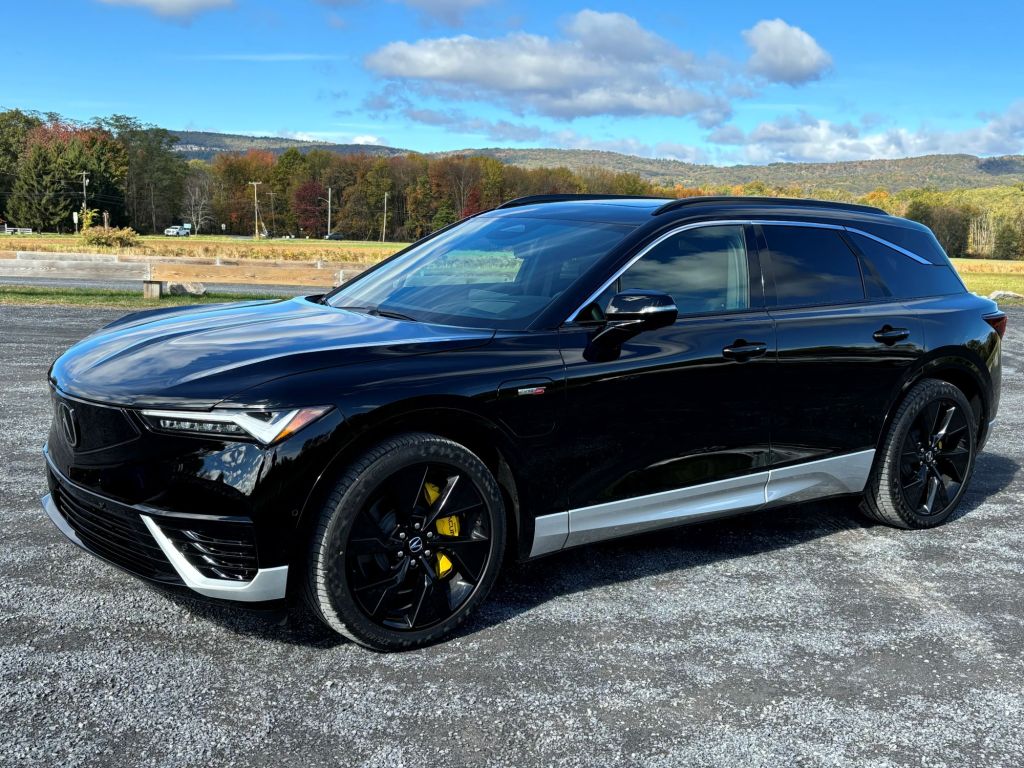
The ZDX comes as a rear-drive vehicle with 358 hp and a range of 313 miles from its 102-kWh battery. Or there is an all-wheel drive version (A-Spec) that provides 490 hp and 304 miles of range from the same battery pack. Or there is another AWD version (Type S) that generates 499 hp and will take you 278 miles with some alacrity.
2024 Acura ZDX Type S. Wicked quick. And you can shop for groceries with it, too. (Image: gsv)
Although Acura does have two cars in its lineup—the TLX and Integra—its two crossovers—the MDX and RDX—are focal points. In terms of powertrain performance, the ZDX smokes the other crossovers (or maybe that should be it “ozones the other crossovers”).
It, too, was styled in LA. And although it is a crossover, its exterior body style resembles for me more of a contemporary station wagon, with a lower, longer, more angular sideview than many other crossovers.
While it seems as though all vehicles today have some sort of light signature up front, credit should be given to the Acura designers for the sharp styling they’ve brought to the lighting of this vehicle.
On the inside the seats in the front are bolstered in keeping with the type of vehicle it is, and the layout of the instruments and gauges are intuitive. A cowl over the gauge screen provides something of a cockpit feeling when sitting behind the wheel.
Both are solidly engineered vehicles that go well beyond the propulsion systems.
The Prologue seems like a Honda (presumably because it is) and the response from the market is good: According to numbers from KBB, through the third quarter there have been 12,644 Prologues sold—more than the 7,998 Blazer EVs sold, and closing in on the popular Mustang Mach-E, which had sales of 13,392.
The ZDX, which is essentially a new nameplate (yes, Acura built a ZDX until 2013, but its sales were so tiny that it isn’t likely remembered by many (outside those who smacked their heads getting into or out of the rear seat on the C-pillar)) has had sales through Q3 of 2,647—which is not far from the Lexus RZ’s 2,742, which has been available for longer.
In 2026 Honda will roll out its 0 Series, which it is developing sans GM.
But neither the Prologue nor ZDX are placeholders until then.
J.D. Power sees improvement. But were we grading on the usual scale. . .
By Gary S. Vasilash
The J.D. Power 2024 U.S. Electric Vehicle Experience (EVX) Public Charging Study is out, and the research firm finds improvement in that experience.
Sort of.
Said Brent Gruber, executive director of the EV practice at J.D. Power, “While the customer satisfaction scores for public charging continues to prompt concern, the results offer reasons for optimism.”
He’s undoubtedly an optimistic individual.
The study found that on a 1,000-point scale, the satisfaction with speed at Level 2 chargers has dropped 4 points to 451.
DC fast charger speed is more satisfying, up from 588 in 2023 to 622.
While that 34 point bump is good, remember Power is using a 1,000-point scale, so if you were in school and got that 622 on a test. . . .
And then there is the issue of non-charging. As in showing up at a charging station and not being able to charge.
Power found 19% of the surveyed EV owners had that problem. A one-point improvement over 2023.
The researchers found that nationwide 61% said the reason there was a wasted visit was because the charger was out of service or didn’t work.
Huh?
The average transaction price for an electric vehicle in July was $56,520, according to the latest figures from Kelley Blue Book.
So someone buys an EV for that price, glides into a charging station—and nearly one out of five times has to leave because the damn thing doesn’t work.
Yes, some 80% of EV owners charge at home, but that means some 20% of EV drivers don’t.
In addition to which, some of the 80% of EV drivers who charge at home are likely to take trips at some point—vacation or business—which could likely mean they need to charge along the way.
And they’re likely to find some 20% of those chargers out of order.
One of the aspects of electric vehicles that is regularly not talked about is that because they tend to be pricier than vehicles with gas engines (according to KBB the average transaction price for an EV is $54,021 compared to $47,218 for vehicles in general) is that insurance rates are higher.
Higher because the vehicle itself is more expensive.
Higher because the cost of repairs is higher.
(When people talk about the need for more EV infrastructure, it is mainly about charging stations. But here’s something to consider: what is the level of availability of repair shops for EVs? I recently went to a repair shop on a Monday to find out when I could get some simple service performed for a non-EV. The scheduler said, “Erm, how about Friday? We’re understaffed.” I suspect that had it been an EV I would have heard, “Well, the EV guy is pretty much booked through. . .” and it would have been beyond Friday.)
According to the U.S. Bureau of Labor Statistic’s Consumer Price Index, while prices for goods and services across the board is up 3.4% from April ’23 to April ’24, motor vehicle insurance over the same period is up 22.6%.
Experian has surveyed consumers and found that 71% say that inflation has “impacted their road trip plans.”
However, over the past 12 months food away from home is up 4.1% and gasoline 1.2%, so it is hard to understand why so many people see inflation as being a big problem.
Adjusting interest rates can be a tricky business for the Federal Reserve.
On the one hand, it wants to reduce the amount of borrowing and—consequently—spending.
That helps reduce inflation.
On the other hand, it doesn’t want to reduce the amount such that the economy falls into a recession.
Consumers don’t like inflation. That’s because things cost more.
Consumers don’t like high interest rates. That’s because they have to spend more to borrow the money to buy things.
Things like cars.
Kelley Blue Book announced the average transaction price (ATP) for new vehicles was down 1% in March compared to the ATP in February.
What’s more (or less), the March ATP was down 5.4% compared with December 2022, when ATPs were at their peak.
It’s not like new vehicles are inexpensive, even with that 1% drop.
The ATP—and remember, this is average—for March is $47,218.
Erin Keating, executive analyst at Cox Automotive, said, “It bears repeating that historically high interest rates and associated inflation combined with an ever-widening deficit of available vehicles at lower price points, will continue to challenge affordability for most car buyers.”
So there’s the interest rate-inflation situation.
The Disappearing Econo Box
Keating’s observation about “widening deficit of available vehicles at lower price points” is key.
KBB found that in March there were some 275 new-vehicle models available in the U.S.
Of the 275 only eight had ATPs of less than $25,000.
Three percent. Imagine trying to find one.
But apparently either people have lots of money or they’re willing to borrow it: in March sales of vehicles with ATPs above $75,000 were greater than those under $25,000: approximately 81,000 of the former and 52,000 of the latter.
Perhaps high interest rates are having an effect—on the lower portion of the market.
Of course, chances are OEMs are putting out vehicles with higher sticker prices because they can make more money on them than those that are more economical.
In December 2023 18 of the 35 brands that Kelley Blue Book analyzed had year-over-year price declines.
This is understandable, given that it was the end of the year, and there is a tendency for product manufacturers of all types, not just vehicles, to want to move out as much inventory at the end of a period as possible (e.g., the classic recommendation about buying a car at the end of the month when the dealer wants to move just one more to make a quota and consequently provides a better deal).
So there was Volvo, which reduced its price by 6.7% and Land Rover, with a 10.2% reduction.
It should be noted, however, that both of those brands have a very minimal (<1%) share of the U.S. market, so it is not like their combined numbers have much of a consequence on the overall average retail price for vehicles in 2023.
KBB calculated that in December the average transaction price (ATP) for vehicles was $48,759.
Notably, the ATP was $50,798 for electric vehicles.
Said Stephanie Valdez Streaty, director of Industry Insights at Cox Automotive, “2023 was a milestone year with 1,189,051 pure battery electric vehicles sold, accounting for 7.6% of all new-vehicle sales.”
So that is good for the EV producers.
What’s more, the point at which price parity between vehicles with combustion engines and those with electric motors is reached is something considered by industry to be the point at which there will be a huge rise in the number of EVs purchased.*
An ATP difference of $2,039 for an EV is almost that, and certainly just a few bucks per month on a lengthy load.
But going back to the companies that had price cuts in December, there’s the company that accounts for 55.1% of the EV market, Telsa. (Tesla has, per Cox Automotive, 4.2% of the entire vehicle market, which is more than Mercedes, Volvo, Jaguar-Land Rover, Rivian, and Lucid combined.)
According to KBB it cut its prices an average 25.1%.
Let’s see: a price reduction of that magnitude, the possibility of getting as much as a $7,500 tax credit for a Model X or Y—well, were Chevy capable of providing those kinds of benefits to customers Malibus would be flying off lots.
People read books about negotiation strategies in order to get a few percent taken off the price of the vehicle they want to buy, coming in ready to take on the dealer by being wise to its tactics, and there was Tesla, slashing prices, presto-change-o. And the Feds offering serious money, too.
Amazing!
No other OEM can afford to make—or take—the kind of cut that Tesla made.
At some point (let’s not forget about the presidential election in a few months) those tax cuts are going to go away. And Tesla may simply being to ratchet its prices back up.
What then?
Perhaps that parity may be fleeting.
==
*Of course, given the continued issue regarding infrastructure, which an increased number of EVs would only exacerbate. . . well, people who have to drive around looking for available, working chargers are not likely to want to repeat that experience when they look for a new vehicle.
For those of you still humming Mariah Carey’s “All I Want For Christmas Is You,” here’s a bit of context for an announcement Ford made this morning:
The year that the Ford F-Series started making its consecutive run as the best-selling truck in the U.S., Ms. Carey was seven.
The F-Series has taken the lead for 47 years in a row.* They’re looking at more than 700,000 of them driven off of dealer lots in 2023.
2024 Ford F-150 Platinum. So nice that you probably wouldn’t want to use it as. . .a truck (Image: Ford)
And underscoring the curious popularity of trucks in suburban driveways as well as on work sites (curious because I rarely see my pickup truck-owning neighbors doing anything with the boxes on the back of those vehicles that they couldn’t manage with a trunk), the F-Series has been the best-selling vehicle in the U.S. for 42 years running.*
There is, of course, the question of whether “the most” means “the best.”
After all, McDonald’s has sold more hamburgers than any other company in the world and there is probably no one who doesn’t know whether they can get a better burger.
But one thing it certainly means is that the F-Series provides an unparalleled level of value for more people than any other pickup.
While there may be specific attributes of trucks from other OEMs that are more appealing or necessary for some purchasers, which means those trucks are more valuable for those people, on an overall basis Ford is consistently delivering.
Credit where credit is due. (And you’ll probably need good credit to get a full-size pickup: according to Kelley Blue Book, the average transaction price (ATP) for one in November 2023 was $66,590. You could get an entry-level luxury car for an ATP of $57,889.)
(On a related-unrelated subject, the tremendous number of trucks sold by Ford—closely followed by GM and Ram—in the context of vocational or functional (i.e., towing, hauling) uses of the vehicles might indicate that people are less environmentally keen than might be expected. After all, light-duty pickups aren’t exactly fuel-economy leaders, so were people concerned about carbon, they’d be buying more efficient vehicles for their daily drives. Yes, there are an electric F-150 and Chevy Silverado and one coming from Ram, but from the point of view of resource utilization, as in the massive batteries that have to be constructed, if those trucks aren’t being used as, well, trucks, then that isn’t exactly the most-environmental choice.)
*As the announcement was made a couple days before the actual end of the year, it is a bit of estimation on behalf of Ford. A small bit.
Kelley Blue Book, an outfit with plenty of folks who know a whole lot about vehicles, their value and what consumers like or don’t about those vehicles, has come up with its list of “Best Buy Awards.”
In other words, the vehicles that were launched last year (or which underwent a redesign) that, based on a variety of criteria, KBB thinks people will be happier to acquire than competitive vehicles not on the list.
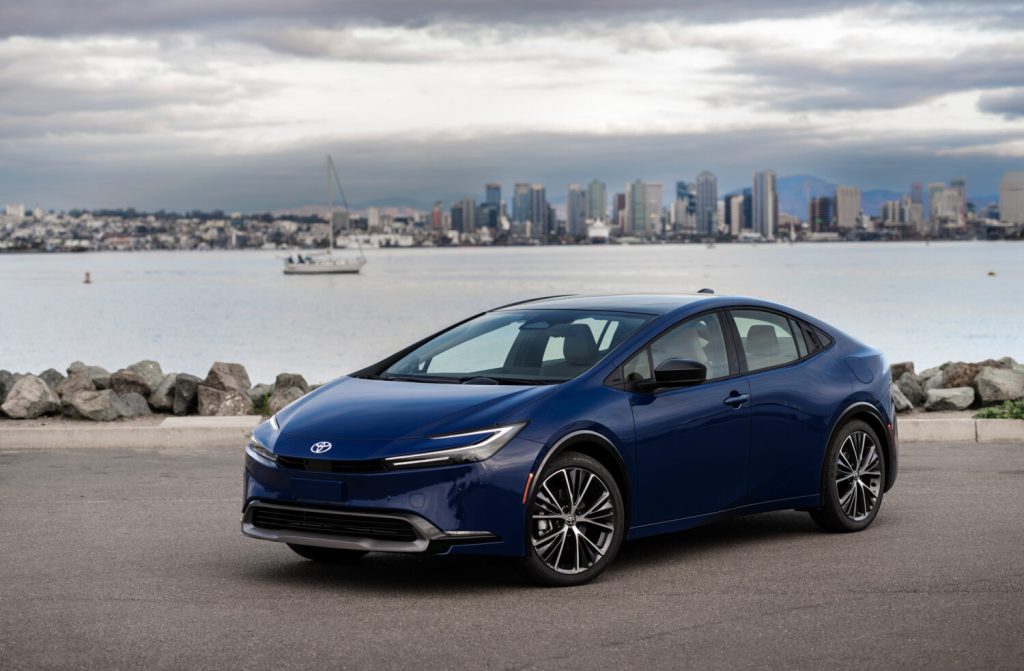
2024 Toyota Prius (Image: Toyota)
So without further ado, here are the winners of the 2024 Kelley Blue Book Best Buy Awards (all model year 2024 vehicles):
Best New Model: Toyota Prius
Best Compact Car: Honda Civic
Best Midsize Car: Honda Accord
Best Subcompact SUV: Hyundai Kona
Best Compact SUV: Honda CR-V
Best Midsize SUV: Kia Telluride
Best Full-Size SUV: Ford Expedition
Best Compact Truck: Ford Maverick
Best Midsize Truck: Toyota Tacoma
Best Full-Size Truck: Ford F-150
Best Minivan: Toyota Sienna
Best Electric Vehicle: Hyundai Ioniq 5
Best 3-Row Electric Vehicle: EV9
Best Electric Truck: Ford F-150 Lightning
One of the things that is evident from this list is that Ford is a superlative truck company.
Which leads to a question: Where’s anything from General Motors? No Cadillac? Chevy? Buick? GMC? Not one?
Or the company formerly known as Chrysler? Nothing from the Stellantis cadre (Chrysler, Jeep, Dodge, Ram, Alfa Romeo, Fiat)? The company that invented the minivan doesn’t make the Best Buy minivan?
And there is also the noticeable lack of anything with a European pedigree.
Looking into the Ford wins, in the Compact Truck category, there is really only the Maverick, so Ford gets a bonus there because it competes with nothing.
And the only other electric full-size truck that would qualify would be the Chevrolet Silverado EV, though it probably came out too late in the year to be assessed by KBB, so Ford Lightning by default (although it is a bit odd, given that the Lightning was launched in April 2022, not 2023).
According to the most-recent figures from Kelley Blue Book, the average transaction price for an EV in October was $51,762. (Silver lining? Down 7.4% compared to the price in October 2022.)
The average transaction price for a non-luxury vehicle—arguably the type of vehicle that the average person buys—was $44,331 in October.
That’s a difference of $7,431. Or to go from the non-lux vehicle to the EV a ~17% increase.
Non-trivial.
The big cost in an EV is the battery. It can represent 40% or more of the sticker.
So one thing vehicle manufacturers are working on is reducing the price of the battery.
One of the ways they’re doing this is by using batteries with less-costly materials.
Right now the (more or less) standard type of battery chemistry is NMC, or lithium nickel manganese cobalt oxide. The key things to know are the nickel and the cobalt, as these are the pricey ones.
There is another chemistry, LFP, or lithium iron phosphate. Iron and phosphorus are a lot cheaper than nickel and cobalt.
What’s more, the manufacturing process to make LFP batteries is simpler, which also contributes to a lower price.
However, LFP batteries have less energy density than NMC batteries. Which means less range for the same-size battery.
Additionally, LFP batteries don’t charge as readily in cold environments.
But there’s a price difference of about 30%, so perhaps the downsides of LFP are not a concern for those who are looking for affordability.
Stellantis and CATL, the leading producer of batteries for EVs, have signed a strategic memorandum of understanding (MoU) for the supply of battery cells and modules to the vehicle manufacturer’s operations—in Europe.
For LFP battery cells and modules.
The interesting thing is this:
Carlos Tavares, Stellantis CEO, rationalized the arrangement by saying, “This MoU with CATL on LFP battery chemistry is another ingredient in our long-term strategy to protect freedom of mobility for the European middle class.”
Have you ever heard a U.S. automotive exec specifically say they’re developing EVs for the middle class?
Until that is the stated objective, odds are it’s not going to happen. And there will continue to be that double-digit percentage difference between the cost of an EV and a non-luxury car.
Yes, Ford, for example, is working with CATL on the now-reduced-scope battery plant that will be built in Marshall, Michigan, and yes, Ford has said that the LFP batteries that will be built there will be less expensive than the NMC batteries it offers, but the market is still waiting for a true middle class EV from Ford (i.e., the least-expensive F-150 Lightning that a consumer can buy right now is $54,995 and the median price for a Mustang Mach-E is $46,995).
Perhaps the cooling in the EV market is explained by the simple fact that the vehicles available, for the most part, are simply too expensive for the middle class buyer.
One of the things that isn’t talked about much is the fact that electric vehicles really aren’t that popular unless they come from Tesla.
Flying in the face of that is a finding of Kelley Blue Book that in Q3 2023 EV sales in the U.S. hit 313,086 units, a 49.8% increase over Q3 2022. Such a jump means interest, right?
Well, the total number of EVs sold in Q3 represents 7.9% of total industry sales.
In other words, 92.1% of the vehicles people bought in Q3 weren’t electric.
And to the point of Tesla’s sway over the market—even though KBB saysTesla’s share of market tumbled to 50%–is that KBB acknowledges“Tesla’s price cuts have moved the market, pushing electric vehicle prices down more than 22% year over year, from $65,295.”
That’s right: a single company moves the entire segment.
(And in case you’re wondering, in October, according to KBB, the average transaction price for an EV was $51,762 while the ATP for a non-lux vehicle was $44,331.)
Drilling down a bit more, it is bracing to discover that in terms of share of the EV segment, the mainstream brands really don’t have much in Q3.
Chevrolet, 5.1%
Ford, 6.7%
GMC, 0.4%
Hyundai, 6.3%
Kia, 3%
Nissan, 1.9%
Subaru, 0.9%
Toyota, 0.9%
VW, 3.4%
And know that the 6.7% for Q3 Ford racked up represents 20,926 vehicles: 14,842 Mach-Es, 3,503 F-150 Lightnings and 2,617 E-Transits.
Ford sold 23,931 Mavericks in Q3, of which 56.5% were hybrids. Somehow that 20,926 EVs sold—encompassing three models, one of which is based on the best-selling pickup Since Time Began—seems more than anemic.
So even before Ford started talking about having to make adjustments as a result of the salary and benefit increases in the proposed agreement with the UAW, the auto company suddenly found things like the F-150 Hybrid more interesting.
When I ask knowledgeable people about the subject, they point out that much of the EV development and promotion is predicated on government regulations, more than organic customer demand. Look at those puny percentages up there, slices of the 313,086 vehicles sold by companies ranging from Audi to Volkswagen.
There’s not much there there.
Yes, there will be more EVs offered. More EVs sold.
But—again, absent Tesla—the market demand isn’t at all what it sounds like it should be.
Another example of this not-big demand is something that some point to as a real success story: the Chevrolet Bolt EV.
Here are the sales figures for the past five years:
2018: 18,019
2019: 16,418
2020: 20,754
2021: 24,828
2022: 38,120
Whoa! you might think. From 2018 to 2022 the sales of the Bolt EV doubled! Remarkable.
But there are a couple of elements that need to be considered.
For one thing, Chevy added a (slightly) different body style, the more ute-like Bolt EUV in 2021, which certainly added some interest to the model(s).
And in June 2022 General Motors cut the price of the Bolt to persuade customers to buy one—sort of like what Elon has been doing.
Had Dodge made a substantial price reduction to the SRT Hellcat Redeye Widebody, the Brotherhood of Muscle would exponentially increase its membership of all genders and municipalities throughout the country would have a sharp uptick in revenues from speeding tickets.
If there is a change in the political situation, those regulations that are driving EV development and sales and those incentives that do the same (what if the government offered $7,500 tax credits for the purchase of a Hellcat?), the question of actual market demand is really going to matter.



 shinymetalboxes