
Remarkable Rotary Engine and Agreeable NACTOY Jurors

Power in a small package. Jurors before casting their ballots

By Gary S. Vasilash

The Omega 1 is a highly efficient engine, one that can produce 160 hp and 170 lb-ft of torque. Yet it weighs just 35 pounds.

While it is a combustion engine, it doesn’t have pistons. Doesn’t have crankshafts.

Rather, the output from the engine comes from a single rotating power shaft.

Yes, the configuration of the engine is predicated on rotary motion. In fact there are no moving parts besides the rotational elements.

It can be fueled with gasoline or hydrogen.

On this edition of “Autoline After Hours” we are joined by Matthew Riley, the founder, CEO of Astron Aerospace and inventor of the Omega 1 and Chris Theodore of Theodore & Associates and technical advisor to Astron.

They explain the way this engine works.
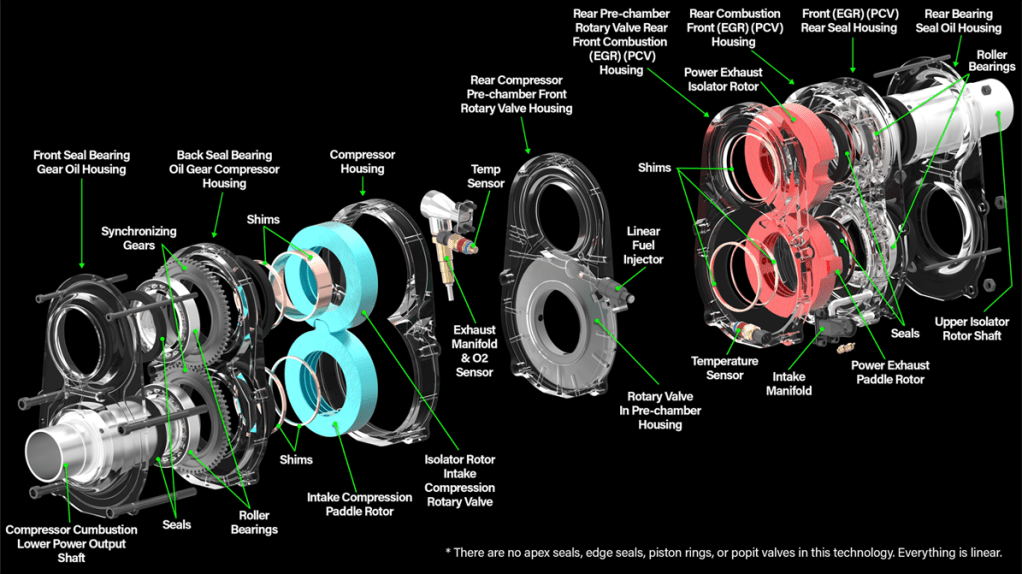
Astron Omega 1. Looks complicated. But simpler and lighter than a reciprocating engine. (Image: Astron Aerospace)

Given the name of the company, there is a focus on use in aircraft applications. For example, drone use would be certainly something that this lightweight engine would lend itself to.

But it also is conceivably applicable to automotive applications: Think of how it could be used to power a vehicle using hydrogen as fuel—there would be no need for a fuel cell to transform the hydrogen.

Then on the second half of the show “Autoline’s” John McElroy and I are joined by Matt DeLorenzo of Kelley Blue Book and Jack Nerad of “America on the Road Radio.” All four of us are jurors for the North American Car, Truck and Utility Vehicle of the Year (NACTOY) awards and will soon be voting on the winners for the 2022 awards.

The finalists are:

CAR

  • Honda Civic
  • Lucid Air
  • Volkswagen GTI/Golf R

TRUCK

  • Ford Maverick
  • Hyundai Santa Cruz
  • Rivian R1T

UTILITY

  • Ford Bronco
  • Genesis GV 70
  • Hyundai IONIQ 5

The four of us discuss which vehicles are likely to win.

The surprising part of the discussion is how much agreement there is, with little in the way of dispute.

But you be the judge by watching it here.

Auto: High/Low

Better (1) have lots of cash—or credit—and (2) be flexible in your vehicle choice

By Gary S. Vasilash

According to Kelley Blue Book automobile prices hit an all-time high in July—and affordability hit a 10-year low.

Here’s a number that is undoubtedly making OEMs and dealers happy and consumers not:

42,736

Stick a $ in front of that and that’s the average transaction price—a.k.a., what people actually pay—for a new vehicle.

This, according to KBB, is $3,223 more than it was one year ago and $402 more than in June 2021.

What’s more, incentives are down, therefore accounting, in part, for the decline in profitability.

That is, in July 2021 the average incentive was 5.9% of the average transaction price. In July 2020 it was 10.1%.

And while probably not as crazy as things are in residential real estate, it is a bit of a surprise to learn that the average price paid was above the manufacturers’ suggested retail price.

You read that right: people paid more than MSRP.

Another factor that plays into this price rise is the lack of inventory. While the last time you went out for a new vehicle the dealer lot was probably jammed with new vehicles, nowadays it has the look of a church parking lot on a Monday.

Surprising Trends in Auto Retail

You spend a lot. And you may be willing to forego the dealer “experience”

By Gary S. Vasilash

According to the most-recent Cox Automotive/Moody’s Analytics Vehicle Affordability Index, the number of median weeks of income to buy a new vehicle is 37.

37 weeks to buy a new vehicle.

That’s the greatest number of weeks since they started measuring it back in 2012.

The firms found a trifecta of things contributing to this situation:

  • Vehicle prices increased
  • OEMs and dealers are putting less cash on the hood
  • Median incomes fell

It would have been worse, apparently. Financing rates decreased, so if that didn’t happen, there would have been higher monthly payments.

Gulp.

In May, the most recent month with figures, the average transaction price that people were paying for a new vehicle was $41,263 according to Kelley Blue Book.

Now admittedly that doesn’t mean that everyone pays that much. It wraps in figures for OEMs from Mitsubishi to Mercedes, from Chevy to Porsche. Cars, trucks, SUVs.

But still, a lot of money.

A lot of weeks to earn that money.

All that said, J.D. Power has announced that predicated on its analysis of the usage of OEM websites, 49% of vehicle shoppers are willing to purchase a new vehicle online.

This is an increase of 11% from 18 months ago—about the time that the effects of the pandemic kicked in in the U.S. market.

So what’s behind this:

  • Is it that people are more comfortable shopping for things online, as many of them have done during the past 18 months for everything from groceries to appliances?
  • Are more people simply questioning the visit to a dealer as being a necessity?
  • Is this a case where people go to a dealership, take the test drive, and then go home and search for a better deal?

Whatever the case, it is clear that there is a shift in how vehicles are going to be bought. And it is also clear that there is a shift in what people are willing to pay for vehicles.

Consider this: If you bought a new vehicle the first week of January this year, you wouldn’t pay it off until the week of September 10.