
AV in the UK

This makes more sense than Tesla in Austin

By Gary S. Vasilash

While there is a lot of attention being paid to Tesla’s rollout of some 10 vehicles in Austin that are operating autonomously—with a safety driver on board and apparently people back in Tesla HQ monitoring the fleet, ready to kick in with teleoperation help if needed—there is virtually no attention being paid to what is happening in Cambridge, UK.

This week an autonomous Mellor Orion E electric midi bus—a low-floor transporter that can be configured to accommodate a maximum 16 passengers—equipped with a CAVStar Automated Drive System started rolling through the streets of the university town.
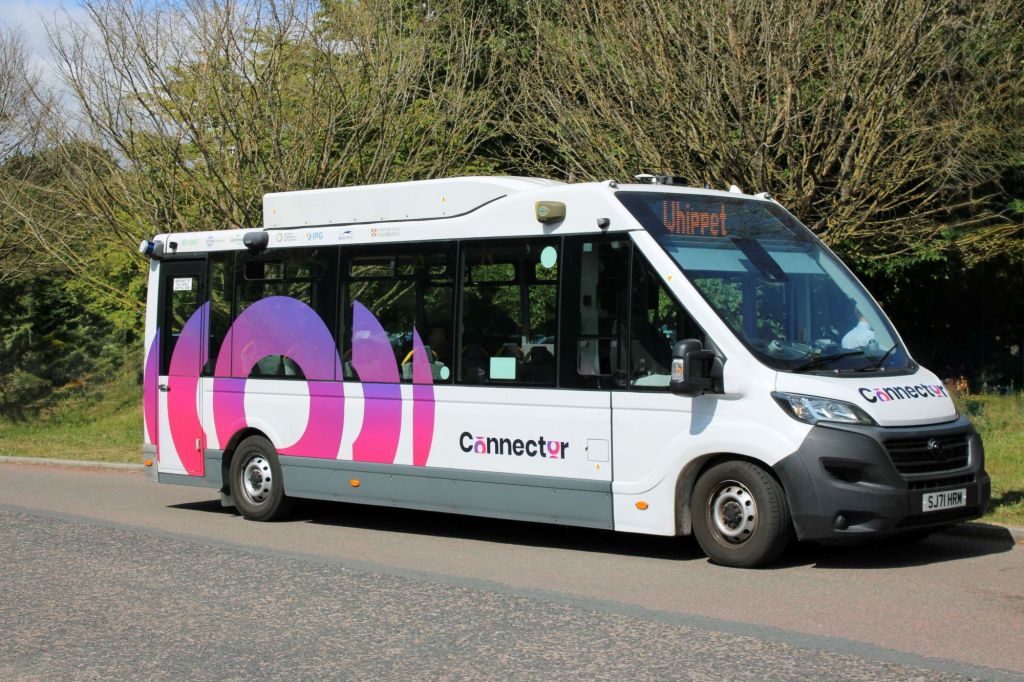
Bus is operating autonomously in the streets of Cambridge, England. (Image: Fusion Processing)

The CAVStar system is engineered by Fusion Processing. It comprises an AI processing unit, radar, LIDAR, optical cameras, and ultrasonic sensors.

The Cambridge vehicle is said to meet the requirements of SAE Level 4 autonomy.

The bus is running as part of the Connector project, which is led by the Greater Cambridge Partnership, which is supported by Innovate UK and the Centre for Connected & Autonomous Vehicles.

The bus initially ran though the areas in Cambridge where it is now operating without passengers to determine fitness for use.

Dan Clarke, head of Innovation and Technology at the Greater Cambridge Partnership:

“People may have already seen the bus going around Eddington and Cambridge West from Madingley Park & Ride recently, as, after the extensive on-track training with the drivers, we’ve been running the bus on the road without passengers to learn more about how other road-users people interact with the technology. We’re now moving gradually to the next stage of this trial by inviting passengers to use Connector.

“As with all new things, our aim is to introduce this new technology in a phased way that balances the trialling of these new systems with safety and the passenger experience. This will ensure we can learn more about this technology and showcase the potential for self-driving vehicles to support sustainable, reliable public transport across Cambridge.”

Somehow this seems more substantial than the reports out of Austin about the performance of some of those Tesla vehicles.

In addition to which: if, as Musk has proclaimed in his various “Master Plans,” his goal is to reduce overall energy use (yes, targeting fossil fuels, but even renewable energy systems are far from being zero-emissions), then doesn’t a mass transit vehicle that can transport plenty of people make more sense than autonomous passenger cars?
Cybertruck Repairs Can Be Expensive (to Understate the Case)

Edmunds.com found out just how expensive. And the truck was parked when the collision occurred

By Gary S. Vasilash

Although you’re likely to find a friend, neighbor, relative or even yourself who has a car-repair horror story, it is unlikely to top the one that the folks at Edmunds.com have with their Telsa Cybertruck.

According to the resource for auto information and available inventory, in July 2024 it bought a Cybertruck Foundation Series for $101,985.

The truck would undergo the Edmunds One-Year Road Test program.

But five months in, last December, the Cybertruck was involved in an accident.

The massive vehicle was parked. A compact sedan crashed into the driver’s side rear wheel and bumper so hard that it broke part of the rear axle.

Edmunds found that it needed to use a Tesla certified body shop in the LA area, where the outlet is based.

Turns out there were just two in a 50-mile radius of LA.

Here comes the tricky part.

One of the shops was in Huntington Beach. It had a one-month waiting lists. Then it indicated there would be six more months before the vehicle could be worked on.

Realize this would mean the vehicle would be towed to the shop, assessed, then towed to somewhere it would collect dust for six months before being towed back.

The second shop in Ontario, California, told Edmunds there was a one-month wait, but that after the inspection was made, it would get to work right away.

An appointment was made. And then delayed by another month.

Still, they took the truck in and after a thorough inspection that cost $1,128, got the repair estimate:

$57,879.89

The single biggest charge would be $9,149 for the rear suspension. The cost for the bed was close, at $8,762.79.

Because the value of the truck at the time were it not in the state it was would be $86,160, it was considered a total loss.

So Edmunds simply sold it to the online auction site Copart.

And got $8,000.

The price of repairs that was on the estimate for the Cybertruck is a few grand under what it would cost to buy a new 2025 Ford F-150 Lariat.

Tesla Tanking in the EU

It is down in Q1 by a big number. A very big number.

By Gary S. Vasilash

Although there are plenty of headlines about Tesla sales dropping 37.2% in Europe during the first quarter of 2025 compared to Q1 2024, it is actually a bit worse than that.

The European Automobile Manufacturers’ Association (ACEA), which reports the numbers, has two charts for new car registrations by manufacturer.

One is for the European Union.

One is for the European Union, the European Free Trade Association (EFTA) countries (Iceland, Liechtenstein, Norway, and Switzerland), and the United Kingdom.

The 37.2% drop is for the EU + EFTA + UK market.

While that combined market is bigger than the EU alone, the EU market alone had EV sales of 412,997 EVs in Q1 and the EFTA and the UK added only 160,503.

Obviously that EFTA + UK number can change the overall percentage.

But the trend in the EU itself is the one that is the more important.

The EU-only chart shows that Q1 2025 Tesla sales are down 45% compared with Q1 2024.

While there may be excuses about changeovers and Q1 not being great for sales, and it is true that there are negative numbers for several OEMs in the EU—for example, Stellantis -14%, Toyota -4.8%, Hyundai Group -7.2%, Mercedes -6.2%–but no OEM is off as much as Tesla.

Not All Red Ink

What’s more (truly more) is that the ACEA finds that Volkswagen Group for Q1-Q1 is +4.8%, Renault Group +9.5%, and BMW Group +0.4%.

Of all the countries in Europe—including the EFTA and the UK—the single biggest market in Germany. Where Tesla has a plant. And where Elon Musk became involved in politics.

Germany’s Robust EV Sales

During the first quarter of 2025 sales of battery electric vehicles in Germany were up 38.9% compared with Q1 2024.

There were 112,968 EVs sold in Germany in Q1. It is the dominant factor in all of the numbers.

While it is probably impossible to know precisely why Tesla sales were down 45% in the EU in a period when EV sales were up 38.9%, it isn’t hard to imagine why.

Yes, California Is Different

Here’s what the dealers sold in the state in 2024. It may surprise you

By Gary S. Vasilash

If someone asked what the best-selling automotive brand was in California in 2024, odds are “Tesla” would leap to mind as the leader.

Close, but no whatever the alternative to a cigar is.

Tesla, which has 3.9% of the total U.S. market, with 11.6% in California, is in second place.

Toyota is the top seller in California according to the California New Car Dealers Association (CNCDA).

In 2024 it had 16.4% of the California market. 12.8% in the U.S.

Coming in third in the Golden State is Honda, with 10.9% of the market. Nationally it is at 8.1%.

So far as California numbers go, after third place the rest of the brands have single-digit (not including the bit to the right of the decimal) shares of the market:

• Ford 7.4%
• Chevy 6.2%
• Kia 4.8%
• Hyundai 4.5%
• Nissan 3.9%
• Mercedes 3.9%
• BMW 3.7%
• Lexus 3.6%
• Subaru 3.4%
• Mazda 2.3%
• GMC 2.1%
• Audi 1.9%

Although some have chastised Toyota for its limited EV offering, odds are Toyota dealers are happy with the approach.

Note how Toyota has a 4.8% advantage over Tesla. Tesla has just a 0.7% advantage over Honda.

You may note what’s missing from the top 15 brands: any Stellantis brand.

They didn’t do particularly well in the California market in 2024.

Compared to 2023 new car registrations in the state:

• Ram -21.5%
• Jeep -28.6%
• Chrysler -32.1%

The good news is that apparently people like muscle cars in California because Dodge registrations were up 6.9%. (What’s interesting is that on the list of those in the positive territory, Toyota’s increase was just 4.4%, which indicates that having 16% of the total market is probably about as good as you can get.)

What is notable is how Ford and Chevy play so very well on the national level.

While Ford, as mentioned, has 7.4% of the California market, it has 11.8% of the U.S. market.

And Chevy, with 6.2% in California, is at 10.9% nationally.

While it probably has a lot to do with pickups, Californias do buy a number of those, too: 37,655 Chevy Silverados and 36,546 F-Series trucks were registered in 2024.

Here’s something to consider:

According to the CNCDA:

“New light vehicle registrations in California declined a slim 0.3 percent from 2023 to 2024. The U.S. market improved by 3.4 percent last year.

“All of the decrease in the state market last year was attributable to Tesla, which had an 11.6 percent decline. Registrations for all other brands increased 1.4 percent.”

If Musk didn’t seem to be so occupied elsewhere you might think he be thinking long and hard about that non-trivial decline in California.

California has some 1.1-million EVs registered. If you take the next four states with high levels of EV registrations—Florida, Texas, Washington, and Arizona—combined they have 520,000 EVs rolling around.

One part of the decline for Tesla in California could be saturation and aging models. Another could be politics, but if that’s an issue, it will really come to the fore in the results for 2025.

//

Incidentally: if you want more shinymetalboxes, check out the Substack at https://shinymetalboxes.substack.com

Bank of America Study of Auto: ICEs Aren’t Over Yet

Market churn and vehicle costs are making a big difference on program launches

By Gary S. Vasilash

Pity the product planner.

Pity the consumers of vehicles near the end of the decade.

The first is one of the things that John Murphy, senior U.S. Auto Analyst for Bank of America Securities, in effect, said at an Automotive Press Association meeting held yesterday in a BoA facility in Farmington Hills, Michigan.

Or, in Murphy’s words, “The unprecedented EV head-fake over the last three years has wreaked havoc on product planning. The prior acceleration in EV launches is doing a U-turn in favor of extending ICE programs and new hybrids. However, while there is a lot of talk about hybrids, there isn’t much action. The next four+ years will be some of the most uncertain and volatile in product strategy ever.”

So while it wasn’t all that long ago that people talked about how EVs had it the “tipping point” and henceforth they would be the powertrain of choice, comparative consumer indifference has led to a reconsideration of what had thought to be fait accompli.

Pity the product planner who has to explain why what was to be a winner is just doing OK—at best.

As part of the BoA Car Wars proprietary analysis, which Murphy has been working on, it is determined that looking ahead—from model years 2025 to 2028—the rate of alternative powertrain launches—which includes hybrids—is being trimmed back a bit, with what had thought to be 79 launches in MY 2025-26 being reduced by one and launches in MY 2027-28 being down from 123 to 112.

Remember: there only seemed to be upside in that space not all that long ago.

Enjoy your opulent interior while it is still there

As for the consumers: Murphy explained that Tesla has figured out how to build cost-effective EVs in a way that the traditional OEMs haven’t. Unless the traditional can design and engineer vehicles that are just as cost effective, then while they will eat into Telsa’s market share, they won’t impact Tesla’s profitability.

Murphy said the place where the traditionals really need to focus their cost-cutting efforts are on things like the structure of the vehicle and the creature comforts (or lack thereof).

Consider: you’re unlikely to hear someone tout the comfortable cabin experience in a Tesla, but there have been plenty of thumbs-up for the interior of the Cadillac Lyriq.

But if Cadillac really wants to compete with Tesla, then that interior needs some significant change—which may not be beneficial so far as the customer is concerned.

What does Murphy recommend the traditional domestic OEMs do while they try to figure out how to get those costs out of EVs?

Go to where the money is.

Concentrate on pickup trucks with internal combustion engines.

In order to get change, thing evidently also have to stay the same.

Yes, Murphy said, the trend is still going EV. But not quite as rapidly as seemed to be the case.

Tesla Q1 Quotes Considered

By Gary S. Vasilash

During its Q1 2024 earnings call, there were some interesting comments made by Elon Musk, CEO and Product Architect (previously Technoking).

So here are some of Musk’s remarks prefaced with some thoughts.

Of course he thinks they’re doing the right thing because otherwise, why are they doing it?

Musk: “As we all have seen, the EV adoption rate globally is under pressure and a lot of other order manufacturers are pulling back on EVs and pursuing plug-in hybrids instead. We believe this is not the right strategy and electric vehicles will ultimately dominate the market.”

In vaguely describing the more-accessible models that will be coming, he described what sounds to be like some sort of kluge, possibly because they want to do something new while using the equipment already installed—something that traditional OEMs have been doing for years.

Musk: “These new vehicles, including more affordable models, will use aspects of the next-generation platform as well as aspects of our current platforms, and we’ll be able to produce on the same manufacturing lines as our current vehicle lineup.”

This leads to a question of what gasoline cars that are autonomous will be analogous to:

Musk: “And I go back to something I said several years ago that in the future, gasoline cars that are not autonomous will be like riding a horse and using a flip phone.”

If an autonomous car has half the accident rate of a human-driven car, while that is safer, is it safe enough for regulatory change or should that accident reduction be less than 50%?

Musk: “I think if you’ve got at scale, a statistically significant amount of data that shows conclusively that the autonomous car has, let’s say, half the accident rate of a human-driven car, I think that’s difficult to ignore because at that point, stopping autonomy means killing people. So, I actually do not think that there will be significant regulatory barriers provided, there was conclusive data that the autonomous car is safer than a human-driven car.”

The key phrase in the following is “when that day happens” because he’s been talking about that day, in effect, since 2016 or, to be generous, 2019, when he said: “We expect to have the first operating robotaxis next year.”

Musk: “But really, the way to think of Tesla is almost entirely in terms of solving autonomy and being able to turn on that autonomy for a gigantic fleet. And I think it might be the biggest asset value appreciation history when that day happens when you can do unsupervised full self-driving.”

Yes, he earlier discovered that making cars is hard, but he managed to get through and is making EVs at a rate other OEMs can only dream of. But this seems to indicate that those who have invested in the company because they figure that their will be an ROI predicated on vehicles are making a mistake. Huh? What’s more, also during the call Vaibhav Taneja, Tesla CFO, said: “We are also getting hyper-focused on capex efficiency and utilizing our installed capacity in a more efficient manner. The savings from these initiatives, including our cost reductions will help improve our overall profitability,” which is all about making solid objects that will carry the promised autonomy.

Musk: “If you value Tesla as just like an auto company, you just have to–fundamentally, it’s just the wrong framework and if you ask the wrong question, then the right answer is impossible. So, I mean, if somebody doesn’t believe Tesla is going to solve autonomy, I think they should not be an investor in the company.”

Here he comes up with a notion that could be useful in a future advertising campaign—yes, Tesla doesn’t advertise like traditional OEMs do, but it seems that of late—with price cuts and dictates to its analogue to “dealers” that they work to upsell people on FSD—it seems that the company is on the road to the traditional. In addition to which, why the regular references to horses?

Musk: “I mean, we’re putting the actual auto in automobile. So, sort of we go like, well, sort of like tell us about future horse carriages you’re making. I’m like, well, actually, it doesn’t need a horse that’s the whole point.”

Here he is talking about not only the self-driving tech that will (someday) be in Teslas but in achieving another revenue stream by licensing it to other OEMs. What he doesn’t seem to address is the cost of making a car a smart car. Which is in line, perhaps, with the $25,000 Tesla that seems to be taken off the table.

Musk: “The people don’t understand all cars will need to be smart cars, or you will not sell, or the car will not–nobody would buy it. Once that becomes obvious, I think licensing becomes not optional.”

2024 Hyundai IONIQ 5 Limited AWD

By Gary S. Vasilash

Although Tesla seems to be in the sort of fix that one might expect a traditional OEM to have rather than it, maybe that is because Tesla is turning into something of a traditional OEM, yet it isn’t quite capable of making the transition, which exacerbates the problem.

Now to be fair, the EV market in the U.S. is still pretty much in two categories:

  • Tesla
  • Everybody Else

So when you look at the increase in sales of Everybody Else’s EVs you have to recognize that in terms of overall numbers, there are certainly models that have internal combustion engines in their lineup that may have percentage decreases yet, in terms of the overall number delivered, well above the EV.

However, one of the issues that Tesla faces and doesn’t seem to be particularly interested in addressing is that the technological heat seekers, those who are constantly on the lookout for What’s Next, have likely purchased a Tesla or two. Now this is not to say that they’re suddenly going to go buy an EV from someone else but, rather, to say that there is a set of those people and they’ve pretty much been saturated.

The upside in the EV market will be people who are interested in something advanced but not completely challenging.

Let’s face it: Although driving an EV is pretty much like driving any a vehicle with a combustion engine, there are differences that require some adjustment on behalf of the driver. So at this stage in the proliferation of the technology it is probably a good thing for OEMs to provide prospective EV owners with vehicles that progressive without being perplexing.

Which brings me at last to the Hyundai IONIQ 5, an EV crossover that could draw plenty of customers into Hyundai stores and if they drive off the lot with one they’re not going to have to study how to use it.

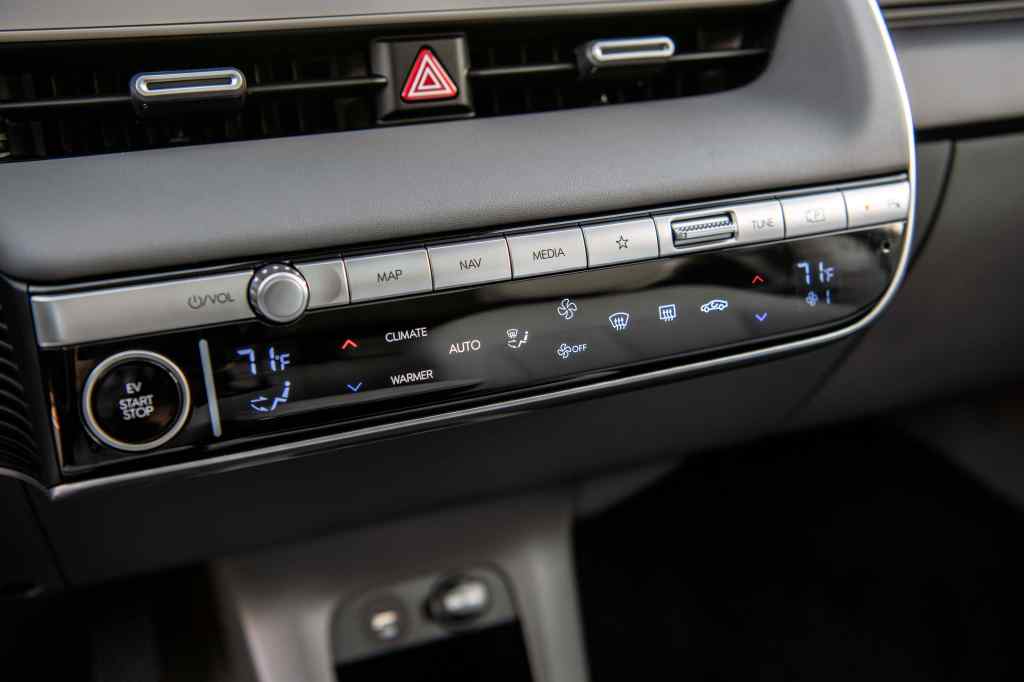
Quick: how do you adjust the temperature in the IONIQ 5? Some things make superior ergonomic sense. (Images: Hyundai)

For example: Want to adjust the HVAC? Yes, there is a 12.3-inch touchscreen. . .but more familiar, on a conductive surface, are red and blue arrows: touch them to get the job done. No searching required through the screen.

Yes, there are buttons and switches. A minimal but familiar assortment of things that can be adjusted.

The design of the IONIQ 5 is superb. There is the now seeming obligatory minimalism, but, more to the point, there is the addition of artistry in the patterns on some of the surfaces that are subtle and provide an overall sense of freshness. This is in contrast to the near-Brutalist approach that is taken inside a Tesla.

The exterior of the IONIQ 5—from the LED lighting up front to the LEDs around back—provides an appearance that is purposeful yet futuristic. I am puzzled by the apparent appeal of the bland front fascia of the Tesla Model Y: the front end of the IONIQ 5 appears as though it was created by a team of innovative engineers and artisans; the Model Y front appears as though the objective was to make a shape that could be readily released from the injection molding tooling.

The exterior is fresh and forward.

And the creases in the body side of the IONIQ 5 speak to a knowledge of forming metal in an aesthetic manner, something that, arguably, is lacking in something like the—admittedly not a competitor—Cybertruck which, again, seems to have been designed so that it could be formed with a press brake rather than a servo press.

The IONIQ 5 comes in RWD and AWD versions, with different motor and battery sizes.

The vehicle driven here is an AWD model; its permanent magnet synchronous motors (one in the front, one in the rear) produce a combined 320 hp. It has a SK Innovation 77.4 kWh lithium-ion battery that provides the vehicle with a range of 260 miles. The on-board charger is capable to being charged at a station with up to 800 v/350 kW; that means the battery charge can go from 10% to 80% in as little as 18 minutes.

People are catching on to the IONIQ 5. In March sales were up 58%. There were 3,361 delivered. The sales of the Hyundai Palisade—a bigger vehicle with an internal combustion engine—were also up 58% in March. There were 9,785 delivered.

The point being, there is a ways to go before there is greater consumption of EVs.

The IONIQ 5 is a vehicle that will help get more people there.

EVs Mainly Elsewhere

By Gary S. Vasilash

According to stats from EV Volumes, in February the top-selling vehicles with a plug (PHEVs and EVs) were:

  1. Tesla Model Y
  2. Tesla Model 3
  3. BYD Qin Plus
  4. BYD Song
  5. AITO M7
  6. BYD Seagull/Dolphin Mini
  7. Wuling HongGuang Mini EV
  8. BYD Yuan Plus/Atto3
  9. BYD Dolphin
  10. VW ID.4
  11. Li Xiang L7
  12. Wuling Bingo
  13. BYD Han
  14. MG 4/Mulan
  15. BYD Destroyer 05 PHEV
  16. Jeep Wrangler PHEV
  17. VW ID.3
  18. Audi Q4 e-tron
  19. Li Xiang L9
  20. Chery Fengyun A8 PHEV

Here’s the thing: outside of the Teslas, VW ID.4, Wrangler, and Audi Q4 e-tron, how many of those vehicles do you have even the vaguest concept of?

There’s nothing from Toyota, Mercedes, Ford, GM BMW, Honda, or Hyundai.

This should be a reminder that when you look at EV (and PHEV) sales numbers, the world is a bigger place.

EVs and Pricing Parity

By Gary S. Vasilash

In December 2023 18 of the 35 brands that Kelley Blue Book analyzed had year-over-year price declines.

This is understandable, given that it was the end of the year, and there is a tendency for product manufacturers of all types, not just vehicles, to want to move out as much inventory at the end of a period as possible (e.g., the classic recommendation about buying a car at the end of the month when the dealer wants to move just one more to make a quota and consequently provides a better deal).

So there was Volvo, which reduced its price by 6.7% and Land Rover, with a 10.2% reduction.

It should be noted, however, that both of those brands have a very minimal (<1%) share of the U.S. market, so it is not like their combined numbers have much of a consequence on the overall average retail price for vehicles in 2023.

KBB calculated that in December the average transaction price (ATP) for vehicles was $48,759.

Notably, the ATP was $50,798 for electric vehicles.

Said Stephanie Valdez Streaty, director of Industry Insights at Cox Automotive, “2023 was a milestone year with 1,189,051 pure battery electric vehicles sold, accounting for 7.6% of all new-vehicle sales.”

So that is good for the EV producers.

What’s more, the point at which price parity between vehicles with combustion engines and those with electric motors is reached is something considered by industry to be the point at which there will be a huge rise in the number of EVs purchased.*

An ATP difference of $2,039 for an EV is almost that, and certainly just a few bucks per month on a lengthy load.

But going back to the companies that had price cuts in December, there’s the company that accounts for 55.1% of the EV market, Telsa. (Tesla has, per Cox Automotive, 4.2% of the entire vehicle market, which is more than Mercedes, Volvo, Jaguar-Land Rover, Rivian, and Lucid combined.)

According to KBB it cut its prices an average 25.1%.

Let’s see: a price reduction of that magnitude, the possibility of getting as much as a $7,500 tax credit for a Model X or Y—well, were Chevy capable of providing those kinds of benefits to customers Malibus would be flying off lots.

People read books about negotiation strategies in order to get a few percent taken off the price of the vehicle they want to buy, coming in ready to take on the dealer by being wise to its tactics, and there was Tesla, slashing prices, presto-change-o. And the Feds offering serious money, too.

Amazing!

No other OEM can afford to make—or take—the kind of cut that Tesla made.

At some point (let’s not forget about the presidential election in a few months) those tax cuts are going to go away. And Tesla may simply being to ratchet its prices back up.

What then?

Perhaps that parity may be fleeting.

==

*Of course, given the continued issue regarding infrastructure, which an increased number of EVs would only exacerbate. . . well, people who have to drive around looking for available, working chargers are not likely to want to repeat that experience when they look for a new vehicle.

Tesla: Still Not Self-Driving

By Gary S. Vasilash

“The two times Autosteer allowed my car to roll right through intersections with stop signs were especially nerve wracking. I could tell from icons on the car’s screen that it could see the sign, yet it did not disengage Autosteer or stop. After digging around Tesla’s website, I discovered that Tesla says obeying stop signs and stop lights is a function included for those who pay for Full Self-Driving. Should you really have to pay extra to keep the software your car comes with by default from doing reckless things?”—Geoffrey A. Fowler, Washington Post columnist, on his experience in his Tesla Model Y after the over-the-air update that was a response to the National Highway Traffic Safety Administration’s investigation, a recall that is meant to make Autopilot safer. As Fowler chronicles, he didn’t feel as though there is an improvement.

Or, as he put it, “I found we have every reason to be skeptical this recall does much of anything.”