Buick doesn’t always get the respect that it has earned, especially when it spent many years in the shadow of Cadillac. (If you can’t afford a Cadillac, then. . . .)
Now the company has switched to an all-SUV lineup. There are four. One is built in the U.S. The others are from South Korea and China. It is worth knowing that David Dunbar Buick was born in Scotland.
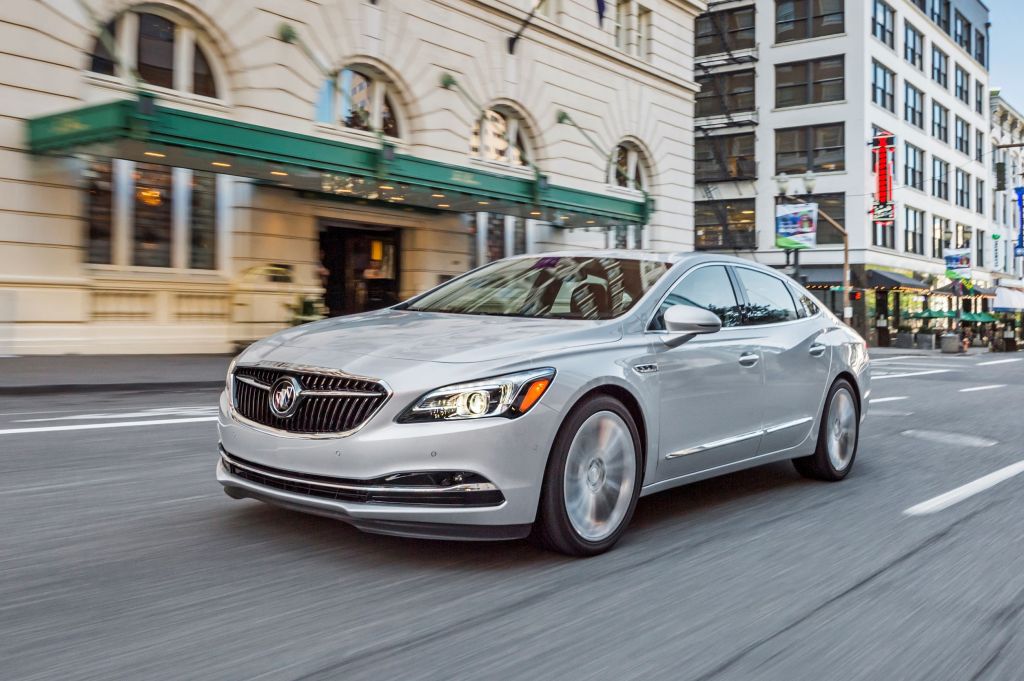
2019 Buick LaCrosse. (Image: Buick)
J.D. Power has released its latest Vehicle Dependability Study. This looks at how people feel about their vehicle’s performance after three years of ownership.
The top brand is Kia with a score of 145. The second-best brand is Buick, at 147 points. (As you may discern, a lower numerical score is better.)
Know that this means Buick beat out the likes of Lexus and Porsche and Lincoln and BMW and Jaguar and others—in many cases, rather handily.
Buick.
What is somewhat ironic is that in terms of vehicle categories, in Large Car Buick also came in second, with the LaCrosse. It no longer offers it.
In first place is the Chevrolet Impala. That is going away, too. (Last year in the U.S. GM delivered 750 Impalas.)
First the good news, according to Michelle Krebs, executive analyst for Cox Automotive:
“The surge in new car prices appears to have peaked.”
That is the new vehicle average transaction price fell 1.8% in January compared to December.
Now it is “just” $46,404.
But while not exactly an entire shoe dropping, Krebs adds:
“Yet, while we expect vehicle supply to improve, it will continue to be tight particularly through the first half of the year. Because of this, we expect prices to remain high for the foreseeable future, but car shoppers can rest assured we don’t anticipate any more record highs.”
Not records. Just high.
Here’s another thing that probably won’t make you feel much better.
Cox calculates that car shoppers for non-lux vehicles are paying, on average, more than $900 above sticker. A year ago those customers were paying $1,600 or more below sticker.
For those in the lux segment it is a similar story, just higher numbers. As in paying $1,300 above sticker when last year the prices out the door were $2,400 under MSRP.
One way of looking at this is that for non-lux cars customers are paying a $2,500 penalty for waiting (the swing from minus $1,600 to plus $900) and the lux buyers $3,700.
With inflation and rising interest rates, however, it may be a good idea to shop earlier rather than later lest those factors add to the sticker.
Remember: MSRP is “suggested” price, not what you’re going to sign off on.
Kelley Blue Book has come out with a list of top vehicular tech for 2022.
One thing that you may immediately notice is that this technology isn’t exactly new in most cases.
But it is a list of things that you might want to be aware of should you be out there looking for a new vehicle.
Of course, finding an affordable new vehicle is all the more difficult nowadays because of the on-going shortage of semiconductors–and it is worth noting that by and large these technologies are predicated on. . .semiconductors:
Advanced Driver Assistance Systems (ADAS)
Automatic Emergency Braking
Connected Mobile Apps/Digital Key (the latter uses a phone as a device to unlock and start the vehicle)
Teen Driver Tech (squeals to Mom and Dad if the kids go too fast, for example)
Safe Exit Assist to Protect Cyclists (blind spot detection of bike rides—helps save them and the driver’s door)
Wireless Smartphone Connectivity and Charging
360-degree Camera
Emergency Services/Stolen Vehicle Tracking Software (when is the last time you heard anyone mention LoJack?)
Blind-Spot View Monitor (not just that little yellow light in the sideview mirror but an actual image of what’s where)
Video Rearview Mirror (switches the reflective mirror to a video display)
Drive carefully even if you don’t have any of this stuff.
Justin Fishkin was the chief strategy officer at Local Motors for seven years (2011 to 2018), then senior advisor for the firm for two years after that.
Local Motors seemed to have it all going for it in terms of what it was doing and how it was doing it.
It was crowd sourcing design. It was using 3D printing to the extent that others were only dreaming about. It was developing vehicles fast. It was putting autonomy into application. It was creating mobility systems.
Olli: Electric. Autonomous. Built in a microfactory. (Image: Local Motors)
From Wired to IMTS Today and an array of media outlets in between, Local Motors was the “it” company in the transportation field.
And a few weeks ago word leaked out that Local Motors was closing up shop.
So on this edition of “Autoline After Hours” Fishkin talks with “Autoline’s” John McElroy, Chris Paukert of Roadshow by CNET and me about what the company set out to do and what conceivably happened.
One of the primary factors, Fishkin suggests, is that there was a case of mission creep in that the company found itself stretching in different directions as different constituents became involved in the company.
They went from crowdsourcing designs that led to vehicles like the Rally Fighter, 3D printing an entire vehicle (the Strati) then creating Olli, a compact people-mover with autonomous capabilities, and along the way created fans and attracted companies that wanted to get some of the “stuff” that was allowing the company to do what it was doing.
An early intention was to have micromanufacturing capabilities set up as a network such that there would be the development of vehicles that would lend themselves to specific markets. The company ended up having two, in Chandler, Arizona and Knoxville, Tennessee
It also built a demo microfactory in National Harbor; GE Firstbuild built a microfactory in Louisville, Kentucky, with Local Motors’ assistance.
In addition to GE, Local Motors worked with companies including Airbus and Siemens. All of which is to get to the point that this was something real, not speculative.
Its Olli had deployments in Buffalo, New York; Turin, Italy; Sacramento, California; Arlington, Virginia; Holdfast Bay, Australia; Akron, Ohio; Dunedin, Florida; Jacksonville, Florida; Clarksburg, Maryland; Yellowstone, Wyoming; Thuwal, Saudi Arabia; Durham, Florida; Marysville, Ohio; Neustadt, Germany; Jacksonville, Florida; Palo Alto, California; Concord, California; Ghent, Belgium; Lake Nona, Florida; Peachtree Corners, Georgia; Peoria, Arizona; Whitby, Canada; Toronto, Canada; and Crozet, Virginia, yet in the broader scheme of things, that is but a handful of places.
Fishkin also talks about his current activities with a startup Future/Of, which is helping, well, startups. One of the companies Fishkin is working with is Biliti, Inc., a company that is producing electric three-wheelers for last-mile transport.
But not just startups, he notes. As he puts it, “Future/Of works with organizations to scale disruptive business models and frontier technologies.” Which established companies can benefit from. And NGOs.
Still, in the context of Local Motors and where it came to, the question becomes where will micromobility and distributed microfactories go? This is a question that Fishkin help provide some solid perspective on.
Yes, there are things like logistics jams and semiconductor absences that are making getting a new set of wheels (1) difficult at most and (2) more expensive than might seem to be reasonable. (Of course, finding a bag of potato chips might be a challenge, too, and once you find one you’ll discover that its contents is reduced and its price has been raised.)
Still, seeing the average transaction prices for General Motors products in Q4 2021, according to Cox Automotive, is somewhat surprising.
For Cadillac, the amount of money that people actually paid at the dealership—the average transaction price (ATP)—was $77,143. Compared to Q4 2020 that is a 29% increase.
Those rolling out of a dealership in an Escalade paid an average $107,336. That 38-inch OLED screen isn’t cheap.
Perhaps a GMC would be a more reasonable buy. Its ATP was $62,501. Perhaps.
Once, in the stairstep approach to brands, Buick was just below Cadillac. There’s something to be said for not giving up aspirational sedans and switching to a showroom of crossovers: even though Buick 2021 sales were up 10.5 percent, even though its ATPs were up 14% in Q4 2021, it was the lowest overall in GM brands according to Cox: $39,304.
Yes, this means that Chevy had a higher ATP: $50,336.
It is worth noting that in 2021 Buick delivered 179,799 vehicles while GMC moved 482,437, of which more than half (248,924) were full-size pickups.
Still, if those pickups, as well as the Canyon (24,125 were sold in 2021), are subtracted from GMC’s overall sales, it moved 209,388 vehicles, or 29,589 more than Buick.
All of which is to say that talking ATPs into account, GMC is doing significantly better than Buick. Clearly people would rather have a GMC.
That said, the $50,336 ATP for a Chevy (yes, the Silverado pickup price has a lot to do with that) makes me think that if people want a hot dog, apple pie and a Chevrolet, they may have to rethink their choices.
According to Kelley Blue Book, which knows about such things, the average used vehicle price at the close of 2021 was $28,205.
That was 28% higher than it was at the end of 2020.
42% higher than in December 2019.
(One thing that is a little odd about this: Given that there was a decrease in the miles traveled during the lockdown portion of that period, as in, say, people working from home and therefore not driving, wouldn’t you imagine that the demand for used vehicles—yes, we know that the lack of semiconductors reduced the availability of new cars, which put some people into the used market—would have been lower, or is it simply that they could have been much higher?)
Back to that $28,205.
According to the U.S. Census Bureau, the median household income in the U.S. in 2020 (these were the latest figures collected as of September 2021) was $67,521, a 2.9% decrease from 2019.
Let’s say for the sake of argument that there was a 5% increase in 2021 (an arbitrary figure based on nothing).
That would make the median income $70,897.
The average used car would be about 40% of that annual income.
Electrify America, the company that was established by Volkswagen as part of its penalties associated with “Dieselgate,” is the network calculated to be best by umlaut, an organization that performs benchmarking, and Charged, an EV magazine.
Electrify America scored highest, with 702 of a possible 1,000 points.
Tesla came in second, at 649.
There were two primary categories:
Digital Platform
Charging Location
The people performing the analysis drove some 2,100 miles in Connecticut, Maryland, Michigan, New Jersey, New York, Ohio and Pennsylvania. They drove in a Mustang Mach-E and a Tesla Model 3.
In the Digital Platform category, which looks at things like the website and the app, Electrify America came in with 275 points. Tesla was well behind, at 165.
In terms of Charging Location, which is about the actual act of charging, Electrify America scored 426.75 points while Tesla came in at 484.25.
So the biggest difference is not out there plugging in at a station but while on one’s phone.
Guess it comes down to what is more important, especially when you just want to get the damn thing charged and on your away.
The other charge point providers and their scores are: Charge Point (611), EVgo (578), Greenlots (548), Blink (505) and EV Connect (472).
Back in 2017 Bollinger Motors revealed two vehicles, the B1 a bona-fide SUV (it actually has a frame, which makes it more SUV than crossover), and the B2, a Class 3 pickup.
Both are electric vehicles.
What was absolutely remarkable about the two is that there is a design aesthetic that is all about straight-up functionality rather than either copying the design, more or less, of an existing vehicle with an internal combustion engine or going completely futuristic. As there are more announcements of electric pickups the B2 stands in a place of its own.
And in 2019, when the company announced the pricing for the fully electric, all-wheel drive vehicles, some took in a quick breath: $125,000.
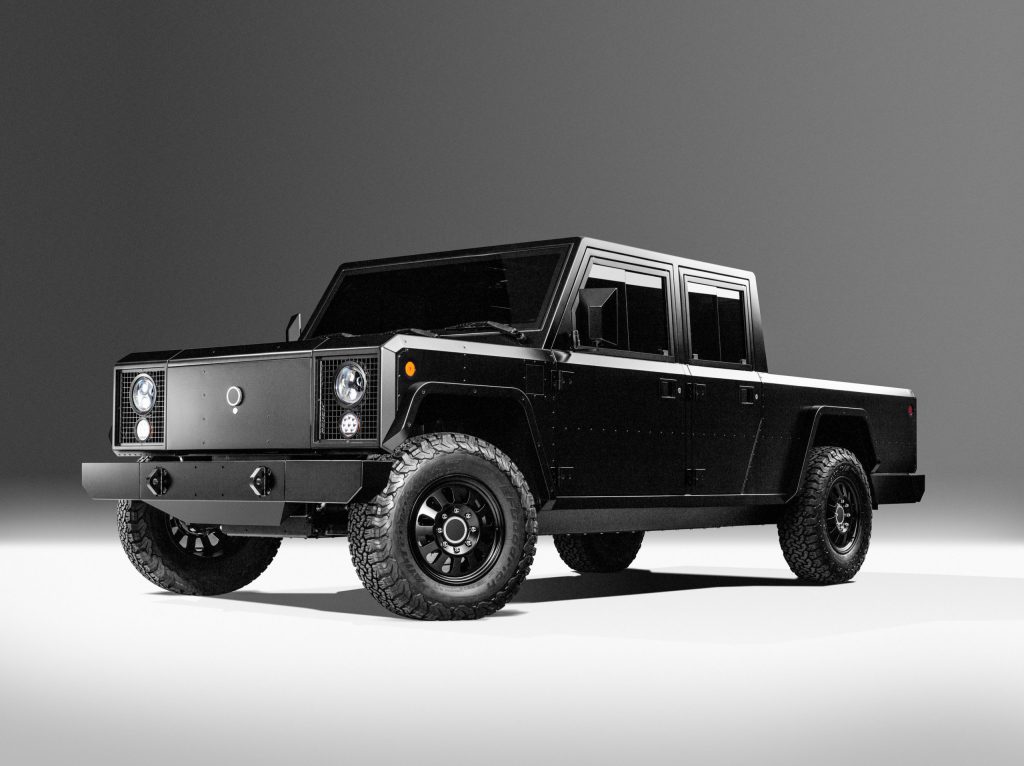
Bollinger Motors B2 (Image: Bollinger)
Be that as it may, reservations came rolling in to the company that had moved from New York to greater Detroit in order to be in the midst of automotive development.
On January 14, 2022, Bollinger Motors announced a change in direction:
“We started Bollinger Motors in 2015 with a dream and a desire to make the best trucks possible,” said Robert Bollinger, CEO of Bollinger Motors. “We’ve put countless hours of hard work and passion into making something that makes us proud. However, today, we’re postponing the consumer trucks’ development and shifting our focus to commercial trucks and fleets.”
The company would be focusing its efforts on vehicles in the class 3-6 category, trucks that are typically bought by businesses in volumes of more than one.
Bollinger engineers had developed the underpinnings for electric trucks in terms of the battery system as well as the structure, so that, rather than the exterior sheet metal, is where the company will now be focusing its development efforts.
So why the change?
On this edition of “Autoline After Hours” Robert Bollinger explains the thinking behind addressing the commercial market first rather than pursuing the personal, or individual, market. He notes that the work they’ve done beneath the skin provides the solid workings for commercial vehicles, a place where he—and many others—think that there will be a significant deployment of electric vehicles.
It is worth noting that the B2 was from the start a robust truck and so that is just being amped up for these new applications.
Bollinger discusses this move with “Autoline’s” John McElroy, Greg Migliore of Autoblog, and me.
It becomes clear that Bollinger isn’t just the guy whose name is on the company but a man who is deeply committed to the development of first-rate vehicles.
That is something that makes a tremendous difference between builders who want to make a quick buck and those who want to make something that people will appreciate.
There is a tendency for OEMs to opt for metals when naming vehicles at the top end of their lineups. Platinum is exceedingly popular. The metal is 78 on the Periodic Table. Gold does it one better, however, at 79.
But somehow gold doesn’t seem quite as exclusive as platinum does. In fact it seems rather common (perhaps it has something to do with those late-night commercials from outfits offering to buy your jewelry).
But if platinum keeps being rolled out as a moniker, then it will become far too common. Soon it will become like, well, gold.
That said, the new Mercedes C-Class has a group of interesting trims:
Premium
Exclusive
Pinnacle
The “Exclusive” name is the most amusing in that if something is truly exclusive do you have to tell someone? And if you have to tell someone, is it exclusive or obscure? (And unless you want to sell a whole lot of something, isn’t obscure, in some ways, better, more, well, exclusive without claiming to be?)
“Premium” sounds like an adjective used at outlet malls.
“Pinnacle” is good. Still, it seems a bit out of place for a sedan. Sounds like an SUV (e.g., Jeep Summit.)
But Toyota has just done Mercedes one better.
The 2023 Sequoia, a full-size, three-row SUV that is about the size of a small but stylish building (it can town 9,000 pounds, so think, perhaps, tiny house), comes in five grades, with the pedestrian Limited and Platinum (see?) and the Toyota-specific SR5 and TRD Pro.
But the ultimate, and really an outstanding choice for a vehicle of the Sequoia’s magnitude (remember, that comes from the name of that massive redwood), is:
Capstone
When you consider that the Sequoia is at the top of the Toyota lineup, the top trim for the model truly has to be called out as a crowning achievement.
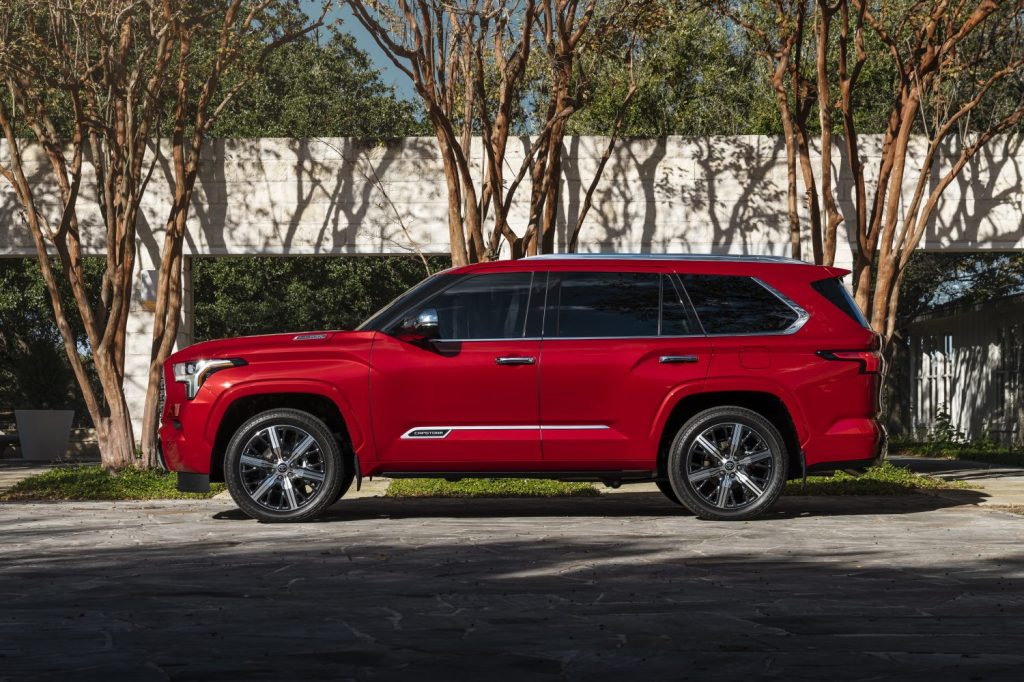
2023 Toyota Sequoia Capstone (Image: Toyota)
(Were one to be snarky, it might be pointed out that “stone” isn’t exactly the sort of thing that one would like to ascribe to a vehicle that is meant to move, as that term can bring to mind mass, and while Toyota hasn’t released the specs for the 2023 model yet, the lightest 4WD 2022 Sequoia weighs 5,985 pounds, and the Platinum trim (go figure) comes in at an even three tons. But (a) we aren’t going to be snarky and (b) we really like the Capstone name.)


 shinymetalboxes