Two taxi cooperatives in Thailand—the Ratchapruk and Bovorn Taxi co-ops—have 500 cabs rolling in the streets of Bangkok, which means that there are some 2,500 vehicles sitting in lots, so a number of these static vehicles have become gardens, according to The Associated Press.
There are bamboo frames on the roofs of the vehicles and black plastic garbage bags stretched across the frames. The plastic is covered with dirt and veg including tomatos and string beans are planted.
Thapakorn Assawalertkul, an executive with the co-ops, told AP reporter Jerry Harmer, “The vegetable garden is both an act of protest and a way to feed my staff during this tough time.”
The tough time, of course, is the covid pandemic that has had a major impact on Thailand, with a reported 1.4-million cases and in excess of 14,000 deaths. The protest goes to the government, which apparently isn’t providing direct financial assistance to the cabbies.
Clearly the people there are resourceful. Here’s hoping that the drivers soon get back behind the wheels of more cabs and that the vegetables they eat sourced from markets once again, not from the roofs of Camrys.
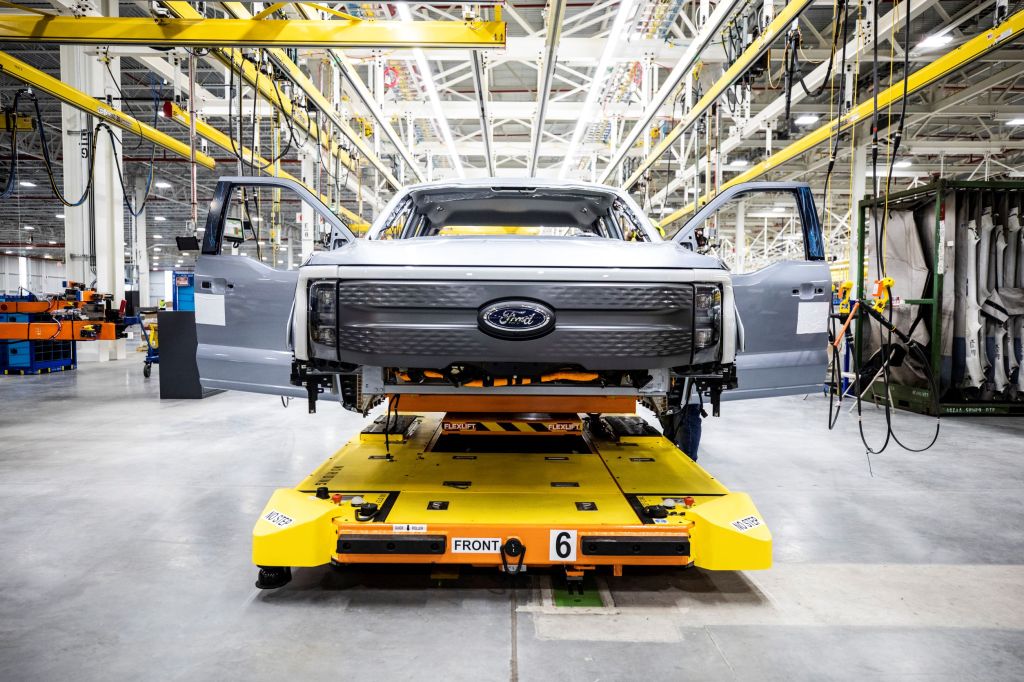
The first versions of the F-150 model are being built at the Rouge Electric Vehicle Center in Michigan
By Gary S. Vasilash
Ford is increasing its investment—to the tune of $250-million—at its operations at the Rouge Electric Vehicle Center, Van Dyke Electric Powertrain Center and Rawsonville Components Plant.
The reason?
The F-150 Lightning.
It also means 450 more jobs spread across the plants, all of which are in Michigan (Dearborn, Sterling Heights and Ypsilanti).
“We knew the F-150 Lightning was special,” said Ford executive chair Bill Ford, “but the interest from the public has surpassed our highest expectations and changed the conversation around electric vehicles.
“So we are doubling down, adding jobs and investment to increase production,” Ford added.
“This truck and the Ford-UAW workers who are assembling it in Michigan have a chance to make history and lead the electric vehicle movement in America.”
Pre-production underway for the all-electric F-150 Lightning. (Image: Ford)
Ford has taken more than 150,000 reservations for the full-size electric pickup that has an estimated range of 300 miles and a starting MSRP of $40,000. (It is worth noting that the reservations require $100—which is refundable.)
The Lightning is another in the F-150 offerings, which has been the best-seller in the U.S. for 44 years running.
Pre-production is underway for the Lightning, with consumer vehicles planned for availability in the spring of 2022.
Why Ford, Argo AI and Walmart are going to be making a difference in the implementation of the tech
By Gary S. Vasilash
Although many people think—or imagine—that autonomous driving is going to occur from a company like Tesla, which will allow people to do whatever while their vehicle chauffeurs them to wherever, in point of fact, that is not going to be the case for a variety of reasons, not the least of which that sensors and processors are expensive, and even though there are some people who are willing to pay an exorbitant amount of money for something that claims to be “full” but is really more than half empty, OEMs are going to need to have assurance that there are going to be many more than a few who are willing to buy the tech.
But while consumers might not opt to spend the money, commercial carriers are likely to if they can determine that the tech is going to provide them with an economic advantage.
Ford, Argo AI and Walmart are driving autonomous tech forward. (Image: Ford)
Which makes the announcement by Ford, Argo AI and Walmart about the retailer using vehicles from Ford (Escape Hybrids) and self-driving technology from Argo AI to launch an autonomous delivery service for the “last-mile” in Miami, Austin, and Washington, DC, all the more significant.
These are mass-manufactured vehicles that are going to be put work by the world’s largest retailer in urban settings doing driving that will conceivably provide an ROI to Walmart, if not immediately, then at some point in the future.
Tom Ward, senior vice president of last mile delivery at Walmart U.S., said, “This collaboration will further our mission to get product to the homes of our customers with unparalleled speed and ease, and in turn, will continue to pave the way for autonomous delivery.”
The way this will work is that the Walmart online ordering platform will send information to the Argo AI cloud-based infrastructure, which will then calculate the necessary scheduling and routing.
The point is that this is all predicated on business processes.
And that’s what is going to make actual autonomy a real thing long before something shows up in your driveway that will take you from somewhere to somewhere else while you sit in the back seat eating a hot dog and watching Netflix.
Know that this is something of a journey as Ford and Argo AI have been testing their tech on city streets since 2018, the same year that Ford and Walmart ran a test in Miami. It takes time, effort and consistency of purpose.
The technology needs to be developed, tested, validated and verified.
It is not the consequence of an over-the-air update that follows a tweet.
If you read the sentence, “Sally drove her HEMI-powered Charger down Woodward” you probably know that the vehicle, the Charger, has a massive engine under its hood, a HEMI. (The “Woodward” part is just for color: M1 is a street in greater Detroit upon which countless HEMIs traveling one-quarter-mile at a time.)
When you read the line “the Aurora-powered Volvo VNL” and know that the VNL is Volvo Trucks’ big rig, Class 8 truck, you might wonder what kind of powertrain the “Aurora” is.
Volvo VNL being equipped with the Aurora Driver. (Image: Aurora)
But of course it isn’t.
Rather, Aurora, as in the self-driving technology development company, has integrated its “Aurora Driver,” its sensor suite for Level 4 autonomous driving, into the Volvo VNL.
The truck is actually being powered—in the Sally sense—by the Volvo D13 Turbo Compound engine that can produce up to 455 hp.
As for the Aurora implementation, the company is working to assure that the Aurora hardware and software are fully integrated into the architecture of the VNL so that Volvo will be able to produce the L4-capable trucks in its plant in Dublin, Virginia.
An inside look at IAA Mobility. Yes, the German auto show
By Gary S. Vasilash
The event formerly—for almost 70 years—known as “the Frankfurt Motor Show” is no more, as this year the event is officially titled “IAA Mobility,” and it moved about four hours southeast by car to Munich.
According to the organizers, the thesis of the event is “Mobility is the foundation for freedom, prosperity, and encounters. We face new challenges daily, such as urbanization, climate change, and digitization. But instead of borders, we recognize the call for action. It is up to us to go new ways, ask questions, and find answers.”
Which doesn’t sound like, well, an auto show as they have long existed.
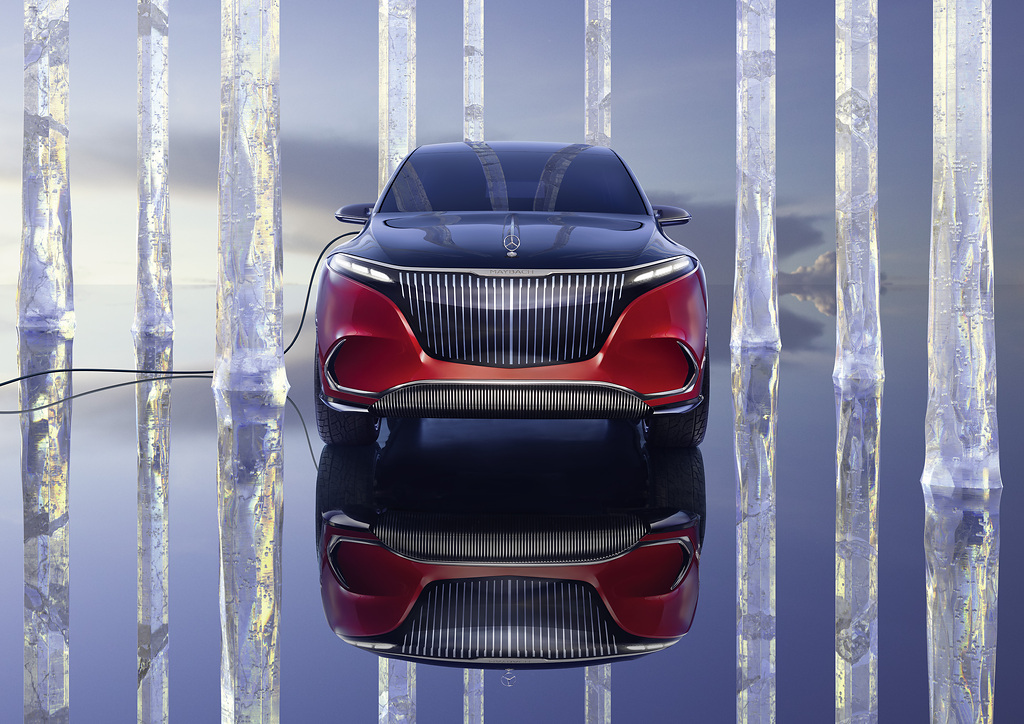
Concept Mercedes-Maybach EQS: Do the 1% like garish grilles on EVs? (Image: Mercedes)
So to get some insights on the event, on this edition of “Autoline After Hours” “Autoline’s” John McElroy and Chris Paukert of Roadshow by CNET, both of whom were at the media days of IAA Mobility, talk with me about what they saw, the vehicles that they found to be of interest. (I wasn’t there.)
One interesting observation that they make is that while there were certainly plenty of introductions by the German car companies—like the Concept Mercedes-Maybach EQS, an electric vehicle that is for, well, the Maybach set; the BMW i Vision Circular, which McElroy points out has a clever approach to the traditional kidney grille, as it basically fills the front end in tasteful matter, not something garishly slapped on the nose; and the Volkswagen ID.Life, a small city car that Paukert notes is unlikely to be able to ever come to the U.S. due to the homologation requirements—the footprint of the show was far different than that of the Frankfurt venue.
In addition to which, we talk about the speed with which Tesla makes changes to its systems (e.g., electrical architecture) and whether traditional OEMs have the capability to catching up, whether those traditional OEMs should combine their mainstream powertrain operations into an independent standalone company and take the savings from the elimination of the cost of their individual ops to spend on things like electrification, and more.
Tires are made of lots of materials. Yes, there is natural rubber. And synthetic rubber.
There are carbon black and silica.
There are cables, both metal and textile.
And there are various chemicals added for good measure.
Continental has developed what is says is a considerably more sustainable tire, one that has more than 50% of its materials being traceable, renewable and recycled.
There are lots of organic materials, including the natural rubber from dandelions (not necessarily the ones you have in your lawn, but similar), silicate from rice husks, and vegetable oils from, well, vegetables rather than petroleum products from prehistoric plant matter and sea creatures.
Conti’s clever “green” tire. (Image: Continental)
Thirty-five percent of the Conti GreenConcept tire (yes, this is still conceptual; you can’t get one—yet) consists of renewable raw materials.
Then there are recycled materials, which account for about 17% of the tire. Things like the polyester recovered from PET bottles—bottles that are used for soda and water.
Another clever aspect of the tire is that it is lighter than a comparable conventional one. This helps lower the rolling resistance, and that means that less energy is necessary to turn the tires. This can mean as much of an improvement of 6% in the range of an electric vehicle.
(It knows a little more than a little about EVs as it has its tires on EVs from companies ranging from Audi to Vinfast—and, yes, Tesla.)
According to Continental CEO Nikolai Setzer, “Continental will completely convert its global tire production to the use of sustainable materials by 2050 at the latest.”
While that might seem like a long time, they’ve been making tires for some 150 years, so it is relative.
No, not the roundel logo. The way it is conceiving and building its vehicles
By Gary S. Vasilash
When people think/talk about environmentally appropriate vehicles, the tendency is to talk about the tailpipe—or the lack thereof.
That is, an electric car (no tailpipe) or a fuel-cell-powered car (which has an exhaust to let the water vapor escape) is seen to be good because it is an electric car or a fuel-cell-powered car. (Trucks and SUVs can be used in place of “car.”)
But what somehow gets overlooked is the fact that there is a heck of a lot more to a motor vehicle than the type of propulsion system that it uses.
There is all of that other “stuff” that goes into making a vehicle.
BMW i Vision Circular (Image: BMW)
Things like the chassis and the body panels. The steering wheel and the seats. The carpet on the floor and the headliner on the ceiling.
And so on.
The production of these things has an effect on the lifecycle emissions of a given vehicle.
Sure, the use of the vehicle has a huge impact on the vehicle’s effect on the environment.
So while it is not exactly a leader in the electric vehicle space, which is leading some people to raise an eyebrow, credit to BMW for introducing a concept vehicle at the IAA Mobility 2021 event (what used to be known as “the Frankfurt show” until it was moved, this year, to Munich) that has an absolute basis in sustainability.
It is called the “BMW I Vision Circular.”
“Vision,” I suppose, because this is something that is for 2040.
“Circular” because the vehicle is entirely developed and built using principles of the circular economy, as in it is built with 100% recycled materials and 100% of those materials can be recycled again.
Even the battery for this electric vehicle, a solid-state battery (of course, although BMW is working on this technology, it is still a ways off for production vehicles, but works quite well in a one-off concept) is designed to be recycled.
While recycled materials have generally thought of as having a premium price, BMW chief Oliver Zipse made an interesting observation: “the current trend in commodity prices clearly shows the financial consequences in store for any industry that is reliant on finite resources.”
Imagine being driven in an autonomous vehicle that’s being controlled by someone who is remote
By Gary S. Vasilash
Most companies that are developing autonomous driving technology for vehicles—companies like Waymo and Argo AI and Cruise—are doing so such that the autonomous vehicle is. . .autonomous.
The sensors and the processors and the actuators necessary to making a given vehicle drive without human input are all embedded in said vehicle.
Teleoperation in Berlin. (Image: Vay)
Sure, the vehicle may access the cloud every now and then for an update of some sort (e.g., perhaps for some information regarding location), but otherwise autonomous is as autonomous does.
But then there’s a company out of Berlin named Vay.
Vay’s approach to autonomy is different.
Vay has developed a “teledriving” system.
This means that there is a “teledriver.” Someone who is not in the vehicle but who is in control of the vehicle.
Think of it, perhaps, like an air traffic controller combined with someone who is playing some version of Forza.
Vay co-founder and CEO Thomas von der Ohe: “As our system does not rely on expensive 360-degree lidar sensors, and is therefore comparatively inexpensive, our way of rolling out driverless vehicles will not only enable consumers to experience driverless mobility sooner, but also provide a highly scalable solution that can be integrated into every car.”
It seems that the plan is learn from the teleoperation so that they will be able to roll out autonomous features gradually.
Vay has vehicles operating in Berlin right now, but there are safety drivers on board. The company believes that they will be able to operate fully teledriven next year.
The Frontier is in a segment that has certainly changed during its history. Both GM and Ford had midsize products, which they both removed from the market before re-entering it.
Toyota, with its Tacoma, has just kept at it, year after year, leading the segment in sales.
As this is an important segment for all involved, Melaina Vasko, Vehicle Performance Manager, Nissan Frontier, says that as they developed the 2022 model they were certainly cognizant of the competition, but, at the same time, they were not going to overlook the fact that during its run to date there have been more than four million Frontiers sold in the U.S.
So she and her development team spent time learning from customers, learning what they wanted and thinking about what they could bring them.
One of the things people are absolutely interested in is a truck that can fit into a garage. The Frontier with a short wheelbase is 210.2 inches long; the long-wheelbase version is 224.1 inches. The vehichle is either 73 or 74.7 inches wide (the more rugged trims have brawnier shoulders); the height variations range from 71.6 to 72.9 inches. There are two bed sizes: 59.5 inches for the standard version and a 72.7-inch long bed.
Vasko explains on this edition of “Autoline After Hours” how the 22 Frontier was developed with an eye toward providing capability, drivability, comfort, technology, and style, and how these are addressed with the new vehicle.
It is notable that this is a vehicle that was a long time coming, longer than most vehicles that you can probably think of.
Consequently, the amount of attention to the execution is certainly something that is different than, say, a model that is turned over every five years.
One of the things that Vasko told her team, one of the things that should be important to anyone in any endeavor, is simply this: “Try.”
When things seemed more than difficult, perhaps teetering on the edge of what might be considered impossibility, they were encouraged to try.
Without trying, they wouldn’t have been able to deliver on the 2022 Frontier.
We’re not sure why we know about this, either. . .
By Gary S. Vasilash
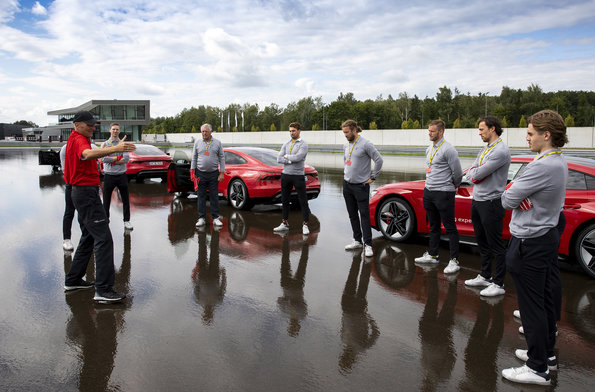
Audi has sent out a press release indicating that the ERC Ingolstadt, the professional hockey team for Ingolstadt, spent an afternoon at the Audi Driving Experience Center in Neuburg on the Danube driving Audis.
Hockey players and Audis. (Image: Audi)
First they underwent a safety training regime, then drove things like the R8 and the e-tron GT.
At the end of the session, “the players accepted their new company cars” and had a barbeque.
And now you know something you probably had no interest in, either.
(If you are interested in ERC Ingolstadt: they will start their Deutsche Eishockey Liga season on September 10, when they’ll be facing off against the Bietigheim Steelers.)





 shinymetalboxes