The EV Infrastructure Issue

Yes, people like fast and free. How do you build a business case on that?

By Gary S. Vasilash

“Public charging infrastructure is a key component in the overall adoption of electric vehicles by the broad population.

“Unfortunately, the availability of public charging is the least satisfying aspect of owning an EV. Owners are reasonably happy in situations where public charging is free, doesn’t require a wait and the location offers other things to do—but that represents a best-case scenario.

“The industry needs to make significant investment in public charging to assure a level of convenience and satisfaction that will lure potentially skeptical consumers to EVs.”–Brent Gruber, senior director of global automotive at J.D. Power.

J.D. Power has launched its first U.S. Electric Vehicle Experience (EVX) Public Charging Study, so Gruber’s observations are predicated on the responses of actual battery electric vehicles and plug-in hybrids.

Think about this:

  • People like free
  • People like fast
  • People like distractions

If energy providers are going to increase the speeds of charging, then this means they’re going to need to spend more money on their equipment.

So free and fast seem to be at odds.

And let’s face it: there is only so long that any business that wants to stay in business is going to be able to offer something for nothing.

As for the distractions, that goes to the point of the amount of time that it takes to recharge an EV.

Again, if the speed goes up, then the need for much in the way of distractions goes down.

(At a local bp station there are video screens on the pumps that play canned content that are high on the annoyance scale and subtractive on the info scale. Thank goodness it takes a brief period of time to recharge.)

Gruber noted: “Building a better infrastructure starts with more collaboration among automakers, charge point operators, site locations, utilities and government at all levels.”

All of which is to say that in order to get more EVs in more garages it is going to take more than having features that allow a vehicle to go incredibly fast or to maneuver like a crustacean.
Auto: High/Low

Better (1) have lots of cash—or credit—and (2) be flexible in your vehicle choice

By Gary S. Vasilash

According to Kelley Blue Book automobile prices hit an all-time high in July—and affordability hit a 10-year low.

Here’s a number that is undoubtedly making OEMs and dealers happy and consumers not:

42,736

Stick a $ in front of that and that’s the average transaction price—a.k.a., what people actually pay—for a new vehicle.

This, according to KBB, is $3,223 more than it was one year ago and $402 more than in June 2021.

What’s more, incentives are down, therefore accounting, in part, for the decline in profitability.

That is, in July 2021 the average incentive was 5.9% of the average transaction price. In July 2020 it was 10.1%.

And while probably not as crazy as things are in residential real estate, it is a bit of a surprise to learn that the average price paid was above the manufacturers’ suggested retail price.

You read that right: people paid more than MSRP.

Another factor that plays into this price rise is the lack of inventory. While the last time you went out for a new vehicle the dealer lot was probably jammed with new vehicles, nowadays it has the look of a church parking lot on a Monday.

Lamborghini Gives Goosebumps

“The first Countach has been present in our Centro Stile as a model for some years now. Whenever I look at it, it gives me goose bumps and it serves as the perfect reminder for me and the entire design team to design every future Lamborghini in a visionary and futuristic way. This is an unnegotiable part of our DNA, the essence if you so will. The first Countach shaped the Lamborghini design DNA like no other car; the new Countach translates that unconventional and edgy character into the future.”— Mitja Borkert, Head of Centro Stile, Lamborghini

///

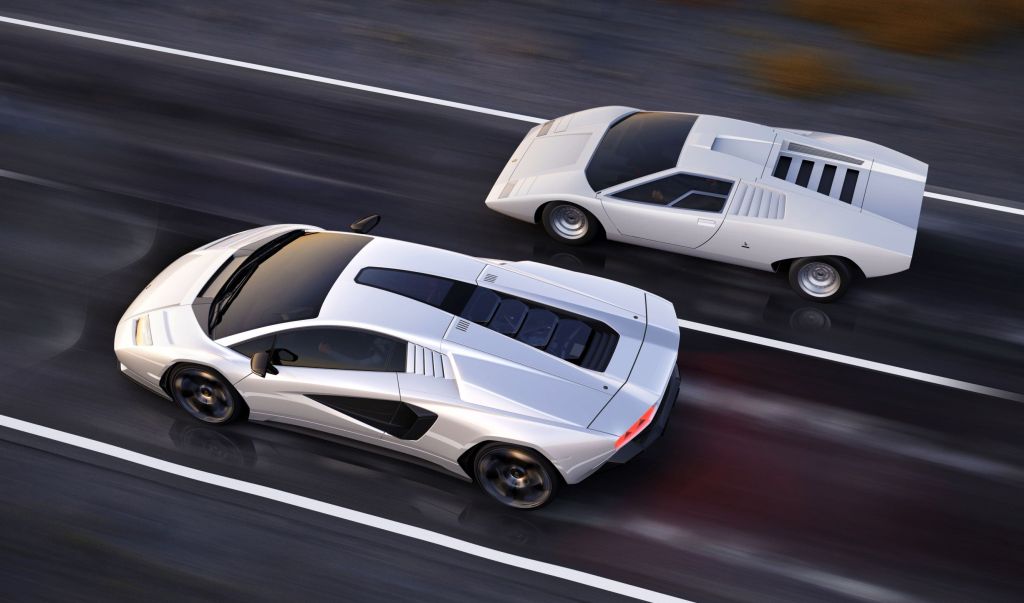
The first Countach—pronounced “Coon-tach,” according to Lambo; it is an expression of surprise and wonder in the Piedmontese dialect—had its run between 1974 and 1990.

Lambo has introduced a new version of the supersports car, the LPI 800-4.

Lamborghini Countach now (front) and then (rear). (Image: Lamborghini)

From the design point of view, there is the well known inverted wedge shape.

In addition to which:

  • The face of the new car is inspired by the Quattrovalvole edition, including a long, low rectangular grille and headlights and hexagonal wheel arches
  • The sharp fall of the greenhouse pickup the straight lines of the original Countach
  • There are the classic Periscopio lines that run from the roof to the rear of the car

Odds are you’re not going to see the LPI 800-4 in all of its carbon fiber glory.

There will be 112 built.

But you probably didn’t have $2.6-million on hand to buy a car, anyway.

Charging EVs With Green Energy

An invention that could make more people use environmentally benign charging for their electric vehicles

By Gary S. Vasilash

While some people buy electric vehicles because they are fashionable or because they like the performance or because they detest the smell of gasoline and beef jerky, some other people buy EVs because they are environmentally sensitive and have read studies or heard that guy in a Starbucks holding forth about how EVs are better for the environment than combustion cars.

While that is true—or so the studies and the guy in Starbucks seem to indicate—there is also an issue that these people need to take into account, which is that a lot of electricity is generated by activities like burning coal. Again, while in the long run the EV—even with the sketchy source of power—is better for the environment, there is better. . .and there is better.

And Jim Bardia of Change Wind Corp. has the proverbial better idea.

It is generating electricity for electric vehicles with wind and/or solar power.

While that in itself is not unique, the approach he is taking certainly is.

(The name of his unit isn’t particularly exceptional, however: Wind & Solar Powered Tower.)

He has designed a wind mill that, unlike the pinwheel style we’re all familiar with from charming postcards from Holland or those unsightly windfarms outside of Palm Springs, are axially oriented: think of a can with sections cut out that is centered on a post stuck in the ground that spins when the wind blows. More: the top of the setup is covered with photovoltaic cells that catch the sun. The post is hollow so all of the collected energy is sent down to the equipment at the bottom (including battery storage) that allows electric vehicle charging.

(OK: if you’re thinking about a can on a stick that somehow was engineered to generate electricity, that would be a scale that might work with a Hot Wheels car. Barida is talking about something that is, well, massive, for grown-up vehicles, as in generating 52.2 kW per hour and being capable of an output of 480-volt DC fast charging.)

In this arrangement the devices can be located in parking lots of everything from car dealerships to shopping malls to football stadia.

While it doesn’t necessarily need to be connected to the “grid” (which, as many people have learned this summer, isn’t exactly the most robust of things), Bardia says that it is beneficial to connect to it because excess power can be sold back to the utilities.

Bardia talks about this clever idea on this edition of “Autoline After Hours” with “Autoline’s” John McElroy, Chris Paukert of Roadshow by CNET, and me.

And Paukert, McElroy and I talk about a number of other issues, including whether Geely is one of the most interesting vehicle companies in the world, the Biden plan for 50% EVs by 2030 and the EPA regs that may make >30% EVs by 2030 a necessity for OEMs, and a whole lot more.

All of which you can see here.

A Valkyrie Variant

Aston Martin develops a clever top for its screamingly fast model

By Gary S. Vasilash

First there was the Aston Martin Valkyrie. Now there is the Aston Martin Valkyrie Spider.

What changed?

Well, the top.

The 1,139-hp (!) hybrid V12 powertrain is in both.

The carbon fiber structure is the same—nearly.

But the Spider has a different roof—entirely.

Valkyrie Spider: Gorgeous. (Image: Aston Martin)

The roof has a carbon fiber central panel that is flanked by polycarbonate windows, which are hinged. The panel hoods to the windshield surround in the front and to the vehicle tub—modified for the topless version—at the rear. Also, the dihedral doors, front hinged, are different on the Spider compared with the non-arachnid version, so as to facilitate roof removal.

This is unusual: Aston Martin Chief Executive Officer, Tobias Moers said: “The sound of that 6.5-litre V12 engine revving to over 11,000 rpm with the roof removed is something I cannot wait to hear.”

Wouldn’t you imagine that the guy who runs the company would have heard it long before it was made public?

Incidentally: the company plans to produce 85 Valkyrie Spiders, all of which are spoken for.

Missed your moment.

Rivian’s Second Factory

And what about its first?

By Gary S. Vasilash

Word is that Rivian, the company that will be producing an electric pickup—the R1T—and an SUV—the R1S—at its factory in Normal, Illinois (quite a name for a burg, if there ever was one), where it is also producing commercial vehicles for Amazon, which is one of its investors (as are Ford, Cox Automotive and others), is looking for a plot of land upon which to build a second factory with a 200,000-vehicle per year capacity.

Seems like the company has big aspirations.

And on the subject of big, it also seems that Texas has the inside track on the factory.

But here’s the thing: the 2.6-million square foot factory in Normal has capacity of over 200,000 vehicles.

You’d think, perhaps, that they would want to make sure that (1) they have all of the bugs worked out of the processes and (2) that they would have sufficient demand for their vehicles before looking to spend a rumored $5-billion on a second factory.

Of course, factories don’t go up overnight.

That said: Might this not be a bit premature?

About Charging the BMW iX3

It is quick. But that’s still slow

By Gary S. Vasilash

According to information about the new BMW iX3 (the UK version) we learn such things as the fact that there are 188 prismatic cells in the battery that have a gravimetric energy density that’s about 20% higher than that of the previous pack.

The new BMW iX3 has range on the order of 280 miles. (Image: BMW)

There is BMW’s fifth-generation eDrive technology that brings along a charging unit that provides power to both the 400V battery and the 12V on-board power supply.

As for the charging, when using AC it will permit single- and three-phase charging at up to 11 kW.

However, when plugged into a DC fast charger, it can charge at up to 150 kW. This means it can go from a 0% state of charge to 80% in 34 minutes.

There is another set of numbers that are striking. The BMW iX3 can charge the vehicle so that it can travel up to 62 miles (based on the WLTP test cycle, which is generally more generous than EPA figures) in 10 minutes.

While 10 minutes isn’t a whole lot of time, 62 miles of distance isn’t a whole lot of range.

According to the EPA, the average fuel economy for light-duty vehicles in 2020–cars, pickups, and cargo vans less than 8,500 pounds GVWR and SUVs and passenger vans up to 10,000 pounds GVWR—was 25.7 mpg.

The flow at your local gas pump (assuming you’re in the U.S.) is limited to 10 gallons per minute.  Which means that a light vehicle can get 257 miles of range in one minute.

Somehow people are going to have to get used to spending more time at a service station.

Porsche Exhibits Product Development

Yes, wrecking cars is part of the process

By Gary S. Vasilash

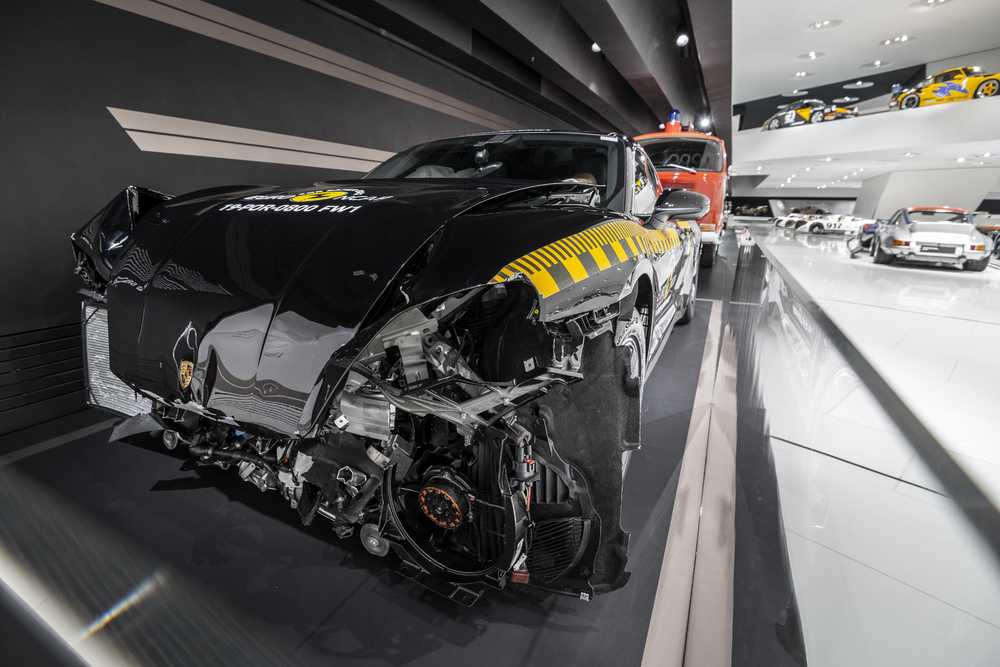
This is a picture of a Porsche Taycan after it hit—under controlled circumstances, not randomly—a barrier while it was going 50 km/h, a.k.a. 31 mph.

(Image: Porsche)

You think that slow-speed accidents aren’t a big deal?

Look at the picture and think again.

Now as you look at the picture you may notice that the setting is not some engineering facility.

Rather, it is the Porsche Museum in Zuffenhausen, where a special exhibition, “50 Years of Porsche Development at Weissach” opened today. It runs through December 5.

The objective of the exhibition is to show various aspects of how vehicles are developed, from concept through design, engineering, and so on.

Said Achim Stejskal, head of Porsche Heritage and Museum, “Sports cars for the road and thoroughbred race cars have been developed in Weissach for half a century. Dreams are designed, created and tested in the middle of idyllic countryside.”

And as that crunched Taycan shows, it is necessary to do unidyllic things during vehicle development to assure that when the vehicles are on the road or on the track the occupants have measures of protection.

Talking to Cars

A novelty, necessity or something else?

By Gary S. Vasilash

“Computer, tea, Earl Grey, hot.” So said Captain Jean-Luc Picard when he was in the need of a hot beverage on Star Trek: The Next Generation.

And the computer would orchestrate things such that he would be able to get a delicious drink.

If you think about it, it makes perfect sense for there to be a voice-activated interface on a starship, especially in the mess. After all, things like boiling water and whatnot would go on behind the scenes, anyway. Back in 1987, when the show premiered, people were using the Commodore Amiga and the 3.5-inch floppy disc had its start. Talking to a computer was certainly science fiction back then.

Now, as everyone is equipped with a computer that they keep in their pocket or purse—assuming that it is not in their hand—talking to the object is not given much of a second thought.

Of course, the device will tell you when The Next Generation aired or what the weather is. It will not provide you with a cup of tea.

I thought about the novelty of talking to an inanimate object when seeing a television ad for the Volvo XC40 Recharge, an electric vehicle.

One of the features of the car is Google Assistant. In the ad, the driver says “OK Google, turn up the temperature.”

If you think about it, Picard altered the computer with “Computer,” then went to the category (tea), type (Earl Grey) and condition (hot). Today it would be “Computer a cup of hot Earl Grey,” perhaps. Far more natural language.

But there is something about the ability to have a voice activated control of an HVAC system in an SUV and ordering a drink on a starship.

When you are behind the wheel of an XC40 Recharge, the ability to adjust the temperature is not even an arm’s length away. It is a simple act. Simpler than boiling water.

It almost seems as a pointless execution of a technological capability. Yes, you can do it. But do you need to?

One could make the argument—and it is a just one—that by having the ability to use voice commands in lieu of reaching over to make an adjustment is beneficial from a safety point of view: the driver maintains control of the steering wheel with both hands. Which is an absolutely good thing.

Of course, the reality is probably closer to someone using their hand to hold a cup from Starbucks, which probably doesn’t contain tea.

Trucks Still Need Engines

While we wend our way to the future, there are still a whole lot of medium-duty trucks to be built that need. . .engines.

By Gary S. Vasilash

You might think that every automotive-related company in the world is transforming itself into something that will be related to electric vehicles. And you would be not entirely incorrect in thinking so, as the transformation seems to be like an avalanche combined with a tidal wave.

But this seems worth noting: the signing of a global framework agreement between Daimler Truck AG and Cummins Inc. related to the development and production of engines for medium-duty engines.

Not “motors.”

Engines.

(Image: Daimler)

These engines will, according to the companies, meet the Euro VII emissions standards for the vehicles that use them.

Cummins is establishing a manufacturing facility for the engines on the site of the Mercedes-Benz Mannheim, Germany, factory. This will help maintain jobs.

But this seems somewhat odd.

When the agreement was first announced in February, a release from Daimler said, in part, “Daimler anticipates the partnership with Cummins will enable Daimler to increase and accelerate its development efforts on alternative and emerging technologies, including non-diesel engines.”

So Daimler will be investing in the future tech while it will rely on Cummins to provide the tried-and-true.

Perhaps Cummins is going to take the profits from the Mannheim products and invest them in something of an electric nature.