Another Straw on the OEM’s Back

As if COVID and chip shortages aren’t enough.

By Gary S. Vasilash

According to analysis firm IHS Markit, the automotive OEMs aren’t maintaining the level of loyalty with their customers that they once did.

In fact, the firm’s data show that brand loyalty dropped to a six-year low in June.

Looked at from a year-over-year perspective, the aggregate of April, May and June 2021 has a loyalty rate of 51.6% compared to 54% during the same period in 2020.

However, the type of vehicle that a person picks is something to which loyalty remains strong, reaching 55.5%.

In other words, if you have a Ford pickup truck and were out there in April/May/June for a new vehicle, there is a likelihood that you bought a pickup truck—not necessarily a Ford.

Or as IHS’s Tom Libby, associate director of loyalty and industry analysis, put it, “Households with a pickup in the garage like the concept of a pickup, and therefore will acquire another one.

“But their likelihood of their staying loyal to the brand of their pickup has diminished.”

One of the explanations that IHS has is that because of the chip shortage there are few vehicles on dealer lots. So if the theoretical shopper went out to a local Ford store for a new pickup and failed to discover anything that met their wants/needs, it very well may be that they’d go to a Ram or Chevy store, something that used to be uncharacteristic.

While the chip shortage undoubtedly plays a non-trivial role in this, there is another consideration: some buyers are simply more willing to try things that they may not have a few years ago.

Consider this the Amazon Effect: You put “wiper blades” into its search bar and it brings back some 8,000 results, brands you may have never heard of. So you try something new. It works. Then you search for something else. Again, lots of results. Maybe you’ve always only used Crest, but Colgate is something you’ve heard of, so you try it.

While this is not to say that a pickup truck and a tube of toothpaste are analogous, it is to say that if you can’t get the features you want on that Ford pickup that you can on the Chevy or Ram, there may be more willingness to take the option, especially as those are brands with which you’re familiar.

This doesn’t mean that brand loyalty is something that will disappear.

It is to suggest, however, that this is going to be an even-greater challenge for incumbent companies and challenger brands.
Safer Is Better

Technologies that are beneficial when you’re behind the wheel or simply a rider

By Gary S. Vasilash

One of the factors of an electric vehicle that is often overlooked—unless you happen to be a first responder—is that when there is an accident and the vehicle needs to be quickly accessed, said vehicle can be “hot”—not (necessarily) a battery fire—but as regards the electrical current that is running through the vehicle.

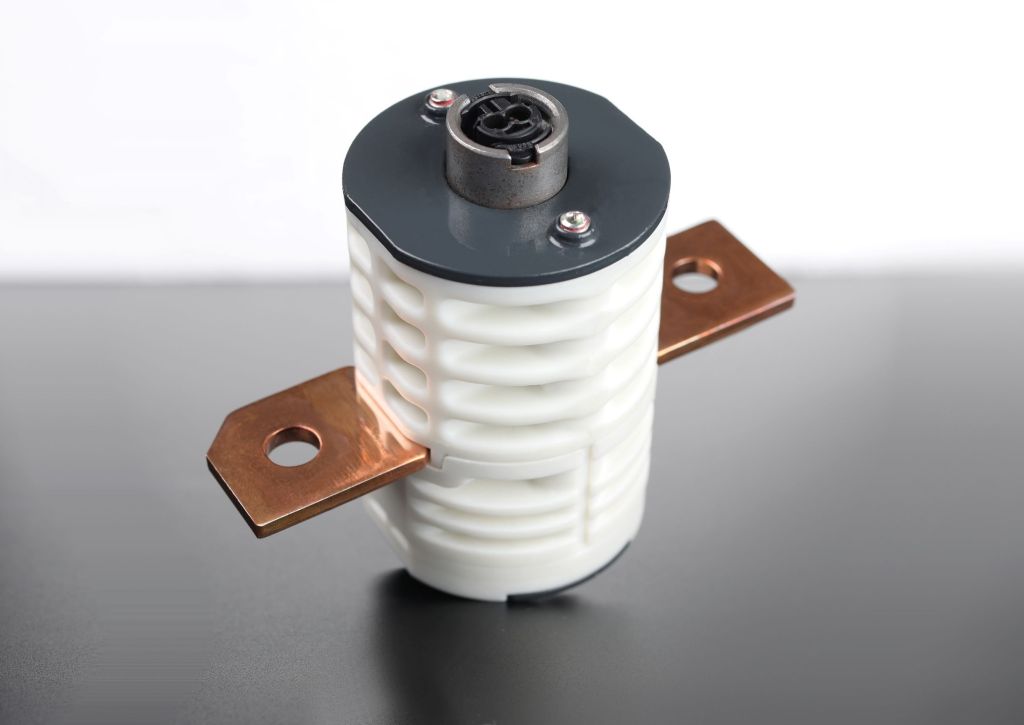
Device is pyrotechnically actuated to severe the high-voltage line in an EV should there be an accident. (Image: Joyson Safety Systems)

So to address this potential hazard, Joyson Safety Systems developed a pyrotechnic device that is triggered by a vehicle’s ECU in the event of an accident and cuts the electric high voltage connection within a matter of milliseconds.

This is just one of the clever products that has been developed by Joyson. Some of these devices are in use on vehicles right now (e.g., Tesla put that high voltage electric line cutter into vehicles in 2017; the system that monitors whether a driver is paying attention when GM’s Super Cruise is activated is a Joyson development, as well).

So to discuss these and other developments, on this edition of “Autoline After Hours” we are joined by Jason Lisseman, vice president, Global Product Line, Integrated Safety Systems, Joyson Safety Systems. Lisseman talks with “Autoline’s” John McElroy, Bengt Halvorson of Green Car Reports, and me.

One of the more interesting—and unusual, though absolutely useful—developments Lisseman describes is a sensor that detects and classifies the air quality within a vehicle.  As he explains, as there are shared, autonomous vehicles, it may be that whomever was in the vehicle before you was rather, um, fragrant, and so having a sensor that will be able to make a determination that the interior is odiferous and need some attention before other passengers climb in can make a big difference.

In addition, McElroy, Halvorson and I discuss a variety of other issues, including the GM battery problem with the Bolts, public charging issues and much more.

Which you can see right here.

About the British Car Build in July

Things are not going as planned. . .

By Gary S. Vasilash

According to the Society of Motor Manufacturers and Traders (SMMT), the British automotive trade association, this past July the UK vehicle production number was 53,438.

In July 2020—when the pandemic was still shockingly smacking every economy everywhere—the number of vehicles produced was 85,696.

Which means that production has declined 37.6%.

Now maybe it was just something to do with the month of July.

SMMT points to the shortage of chips. The contact tracing system that is in place in the UK (leading to many people getting alerts on their phones about contact, something called the “pingdemic”), and some companies just shutting down for a break to accommodate supply change changes.

The good news in all of this is that the production numbers year-to-date in 2021 are 18.3% higher than they were in 2020.

That said, it is clear that there are still challenges being faced in the UK auto industry, which, according to the SMMT, accounts for 12.8% of all UK exports and directly employs some 168,00 people.

Which means it is non-trivially important to the overall UK economy.

A Green Car in “Nightshade”

When a car known for environmentally friendliness wants to have a bad-ass look, too

By Gary S. Vasilash

One of the things that the people at Dodge are absolute masters of is taking their existing vehicles and then rolling out “special editions” of them. Chargers and Challengers keep gaining variants while fundamentally staying what they’ve long been.

But that isn’t the only brand in the game.

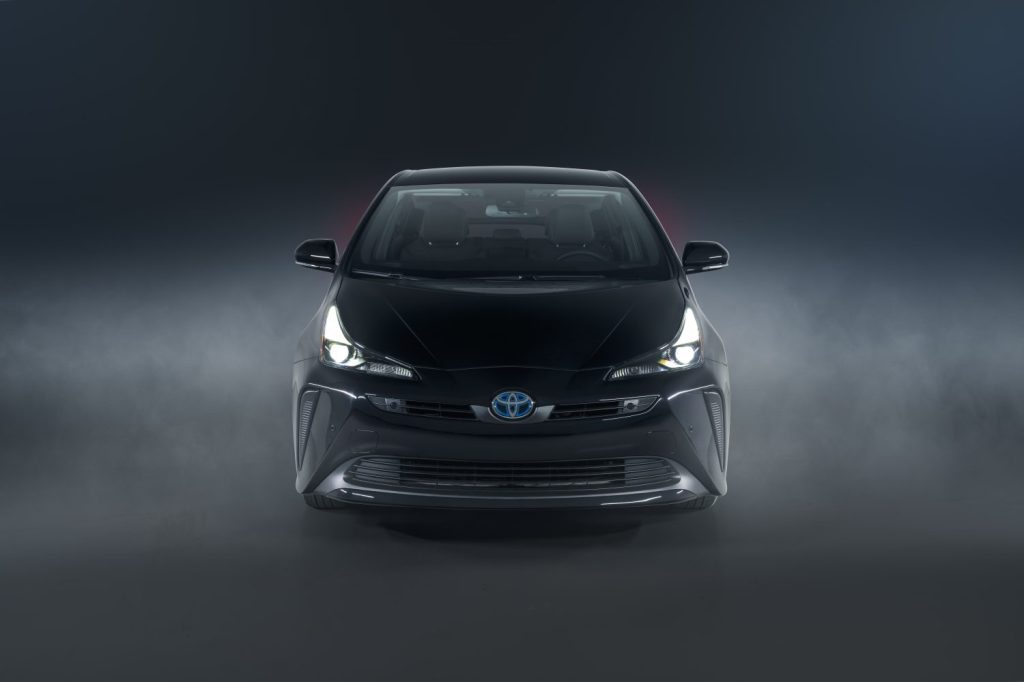
2022 Toyota Prius Nightshade edition. (Image: Toyota)

Toyota is offering “Nightshade” special editions. And the latest to get the treatment is the 2022 Prius.

Although one might imagine that a “Nightshade” vehicle would be black, and while there is Midnight Black Metallic paint available, there are two other colors: Super White and Silver Metallic. So two out of three aren’t black.

But there are black headlight accents, mirror caps, door handles, and the shark-fin antenna is also black.

For the FWD model there are black 17-inch alloys, 15-inch alloys for the AWD model. There are black lug nuts.

This is the fourth generation Prius since the hybrid was launched back in 1997.

While it has the reputation of being the synonym of “green,” evidently Toyota hopes that other colors resonate in the market.

Mazda: Looks Aren’t Everything

The MX-30 EV has a problem, and that is how it is engineered

By Gary S. Vasilash

When it comes to vehicle styling, Mazda is a stand-out company. It is remarkable how the company has consistently brought out vehicles with the sheet metal shaped and formed in ways that would only be in the “concept car” category for other OEMs, and even then they might hesitate.

And Mazda has kept the Miata (which is officially known as the “MX-5,” but even though that’s been the case for some years, it will always be the Miata) in production when those people wearing the proverbial green eyeshades would have struck it from the list of offerings a long, long time ago.

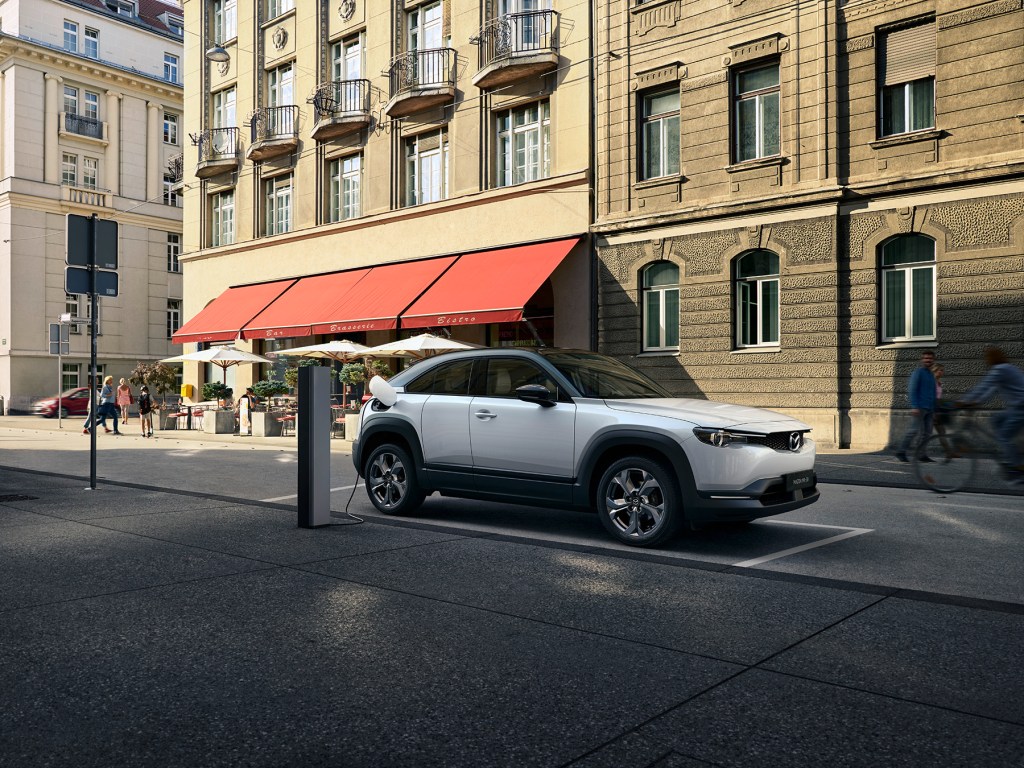
2022 Mazda MX-30 EV: Looks good. Doesn’t go far. (Image: Mazda)

That Mazda has continued is a testament to what could be called “pluckiness.”

And the auto industry is a better place for it.

Which brings me to the forthcoming 2022 Mazda MX-30 EV.

And why I think it is going to be, well, let’s just say not particularly successful.

Yes, it is a crossover, which is good in the market.

Yes, it continues with the Kodo design language, evolved, which is good for everyone who looks at vehicles.

Yes, it probably has a great interior, as this has been something that Mazda has been consistently brining to market. (Apparently the interior of the MX-30 features cork, a nod to the company’s founding more than a century ago as a cork manufacturer.)

Yes. Yes. Yes.

But.

It has an EPA estimated range of 100 miles.

That is absolutely insufficient.

Mazda evidently knows that because for owners of the MX-30 (and know that the vehicle will be available in California, not other markets) there is what it is calling the “Mazda MX-30 Elite Access Loaner Program,” which provides access to other Mazda vehicles—all of which have a >100-mile range—for up to 10 days per year for three years.

The base MSRP is $33,470. And just 100 miles?

Beyond the Bolt Battery Problem

Yes, it is an issue right now, but it has serious ramifications going forward

By Gary S. Vasilash

The facts of the situation is that General Motors is recalling all of the Chevrolet Bolts that the company has ever built. About 142,000. “Out of an abundance of caution.” There is a manufacturing defect in the batteries that could lead to fires. The batteries are produced for GM by LG Energy Solution.

GM is going to replace the batteries in the vehicles.

All in, the price is going to be on the order of $1.8-billion.

2022 Chevrolet Bolt EV connected to a DC fast charger during the final stage of production at the General Motors Orion Assembly Plant. (Photo by Steve Fecht for Chevrolet)

GM and LG are currently building two battery plants. But these plants are for a different type of battery—“Ultium” is the brand name—than the type of battery found in the Bolt EV and Bolt EUV. It doesn’t have a brand name.

The new GM EVs—which aren’t out yet—will  have the Ultium batteries, not the type found in the Bolt.

This doesn’t mean that there aren’t potential problems with the Ultium battery somewhere down the road. But it does mean that there aren’t issues for those new vehicles—e.g., Cadillac Lyriq, HUMMER EV—right out of the box.

What could be a real problem for GM—no matter how well the recall is handled—is that of the perception of potential consumers.

There needs to be a sell of the whole idea of an EV. This is not easy. Everyone driving today is at least passingly familiar with pulling into a gas station. But charging is something else entirely. First of all, everyone (I know I am using this broad brush broadly, but let’s face it: we live in a transportation environment that is predicated on petroleum) knows where gas stations are. How many people know where charging stations are? (Yes, most haven’t had a need to look for them, but I have, and they aren’t easy to find, even if you know where they are.) So some people are going to be off-put by that. And there are issues like the comfort of plugging in, and the time required to charge a vehicle. (“What if it is raining?”)

These are real challenges. Non-trivial challenges.

GM now has a group of people who are going to be all the more trepidatious to get an EV that it needs to convince to buy EVs. GM wants the EV to be a mass-market vehicle, not something driven just by the rich or enthusiastic.

All OEMs—with the probable exclusion of Tesla—are pretty much faced with the challenge of convincing people about buying EVs.

GM now has a particular problem as a result of this recall.

Mobility in Michigan

The auto industry is changing. And Michigan is doing so right along with it

By Gary S. Vasilash

To be sure, the world is chasing advanced mobility solutions, things that will include cars and trucks as we know them—more or less—as well as other modes of transportation, be they electric scooters or air taxis.

Of the places in the world where this is probably focused on more than almost anywhere else is Michigan, given that the southeastern part of the state is where cars and trucks as we know them originally emerged in sufficient numbers that, well, we know them. (While Henry Ford didn’t “invent” the automobile nor the truck, what he did do was create a system whereby those things became accessible to regular people: manufacturing operations may not be the sexiest of things, that’s how Ford, as the phrase has it, “put the world on wheels.”)

Detroit Smart Parking Lab (Image: Ford)

Certainly there are other places where mobility is of intense interest, whether it is Silicon Valley or Stuttgart.

So the state of Michigan appointed its first chief mobility officer, Trevor Pawl. And we have him on this edition of “Autoline After Hours.”

Pawl’s undertakings in this position are wide ranging.

For example, the State announced it is working with Ford, Bedrock and Bosch to launch what is described as “the nation’s first-of-its-kind, real-world test site for emerging parking technology.” Yes, parking. It is the “Detroit Smart Parking Lab.”

About a year ago the state announced that it would be building what is described as “a first-in-the-nation connected and autonomous vehicle corridor” between Detroit and Ann Arbor, again working with a number of partners (including Ford—that company is serious about the future of transportation).

And Pawl and his team are working on the ways and means to get seniors and the disabled to where they need to go. They are working on the build-out of charging infrastructure.

And a whole lot more.

Pawl talks with “Autoline’s” John McElroy, automotive analyst Stephanie Brinley of IHS Markit, and me on the show.

And you can see it all here.

Chevrolet Measures Back-to-School Driving Concerns

And when you enter a school zone, slow the hell down

By Gary S. Vasilash

You may have noticed that Chevy ads of late are focusing on how their new vehicles can help keep kids safe.

So as to underscore that with some data, Chevrolet contracted the Harris Poll to survey 1,204 adults who have at least one child from 3 to 18 about their concerns vis-à-vis their offspring and driving, which is likely to be more prevalent this year as many kids will actually be going back to school in person rather than via Zoom.

The survey shows that 68% of the adults think that getting back on the road this year every day is a troubling concern.

One of the issues: 61% say that their teen driver had less time behind the wheel last year and therefore the driving skills may be less than what regular practice could provide.

And then there is the issue of other drivers.

Seventy-eight percent of parents say that other drivers seem more unsafe than they were before the pandemic. Perhaps they lost practice time, too.

And 73% say that there seem to be more aggravated drivers on the road now than there were pre-pandemic, which is certainly a non-trivial issue.

Let’s face it: there is nothing funny about an agitated person who is rusty in their skills piloting a two-ton object at speed.

Drive safely.

Regardless of what you’re driving, physics are physics and accidents do happen—with incredibly unfortunate consequences ensuing.

The EV Infrastructure Issue

Yes, people like fast and free. How do you build a business case on that?

By Gary S. Vasilash

“Public charging infrastructure is a key component in the overall adoption of electric vehicles by the broad population.

“Unfortunately, the availability of public charging is the least satisfying aspect of owning an EV. Owners are reasonably happy in situations where public charging is free, doesn’t require a wait and the location offers other things to do—but that represents a best-case scenario.

“The industry needs to make significant investment in public charging to assure a level of convenience and satisfaction that will lure potentially skeptical consumers to EVs.”–Brent Gruber, senior director of global automotive at J.D. Power.

J.D. Power has launched its first U.S. Electric Vehicle Experience (EVX) Public Charging Study, so Gruber’s observations are predicated on the responses of actual battery electric vehicles and plug-in hybrids.

Think about this:

  • People like free
  • People like fast
  • People like distractions

If energy providers are going to increase the speeds of charging, then this means they’re going to need to spend more money on their equipment.

So free and fast seem to be at odds.

And let’s face it: there is only so long that any business that wants to stay in business is going to be able to offer something for nothing.

As for the distractions, that goes to the point of the amount of time that it takes to recharge an EV.

Again, if the speed goes up, then the need for much in the way of distractions goes down.

(At a local bp station there are video screens on the pumps that play canned content that are high on the annoyance scale and subtractive on the info scale. Thank goodness it takes a brief period of time to recharge.)

Gruber noted: “Building a better infrastructure starts with more collaboration among automakers, charge point operators, site locations, utilities and government at all levels.”

All of which is to say that in order to get more EVs in more garages it is going to take more than having features that allow a vehicle to go incredibly fast or to maneuver like a crustacean.

Auto: High/Low

Better (1) have lots of cash—or credit—and (2) be flexible in your vehicle choice

By Gary S. Vasilash

According to Kelley Blue Book automobile prices hit an all-time high in July—and affordability hit a 10-year low.

Here’s a number that is undoubtedly making OEMs and dealers happy and consumers not:

42,736

Stick a $ in front of that and that’s the average transaction price—a.k.a., what people actually pay—for a new vehicle.

This, according to KBB, is $3,223 more than it was one year ago and $402 more than in June 2021.

What’s more, incentives are down, therefore accounting, in part, for the decline in profitability.

That is, in July 2021 the average incentive was 5.9% of the average transaction price. In July 2020 it was 10.1%.

And while probably not as crazy as things are in residential real estate, it is a bit of a surprise to learn that the average price paid was above the manufacturers’ suggested retail price.

You read that right: people paid more than MSRP.

Another factor that plays into this price rise is the lack of inventory. While the last time you went out for a new vehicle the dealer lot was probably jammed with new vehicles, nowadays it has the look of a church parking lot on a Monday.