Q1 Sales Surprises

Yes, customers are back. But some of what they’re buying is surprising.

By Gary S. Vasilash

Although it was April Fool’s Day when the first quarter 2021 numbers for U.S. sales were announced by OEMs, the smiles were real in offices across the land as the SAAR (seasonally adjusted annual rate) rose to approximately 16.5-million units, or about a 12% sales increase compared to Q1 2020, which, of course, contained the first month of the pandemic in America.
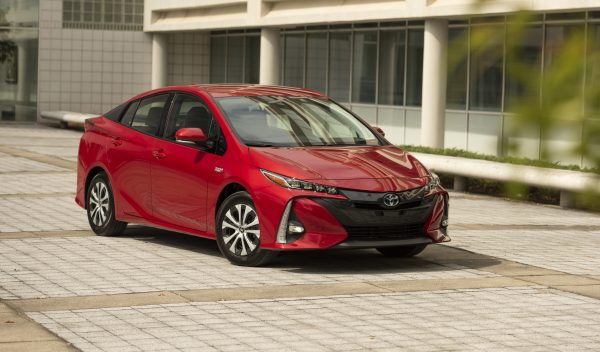
2021 Toyota Prius Prime. There was a 70.6% sales increase for the model in Q1 2021. Who saw that coming? (Image: Toyota)

This wasn’t supposed to happen

Plenty of people who seem to have a particular affection for liking the use of fossil fuel and has therefore been gloating over the fact that Toyota Prius sales have been dropping must have gotten a surprise. Despite that fact gasoline prices have been low for the past several months and still under $3.00 per gallon ($2.85 in the U.S. as of now, according to the Energy Information Agency), Prius sales rose 22.4% in Q1, to 14,050 units. (For a not apples-to-apples comparison: Chevy sold 7,089 Camaros during Q1.)

What is more striking is that all Toyota hybrids had a combined 152% increase, to 125,318 units. (“Thank you, RAV4,” they must be saying down in Plano.)

***

The Big Three?

Remember when that was General Motors, Ford and Chrysler?

GM is still big. Overall sales of 642,250 vehicles.

The other Two, however:

Ford, including Lincoln, had sales of 521,334.

FCA, including Chrysler, Jeep, Dodge, Fiat, Alfa Romeo, had sales of 469,651.

Toyota, including Lexus, 603,066. That’s a lot more than either Ford or FCA.

***

This wasn’t supposed to happen, 2

Everyone knows that (1) sedans are nearly dead in the market and (2) economical vehicles are so 2010.

Nissan, including Infiniti, had a good first quarter, with overall sales of 285,553 vehicles, which is a 10.8% increase over Q1 2020.

But there are two absolute standout vehicles in the Nissan lineup:

  • Versa: 22,394 vehicles, or an 83.9% increase
  • Sentra: 37,238 vehicles, or a 55.9% increase

Admittedly, crossovers like the Kicks (24,421 units) and the Rogue (86,720) were big contributors, the fact that the Versa and the Sentra did so well ought to make some analysts reconsider that whole “Cars are on life support” position.

***

This puts March 21 vs. March 20 in perspective

In March 2020 Hyundai delivered 35,118 vehicles.

In March 2021 Hyundai delivered 75,403 vehicles.

That is a 115% increase.

Still: Wear a mask.
Made You Look, Didn’t I?

There are jokes. And things that fall flat. And things that have consequences. And something in between. Which isn’t particularly good.

By Gary S. Vasilash

“You’ve got a spider on your head!”

“Taylor Swift is on the phone.”

“There’s a unicorn in the backyard—come see, quick!”

Today in the U.S. people of all ages are saying things like that. It is April Fool’s Day.

Are those characteristics supposed to be a joke, too? (Image: Volkswagen of America)

For the past several years automotive companies have been participating in pranks. They distribute news releases on April 1 describing things from flying cars to flux capacitors.

The more plausible, the more funny they tend to be.

Earlier this week, on Monday, there was a “leak” that Volkswagen of America was going to change its name to “Voltswagen of America.”

Reporters contacted sources that substantiated that yes, VoA was going to be doing that. The rationale was that it really wanted to emphasize that it is going to be an all-electric brand.

Right now VoA has one electric vehicle, the ID.4.

On Tuesday, the company sent out a news release with the headline:

Voltswagen: A new name for a new era of e-Mobility

The opening sentence: “Today, Volkswagen Group of America, is unveiling the official change of its U.S. brand name from Volkswagen of America to Voltswagen of America.”

There was a link to the company’s media webpage.

(Those of a grammatical bent might have thought there was something awry because of that second comma, which shouldn’t be there.)

The dateline on that release: “Herndon, VA, March 30, 2021.”

Herndon is where VoA is headquartered.

Now the company is claiming that this is all an April Fool’s joke.

Let’s see:

–April Fool’s Day: April 1, 2021

–VW press release: March 30

–VW denial: March 31; the press release was scrubbed from the site

If it is a joke, then it wasn’t very well executed.

If you told your significant other, who was going to be leaving for an important meeting, that their car had a flat tire and then said “April Fool’s!” when it was March 30, you probably would be spending that night on the couch.

There are those who say that this isn’t a big deal, that it is simply something along the lines of P.T. Barnum’s “I don’t care what the newspapers say about me as long as they spell my name right.”

But in this case, the name wasn’t being spelled correctly.

The people trying to minimize this say that “regular people,” not those who are obsessed with the auto industry, probably don’t pay much attention to this.

I would suggest that this story had national attention and while it didn’t shake anyone to their core, “regular people” heard “Volkswagen” and words associated with denial and retraction.

Maybe the last time they heard the word “Volkswagen” on their local news “diesel” was linked to it.

VW’s market share in the U.S. is small. The company, which is #1 or #2 in Europe, depending on the month, is way down the list in the U.S. market.

The people in Wolfsburg are probably quite frustrated at this.

VW is going electric in a big way. So far that big way is in Europe and China.

In the U.S., not yet.

But this whole thing has done nothing to improve its reputation in this market.

And that’s the problem. They need to get people into dealerships to buy vehicles to increase their market share. One of the ways they could do this is by selling more EVs.

I’ve driven the ID.4 and I think it is a very good car, something that could make “regular people” go to an EV.

But if those regular people are skeptical about VW and are interested in an EV (and let’s face it: there aren’t a whole lot of them right now), they could conceivably go to their local Ford or Chevy dealer for a Mach-E or Bolt EUV.

Right now I am test driving a 2021 VW Golf GTI 2.0T Autobahn and think that it is the best car that I’ve had the opportunity to be in during the first quarter of 2021: Inside, outside and under the hood, this is what seems to me to be a well-executed machine that is the definition of affordable German engineering. A superb car.

It would be a shame if people stay away from VW vehicles because they think there is something foolish about the company.

P.T. Barnum also allegedly said, “There’s no such thing as bad publicity.”

Yes there is.

By the way: There’s ink on your nose.*

*Ignore this after April 1.

What That Semiconductor Shortage Could Mean to You

Your phone may become far more advanced than your vehicle

By Gary S. Vasilash

Here’s something not to look forward to, according to Tom Blackie, founder and CEO of VNC Automotive, a Cambridge, UK-based car connectivity and telematics software developer for OEMs:

“Our customers are experiencing serious supply issues, with some making big long-term commitments in order to get any kind of guaranteed supply, and the implications are much higher costs.”

But here’s the dropping of the proverbial other shoe:

“This will ultimately impact consumers, who will be left with stagnated systems or, in extreme cases, retrograde technology as manufacturers and tier 1 suppliers are forced to hobble systems to work with less advanced semiconductor designs. . . . [W]e’re concerned that it will lead to a generation of cars that will become quickly incompatible with future mobile phones and connectivity technology.”

Swell.

The Lexus LF-Z Electrified Concept Revealed

What took them so long?

By Gary S. Vasilash

It was called the “Lexus Concept Reveal Show,” and the purpose of the show, such as it was,* was to introduce the LF-Z Electrified.

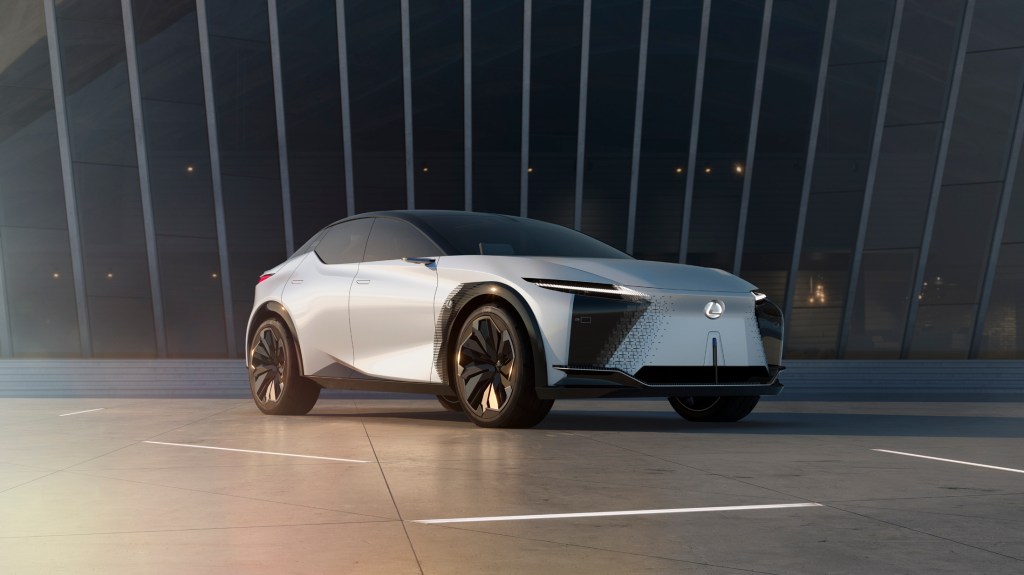
The show was about the car—a design that has the now-familiar Lexus sheet metal angularity but type-wise something of a cross between a four-door sedan and an SUV, which arguably makes it a bona-fide “crossover”—that is to come out in some form (concepts don’t always turn into production vehicles) by 2025 as part of “20 new vehicle models including BEVs, PHEVs, HEVs, and other electric vehicles.”

Well, it sort of has a spindle grille: the Lexus LF-Z Electrified. (Image: Lexus)

Heretofore the focus at Toyota—of which, of course, Lexus is a part—has been on hybrids.

And it was ahead of the rest of its competitors back in 2005 when it launched the RX 400h, a hybrid.

An interesting thing about that: Lexus was ahead with the straight-up RX, which has become a phenomenal success for the brand, out performing not only anything else in its lineup, but vehicles from its competitors. And the hybrid version was something that others didn’t have because they, to a certain extent, thought that diesel engines were the future.

Yet Lexus was there with that hybrid, then made hybrid variants of everything from its performance cars to its compact utilities.

But its full-EV–especially in the blinding-light of Tesla–was nowhere.

The details of the LF-Z Electrified are sketchy. As in “DIRECT4,” a “four-wheel driving force control technology” that sounds as if it is an approach to torque vectoring (the various wheels are controlled such that the appropriate amount of torque is distributed to each depending on conditions). It rides on a specific battery-electric vehicle (BEV) platform.

The battery is placed longitudinally and helps provide a low center of gravity, but what kind of battery it is or how big aren’t revealed.

The interior is said to be minimalist, using a new design concept, “Tazuna,” which is the Japanese word for rein, as in a rider reining in a horse. (Mazda has long used Jinba Ittai in the development of its vehicles: the combination of a rider and horse as one.)

Lexus has to come big with electric vehicles. Audi is rolling out with models right now, Mercedes is ratcheting up its output, BMW has a suite of electrified vehicles and has announced its own BEVs, and even Cadillac is going all in.

Given that Lexus was already providing electrified vehicles back in 2005 makes me wonder what’s been taking it so long.

*While this was about a car, it should not be mistaken for an “auto show,” one of those events held in a municipal convention center or fairgrounds with miles of aisles of displays of new vehicles, an event that was in the process of diminishing in importance before the pandemic. It almost seems as if those shows, where things like concepts were routinely introduced, may be giving way to things of a tightly controlled and digital nature.

Cox Automotive Looks Through a Crystal Ball

Nothing like a bit of prediction. . .

By Gary S. Vasilash

Who doesn’t like predictions? Especially after the year we’ve all just been through.

So here are six from Kayla Reynolds, Industry Intelligence Analyst at Cox Automotive, regarding the vehicle market in the U.S.

  1. Things won’t return to “normal” in 2021, even with the vaccines rolling out. Seems that social distancing and mask-wearing are going to become the way of the life. Comment: Well, at least in some geographies and demographics. Depending on where you live, you might want to bring some Clorox wipes should you be taking a test drive anytime soon.
  2. The auto industry will emerge stronger from the pandemic. Reynolds said that dealers anticipate improved profits on lower volumes. Comment: Odds are you’re not going to be seeing as many giant inflatable animals in front of dealerships because there is evidently lots of demand.
  3. Inventory will remain tight through the year. New and used vehicles are both in shorter supply—by a lot. Comment: Unless it is really something no one wants, deals are going to be few and far in between. Better get ready to spend that stimulus check.
  4. This year will be a tipping point for digital retailing. Consumers discovered that they could spend lots of time on line in preparing to buy, which meant less time being in a showroom, which was a good thing with a raging pandemic. Comment: No, Amazon Prime isn’t going to deliver your new set of wheels this year.
  5. New competition will slow Tesla’s growth. Reynolds said, “We’ve said this before, but we mean it this time.” Comment: The fact that Tesla is the only company to get its own prediction says a lot about that brand. Yes, at some point Tesla sales are likely to suffer. Some point.
  6. Vehicle ownership increases as ride-sharing and ride-hailing decrease. This is predicated on the first prediction, a consequence of the pandemic. Comment: According to the TSA, there were 1,574,228 air travelers processed on March 28, 2021. On February 28, 2021, there were 1,190,682 passengers processed.  That is a 25% increase in a month.  How long until people are fine climbing into Lyfts and Ubers? Probably a lot sooner than the Cox prognosticators think.

Inside the Volkswagen ID.4

A look at the vehicle and the strategy that Volkswagen has for this important electric vehicle

By Gary S. Vasilash

Even though the Volkswagen ID.4 is only now beginning to roll out on American roads (as well as on German autobahns, which one would have imagined would have happened sooner, as the vehicles are built in a plant in Zwickau), people at Volkswagen were evidently certain of the likely success of the electric vehicle as on November 19, 2019, there was a ground breaking for a $800-million, 564,000-sq. ft. facility at the company’s Chattanooga, Tennessee, complex that will be used, in large part, to build EVs, with the ID.4 being the first.

What’s more, they’re in the process of building a plant for assembling battery packs.

Volkswagen ID.4 (Image: Volkswagen)

So to say VW has a lot riding on EVs is not a hackneyed phrase.

What’s interesting about Volkswagen in America is that it has made a decided focus on crossovers.

While there were once the Touareg and Tiguan Limited, it wasn’t as though either of them made much of a dent in the ute market. The Touareg was described as being “the people’s premium SUV” and the Tiguan Limited was, well, limited in its appeal. MY 2017 was the final for both of the vehicles in the U.S.

But VW has subsequently come out with a new Tiguan, the Atlas, the Atlas Cross Sport and the soon-to-arrive Taos. And the ID.4 is also positioned in the utility space.

In 2020 VW sold 325,784 vehicles in the U.S. While it is down 10% from 2019, arguably because of the pandemic, even 2019’s 363,322 units was nothing to necessarily celebrate, especially when you consider, for example, that in 2020 Toyota delivered 430,387 RAV4s. In other words, one vehicle sold nearly 105,000 more units than the entire Volkswagen lineup.

Be that as it may, the SUV lineup is fundamental to the success of VW in the U.S. market as it accounted for 58% of all VW sales in the market. The Tiguan is the only model that had 100,000+ sales in the U.S. in 2020.

So on the one hand, VW wants to sell more SUVs. On the other hand, it wants to sell more EVs. And while the ID.4 is an EV SUV, it still presents a bit of an issue for VW in that it is close to the Tiguan in terms of passenger volume, which is a metric that people pay attention to more than, say, slight differences in wheelbase (the ID.4 has a 108.9-inch wheelbase, which is 0.9 inches shorter than the Tiguan).

A man who has to deal with all of these issues is Hein Schafer, Volkswagen of America senior vice president, Product Market and Strategy.

And he explains what the company is doing regarding the ID.4 in the context of the company’s other offerings on this edition of “Autoline After Hours.”

Schafer also gives insights into features of the electric vehicle and why they are the way they are (e.g., when you climb into an ID.4 with the keyfob, you don’t need to push a button to start the vehicle: you engage the gear selector and just go; Schafer says they took that approach to make the vehicle simple to use, recognizing that people unfamiliar with EVs might have a preconceived notion that driving one is akin to an algebra class or science experiment).

Schafer talks with “Autoline’s” John McElroy, freelance journalist Sebastian Blanco, and me on the show.

Additionally, McElroy, Blanco and I discuss a variety of other subjects, including the focus other OEMs have on luxury EVs rather than something that is more mainstream like the ID.4, whether sales practices are likely to change as a result of the massive increase in on-line shopping for seemingly everything during the past year, and a whole lot more.

You can watch the show by clicking here.

Ford, HP, 3D Printing and Recycling

3D printing and recycling! In a single piece!

By Gary S. Vasilash

For some reason, 3D printing seems to be wizardly popular. This is not to say that it isn’t an exceedingly interesting way that things can be produced, even geometries that couldn’t otherwise be at all produced, but there are some processes that are simply more effective, efficient and economical, especially when it comes to things needed at automotive volumes.

Like, for example, injection molding.

Which is predicated on taking a resin that flows and injecting it into a mold, where it hardens and becomes a part.

Ford announced, “Ford and HP Collaborate to Transform 3D Waste into Auto Parts, an Industry First.”

Which it probably is.

It not like there has been such a volume of 3D printed parts being made in auto that there is a whole lot of waste that can be turned into much.

But there is some powder used in 3D printing that doesn’t become a part. There are some portions of parts (e.g., supports) that are printed then eliminated from the final part.

Ford is collecting things like that.

But there is another waste stream: SmileDirectClub, which produces more than 40,000 teeth aligners per day on its more than 60 HP 3D printers.

The waste from the various operations is being collected by a company named Lavergne, which turns them into high-quality plastic pellets.

Which are then used to injection mold fuel-line clips for the Super Duty F-250 truck by supplier ARaymond.

This is a good thing.

But somehow the tying this to the magic of 3D printing is a far reach.

The Problem With Energy

Who knew that it was as much of a concern as it is?

By Gary S. Vasilash

Seventy-three percent of Americans worry—“a great deal/fair amount” about energy availability and affordability according to Gallup.

This is up from 54% in 2020.

And what is surprising is that Republicans and Democrats are probably closer on this this concern than anything else: 77% of Republicans are uneasy about energy affordability and 73% of Democrats.

According to the Energy Information Agency, the average price of a gallon of gas in the U.S. the last week of February 2020—before the lockdown—was $2.55 per gallon.

The average price of a gallon of gas in the U.S. the last week of February 2021—when things were lifting economically from the pandemic—was $2.71 per gallon.

And this from the EIA is worth noting: “In February 2021, OPEC+ cuts, combined with supply disruptions in the United States, contributed to monthly global petroleum inventory withdrawals that EIA estimates totaled 3.7 million b/d, the largest monthly withdrawal since December 2002. The Brent crude oil futures price averaged $63/b in early March leading up to the OPEC+ meeting, and the OPEC+ announcement put further upward pressure on crude oil prices.”

Yes, OPEC+ metering out their supply and a blizzard in Texas had consequences.

Another surprising stat from Gallup: 53% think there will be “a critical energy shortage” in the next five years.

How Are Sales Doing?

Were it not for things like blizzards, probably even better

Although it seems that new vehicle sales are an unstoppable force now that more people have become bored with COVID been vaccinated, according to Cox Automotive, in February there were 2.82-million cars, trucks and utilities on dealer lots—and in January that number was 2.79-million.

Turns out that things like winter storms not only knock out power grids but keep people from showrooms.

While 2.82-million may seem like a lot, back in normal times (remember those), the number was bigger: a year ago it was 3.41-million.

That’s for new. What about used?

Well, that part of the business is evidently better. There was an unsold supply of 2.59-million units on lots at the end of February. The number was 2.66-million in January, or a 70-million-unit difference.

And the difference between now and last year is notable: 12%. There were 2.97-million used vehicles ready to go in February 2020.

Still, whether it is one of the 2.82-million or 2.59-million, there is probably a vehicle that could have your name on it.–gsv

Jeep Goes to Moab

Last year they had to give it a pass. This year, the Jeep team is back in force

There are probably few people who work in the auto industry who have more fun than those who have the opportunity to work on developing Jeeps because in addition to doing their day jobs (as in “developing Jeeps”—that are destined for a dealership near you), they also do a sponsored side hack, which has them developing vehicles that are taken to Moab, Utah, for the annual Easter Jeep Safari.

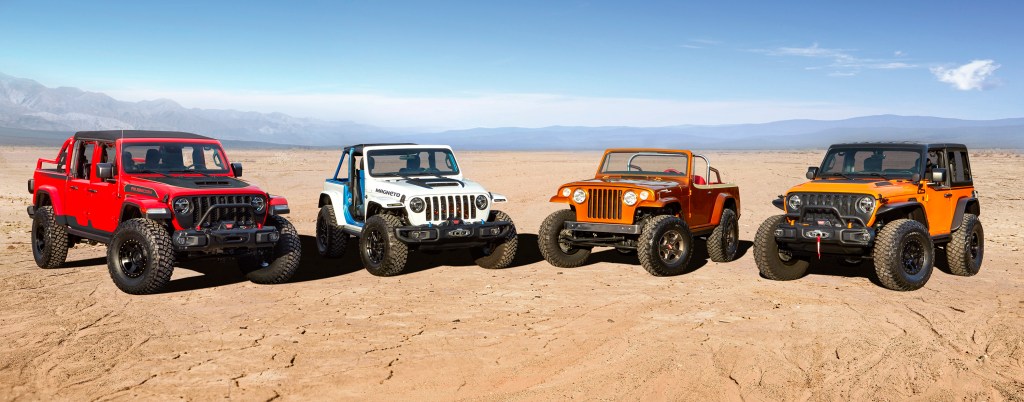
Going to Moab March 27 to April 4 from Auburn Hills are (l to r) Jeep Red Bare, Jeep Magneto, Jeepster Beach and Jeep Orange Peelz.  

(Odds are that once upon a time the vehicles that were snuck out garages and shipped to Moab were literally snuck out and cobbled together from an array of parts that these designers and engineers managed to accumulate; given the great reception that these vehicles have received from the Jeep Faithful, it is now a fully legit undertaking. Just listen to Jim Morrison, vp, Jeep Brand North America: “The Moab Easter Jeep Safari has long been our testing ground for both our newest Jeep 4x4s and for showcasing new Jeep brand concepts, Jeep Performance Parts and ideas that truly resonate with our most passionate customers — the die-hard off-road enthusiasts who attend this event every year.” The die-hard off-road enthusiasts who buy Jeeps as well as products from Jeep Performance Parts.)

While some have criticized Stellantis for being somewhat behind the curve when it comes to having electric vehicles on offer (hybrids, yes, EVs, no), for ’21 one of the vehicles for this year’s Safari is the Jeep Wrangler Magneto, not a nod to Marvel but a reference to the permanent magnet electrical generator. The motor in the Magneto is said to be equal to the output of a 3.6-liter Pentastar V6; it generates 285 hp and 273 lb-t of torque. What is unusual for an EV—though not for a Wrangler—is that it features a six-speed manual transmission. Of course it does.

Then there’s the Jeepster Beach, which started as a 1968 Jeepster Commando and was melded with a 2020 Jeep Wrangler Rubicon. Here’s a fun fact about Commandos: it was the first compact 4WD with things like roll-up windows and a roof as standard equipment. A roof. (Guess what the Jeepster Beach is shown without?)

The Red Bare Gladiator Rubicon is built for dealing with the tough terrain, with a 3.0-liter diesel, an eight-speed automatic calibrated for low-RPM shifts, and upgraded Dana 44 front and rear heavy axles. It has a 91:1 crawl ratio. If you don’t know what that means, you can know that it is impressive for those who crawl on the rocks at Moab.

And the Orange Peelz. This one has things like half doors and is without things like side and rear windows. But it does have a windshield made of Corning Gorilla Glass.

Good fun will be had by all, one suspects.