There isn’t a heck of a lot known about the Acura Integra, a sport compact with a five-door design, which will be launched next year.
One of the things that is known is that unlike the other vehicles in the Acura lineup—the ILX, TLX, RDX, and MDX—the Integra has a name. Yes, it is a made-up name, but not sequence of three letters.
1986 Integra RS–the original (Image: Acura)
The name goes back to the model introduced in 1986 and had a run until it was renamed. . .RSX in 2001.
Remember: Alphanumeric designation, with or without one or the other, was long thought to denote luxury, and Acura has been working for decades now trying to make people understand it is a luxury brand.
(Arguably, of the Japan-based company brands, only Lexus has achieved that with Infiniti and Acura trying to make their way to that category.)
The current tagline of Acura is “Precision Crafted Performance.”
The last word in that—performance—has a lot to do, no doubt, with the fact that the Integra will be offered with a six-speed manual.
Let’s face it: people who bought sport sedans in 1986 liked to slam though the gears.
But today. . .?
Yes, there is performance cred still associated with manuals. At least for some people.
According to LMC Automotive, global light vehicle sales in September 2021 were 6,229,029 units—which is down 20.3% compared with September 2020.
Think about that.
2020, which will be forever known as the year COVID hammered the world, had higher September sales than in September 2021. (Read that again.)
In the U.S. sales were comparatively down 25.1%. Canada was off 19.9%. Western and Eastern Europe down 24.2% and 20.9%, respectively. Japan down 32.2% and Korea off 30.5%. China sales were down 16.5%. Brazil/Argentina off 26.1%. And wherever Other is, that is down 11.3%.
Essentially, this all goes to the lack of microprocessor supply the world over.
Historically, it would be something like energy prices or a lack of steel driving a diminishing of sales.
But no, silicon.
Yes, the world’s auto industry is advanced, given the evident dependence on chips.
Although the folks at Lucid Group probably don’t think about Elon all that often. . .
By Gary S. Vasilash
Lucid Group, which is producing its Lucid Air electric vehicles in its brand-new plant in Casa Grande, AZ, put Tesla in second place in the range department as it got a 520-mile range rating from the EPA, and the Model S Long Range is 412 miles.
(To be sure, 412 miles is nothing to sniff at, as it is the sort of thing that most OEMs would give up an engine plant to achieve.)
And now there is another numeric–and arguably functional–difference.
Elon Musk is famously sensor thrifty, as Tesla models dependi on cameras and ultrasonic sensors (it had been using radar, but evidently that went away earlier this year). Which make the nomenclature “Full Self-Driving” and “Autopilot” all the more troubling for those who actually think about the implications of those names.
Lucid announced the details of its “DreamDrive” advanced driver assistance systems, the base and Pro versions (Pro is standard on Lucid Air Dream Edition and Lucid Air Grand Touring, so the “dream” in the name goes to the model, not some sort of suggestion that one can sleep behind the wheel).
Lucid DreamDrive sensor suite provides a comprehensive scope. (Image: Lucid)
The system can utilize as many as 32 sensors, including 14 visible-light cameras, five radar units, four surround view cameras, ultrasonic sensors throughout the vehicle exterior, and, for DreamDrive Pro, solid-state lidar.
Of course, sensors are only part of an ADAS system. Processing capability is essential.
Lucid is using its proprietary “Ethernet Ring” system, which is a high-speed data network for four computer gateways to communicate at gigabit speeds so that the processors can assure that the sensor input gets translated into the steering, braking and accelerating functions as required.
When it comes to driver assistance, the more support—and sensors—the better.
. . .because (a) you’re going to be spending more than you might think and (b) you may be buying something that you aren’t necessarily considering
By Gary S. Vasilash
If you’re thinking about buying a new car, ute or truck—and “new” may mean “new to you,” as in “used”—then you ought to hear what Charlie Chesbrough, senor economist and senior director of industry insights for Cox Automotive has to say about the current market conditions.
As Cox Automotive encompasses a variety of businesses that know more than a little something about, as they say, the conditions on the ground—as in Kelley Blue Book and Manheim Actions—Chesbrough’s observations and understanding are grounded in what’s really happening, not some theoretically calculations.
The fundamental thing is this: Although it might seem that COVID is behind us, that everything, with a few hitches here and there, is getting back to normal, that is far from being the case with regard to the availability of some things. Things like motor vehicles.
This is because COVID helped cause a semiconductor chip shortage. In part this came from everyone working or playing from home, which led to a sudden demand for PCs and PlayStations, both of which use silicon.
Because the auto companies faced shutdowns of their factories last year, they canceled their orders with the semiconductor providers, who then readily found anxious customers who were making things like PCs and PlayStations.
So the vehicle manufacturers had to go to the end of the line.
It is also worth noting that some of the chips that go into vehicles don’t have the types of margins that chips that go into other products do, so the semiconductor manufacturers realized that they’d do well by just serving the non-automotive customers fulsomely while providing the auto manufacturers—who are famously thrifty when it comes to paying suppliers—with a reduced number of chips.
This has led to two things, Chesbrough notes:
Overall reduced number of available vehicles
Overall increases in the prices being charged for vehicles—new and used
While the first part of the year seemed to be improving when it came to the availability of vehicles (relatively speaking—2020 was a horrible year for sales and 2021 was an improvement on that), things have gone south since then.
Chesbrough suggests that things won’t get back to what may be considered “normal” until sometime next year (if at all).
At present, OEMs are concentrating on putting chips in vehicles that are high-ticket items, which is good for returns, but which put many consumers in a bind (unless they are high-end buyers).
There are some companies, like Ford, which are recommending that people order vehicles, something common in Europe but not a practice that is at the basis of the auto market as it has developed in the U.S., which is all about moving the metal.
In addition to which, Naughton, White and I talk about Ford’s massive investments in electric vehicle/battery manufacturing capacity in Kentucky and Tennessee—and how Michigan didn’t even make a proposal for the investments, as well as about GM’s Investor Day presentations, which were clearly designed to make Wall Street look at GM more as a “tech company” with a wide range of product in the pipeline and technology and capacity that will make money sooner rather than later.
Who wants to spend time cooling their heels at a charging station?
By Gary S. Vasilash
Although there is something to be said for electric vehicles (as in the previous post below), one thing that is a bit of a nuisance with EVs is not the driving but the charging.
Not even the fastest fast-charger is going to stuff electrons into a battery as quickly as gasoline goes through the nozzle at your local gas station.
What’s more, there is a bit of a problem with the whole notion of fast charging in that the faster you stuff those electrons in, the more the battery is affected, and not in a good way.
One of the alternatives to a battery electric vehicle is a hydrogen fuel cell electric vehicle.
Yes, a hydrogen fuel cell vehicle is an electric vehicle, too, with the battery being replaced by a fuel cell stack and a cylinder (or two or more) of compressed hydrogen. The hydrogen goes into the stack, is turned into electricity, and that powers the motors that drive the wheels.
And refueling a hydrogen vehicle is quite analogous to pumping gasoline.
As for time:
A 2021 Toyota Mirai went to a hydrogen pump at the Toyota Technical Center in Gardena, California, on August 23, 2021.
The tank was filled. It took five minutes. The tank was sealed with a sticker by the observer from the Guinness World Records.
Toyota evp Bob Carter, a Guinness certificate and the Mirai that earned it. (Image: Toyota)
Over two days of driving the two drivers drove around SoCal under a variety of conditions (yes, including the legendary traffic jams). When they returned to the start point, they had traveled 845 miles on that single tank of hydrogen.
A tank that was filled in 5 minutes.
Admittedly, the drivers are hypermilers (Wayne Gerdes and Bob Winger). Their driving techniques are not those that most of us—not even the most diligent of us—are likely to use with any consistency.
But it underscores the fact that hydrogen can get you much further with less time spent at a station than electricity can. Even for those with a lead foot.
A huge concern in the auto industry—always and everywhere—is cost. The cost of batteries for EVs is showing an impressive decline.
By Gary S. Vasilash
One of the things about electric vehicle development that doesn’t get quite the amount of attention that it deserves is the rate at which the prices of lithium-ion battery packs are declining.
According to the US. Department of Energy Vehicle Technologies Office, the cost of a Li-ion battery pack declined 87% between 2008 and 2021, based on 2021 constant dollars.
The DOE estimates that the cost of a Li-ion battery pack circa 2021 is $157/kWh based on a usable energy basis (i.e., the battery pack may have more stored energy but it is not used because it is important to maintain the health of the battery).
Back in 2008 that number was $1,237/kWh.
Impressive decline in battery costs. (Image: DOE)
Recognize that what is happening is that there are improvements in technologies and chemistries, as well as in manufacturing economies of scale. (Did you notice that when people are talking about battery plants they typically refer to them as “gigafactories”? They’re big and make lots of batteries, which leads to the economies of scale. It is somewhat odd, if you think about it, to know that Mars makes about 15 million Snickers per day and there is no mention of a “megafactory.”)
The improvements in technologies and chemistries are probably the real, as they say, game-changer in batteries.
Realize that you have vehicle manufacturers, Tier One suppliers, battery companies, chemical companies, electronics companies, utility companies, energy suppliers, research organizations, universities, and undoubtedly others working on batteries.
Nowadays only a fraction of them are working on eking out improvements for internal combustion engines, which leads to the hypothesis that with time ICEs are going to run out of time.
That 87% is a big number. And the decline in price-performance will undoubtedly continue to change for the better.
We can’t put it any better than this, which comes from the House of Rolls-Royce about its latest addition to the Rolls-Royce Connoisseur’s Collection, the Rolls-Royce Cellarette:
The polished aluminium chassis, enveloped by embossed Rolls-Royce Havana leather complete with an Obsidian Ayous Open Pore veneer serving tray with Spirit of Ecstasy inlay, makes the Cellarette the perfect accessory for any Rolls-Royce owner with a passion for convivial hosting.
A Cellarette from Rolls-Royce. (Image: Rolls-Royce)
Said Cellarette can be fitted in the back of one’s Rolls, however the company notes that “it truly comes into its own as a centrepiece at an al fresco dining experience, or as an accompaniment at an intimate gathering.”
Cellarette?
It is something that carries bottles of whisky and holds cigars.
That’s what the Ram folks call the TRX. A bit of a dig at the Ford Raptor, of course. The TRX is being judged in Croatia.
By Gary S. Vasilash
The Ram 1500 TRX is a half-ton pickup with a 702-hp, 6.2-liter HEMI V8 under its hood.
It has a top speed of 118 mph and goes from 0 to 60 in 4.5 seconds
This is a truck.
The Ram 1500 TRX. Yes, it is a daily driver, too. (Image: Ram)
A big truck.
As in being 232.9 inches long, 88 inches wide and 80.9 inches high.
You’re not going to see that HEMI without a step ladder.
It has a 5-foot, 7-inch box on the back. You’re going to want to make sure that things in the TRX are tied down because there are those inertial forces.
Although the interior of the vehicle—both in terms of materials and tech—are nothing short of first class. Yet one of the development goals of the Ram team was to develop the “quickest, fastest and most powerful mass-produced truck in the world,” one that can handle off-road and on-road demands with solid performance.
While the truck has been available in the U.S. for about a year now, it made its way to Europe in July.
And today (October 5) it is in Croatia, where it will be judged as part of the 2022 IPUA—International Pick Up Award.
Somehow it is hard to imagine anything less European than the TRX.
Still, it is so over-the-top (and capable, too) that its odds are probably very good.
Yet it is working to maintain freshness and relevance in the market by paying attention to the market
By Gary S. Vasilash
One of the aspects of vehicle ownership that probably doesn’t receive as much attention as it ought to is the act of ownership itself.
As in purchasing the vehicle. Then the on-going owning of the vehicle.
To be sure, the product itself has to be worth acquiring. Features, functions, capabilities and the like. Style and technology.
Lincoln, which is now predicated on a lineup of SUVs, is going to be launching an electric vehicle next year and will be offering a fully electrified lineup by 2030.
Lincoln is readying the launch of the Lincoln Intelligence System, a cloud-based system that provides extensive capabilities for its vehicles, including over-the-air updates.
Lincoln will soon be launching its Lincoln ActiveGlide hands-free driving system.
And there is more.
But one of the more interesting aspects of what Lincoln has been steadily doing is providing excellent customer—it calls its purchasers “clients”—service. According to a recent J.D. Power survey, Lincoln is number-one in sales satisfaction among luxury brands.
2022 Lincoln Navigator (Image: Lincoln)
It has developed what it calls the “Lincoln Way,” which is a customer-centric approach to the buying and ownership experience, which it is initially launching in China—an important market for the brand—and then will roll out in North America.
Michael Sprague is Lincoln’s North America Director, which means he is in charge of marketing, sales and service for the marque in the U.S., Canada and Mexico.
And on this edition of “Autoline After Hours” Sprague talks to “Autoline’s” John McElroy and me about what Lincoln is doing to help increase the momentum that it is building with not only vehicles like the Navigator, but with its approach to the customer both during and after the sale.
Sprague is one of the most thoughtful and articulate people in the industry, so his observations about the brand—which will be 100 next year (at least will have been part of Ford for 100 years, since it was founded by Henry M. Leland in 1917, and he sold it to Ford in 1922. . .and it is worth noting that Leland had earlier founded another company: Cadillac)—are worthwhile for those with interest in the industry.
In addition to which, McElroy and I talk with Patrick Lindemann, president, Transmission Systems, E-Mobility, Schaeffler, and John Waraniak, CEO, Have Blue, about the Indy Autonomous Challenge, which will be run at the Indianapolis Motor Speedway on October 23.
This race will pit 10 vehicles, all Dallara AV-21s, that have been engineered by student teams from around the world, in a race with $1-million going to the winning team.
No, it will not go to the winning driver, because as the name of the race indicates, there are no drivers, this is an autonomous event.
An approach to vehicle production at a fast rate: have someone else do it
By Gary S. Vasilash
General Motors is proud because in a rapidly changing industry, it shows that it can go fast.
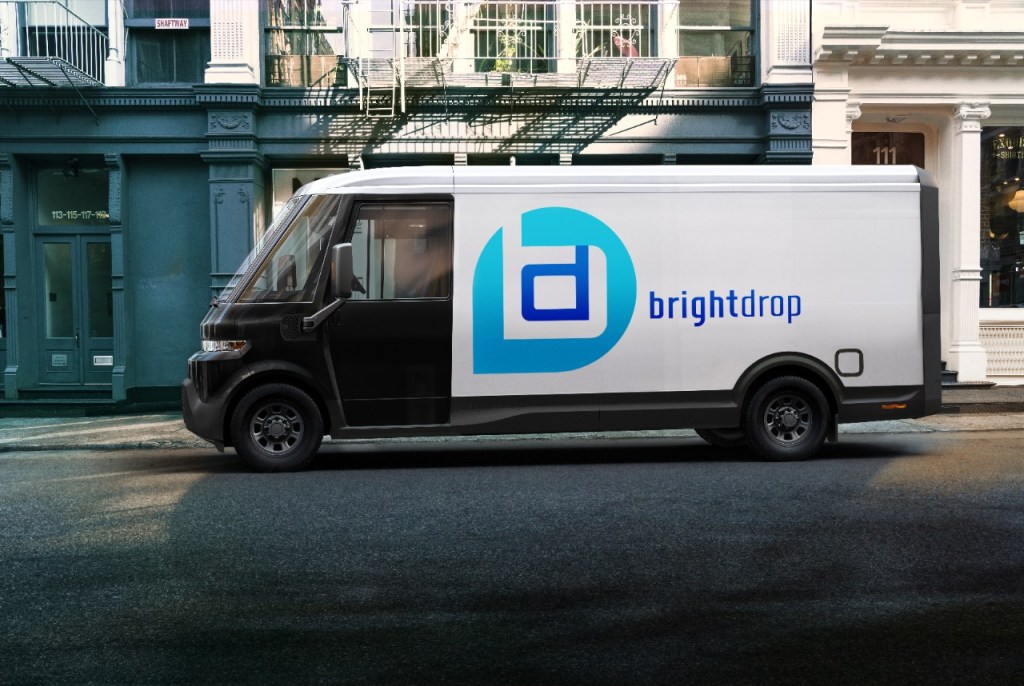
“Getting our first electric vehicles on the streets in record time before another peak holiday shipping season is the best gift we could receive this year, especially when we consider the supply chain headwinds the world is facing right now,” said Travis Katz, BrightDrop president and CEO.
BrightDrop is the GM business that is developing products—such as electric delivery truck and associated material handling equipment—for companies like FedEx Express and Verizon.
The classification is “eLCV,” for “electric light delivery commercial vehicle.”
Katz is referring to the production of the EV600.
BrightDrop EV 600 (Image :General Motors)
From concept to development in 20 months.
Speaking of the build speed, Katz continued, “This is a strong statement to the market of how our unique operations setup, which marries the cutting-edge innovation, agility and focus of a technology startup with the scale and manufacturing might of a major automaker, can deliver real value to both customers and the planet.”
An interesting aspect of this.
The early builds of the EV600 were done for General Motors by automation supplier Kuka AG.
Perhaps that is the “unique operations setup.”
To be fair, GM will be building the EV600, the EV410 and possibly other vehicles at its CAMI Assembly Plant in Ingersoll, Ontario. The plant is currently being transformed for the production.
The first EV600 is expected to go off the line at CAMI in November 2022.