Startling Projected Sales Numbers

This is what happens when there’s little supply and plenty of demand

By Gary S. Vasilash

Back in November 2020, the Centers for Disease Control determined, “The overall weekly hospitalization rate is at its highest point since the beginning of the pandemic, with steep increases in adults aged 65 years and older. Based on death certificate data, the percentage of deaths attributed to PIC for week 48 was 12.8% and, while declining compared with week 47 (18.6%), remains above the epidemic threshold.”

In other words, horrible times.

As we come forward to now, here is something that seems nearly inexplicable: J.D. Power and LMC Automotive estimate that new-vehicle retail sales in November 2021 will be 12.6% lower than they were in November 2020.

Thomas King, president of the data and analytics division of J.D. Power, explains, “For November—as has been the case since August—new-vehicle sales are being constrained by available inventory.”

Less to buy.

King continues, “Retailers continue to sell a large proportion of vehicles almost as soon as they arrive in inventory. This November, a record of nearly 55% of vehicles will be sold within 10 days of arriving at a dealership, while the average number of days a new vehicle sits on a dealer lot before being sold is on pace to fall to 19 days, a record low and down from 48 days a year ago.”

Think about that. A year ago vehicles were on lots for nearly 30 days longer than they are now.

And the people on the short end of the proverbial stick are customers. The research firms estimate that average transaction prices—the prices actually paid by people—will be $44,043, which is 18.1% higher than they were in November 2020.

As a result, the total retail profit per vehicle will hit a record $5,164, which is up $3,060 last year.

$5,164 now. $2,104 then.

And then there’s this:

Two years ago, November 2019, COVID wasn’t even on the radar of most people.

Yet the J.D.P.A. and LMC estimate that the total aggregate profit from new-vehicle sales in November 2021 will be 226% higher than in November 2019.

Keep that in mind when you visit the nearly empty lot of your local dealer. You might think they’re hurting. But that may not be the case.

Dashing Through. . .Manhattan

Santa rolls in style with Ram

By Gary S. Vasilash

When Santa arrives at his destination at Macy’s on West 34th at Herald Square, his sleigh will have traveled the 2.5-mile route down Central Park West to Columbus Circle to Central Park South then 6th Avenue to West 34th to the end, he will have been pulled not by reindeer (after all, the sleigh is earth-bound, not in the air) by a Ram 1500 Limited (RAM)RED Edition.

Propelling Santa through NYC. (Image: Ram)

That’s right: Not Rudolph, but Ram.

Ram is the Official Truck of the 95th Macy’s’ Thanksgiving Day Parade and Ram trucks will tow all of the floats, as it has done for the previous six years.

It is worth knowing that Ram Trucks, along with partner brands Jeep and FIAT, have committed a minimum of $4-million between 2021 and 2023 to the Global Fund to help fight health emergencies with (RED).

(RED), established in 2006, has funded HIV/AIDS programs. It is now expanding to help deal with the COVID 19 pandemic.

Credit to (RED). And in this case, Ram.

GM Takes to the Water

Electric vehicles don’t all have to have wheels

By Gary S. Vasilash

From 1919 to 1979 General Motors owned Frigidaire, the appliance company that made, primarily, refrigerators.

Toyota was once cracked for making “appliances.” GM once did, literally.

(The Toyota comment was related to the fact that its designs were rather innocuous, like those white rectangles that are in kitchens and laundry rooms. Of course, a positive spin would go to the point that many major appliances are often highly reliable. . . .)

GM has announced that it is taking a 25% ownership in Pure Watercraft.

Seattle-based Pure Watercraft make boats.

But not your ordinary run-of-the-lake boats but electric boats. For the sake of argument, these are not “EBs” but bona fide “EVs.”

Said Dan Nicholson, GM vice president of Global Electrification, Controls, Software and Electronics, “GM’s stake in Pure Watercraft represents another exciting opportunity to extend our zero-emissions goal beyond automotive applications.”

The company recently announced that it is working with Wabtec Corp., a locomotive builder, providing batteries and its hydrogen fuel cell technology.

So obviously they’re serious about “beyond automotive.”

If you think back to the last time you were trying to take a snooze on a beach and then a boat with a massive outboard came blasting by, the whole notion of the silent running of a battery-powered boat seems all the more understandable.

At the very least the GM investment is going to expand scale to boat electrification, which should make it more accessible to more people.

And let’s face it: GM’s involvement in watercraft makes a whole lot more sense than refrigerators.

Developing the ’22 Toyota Tundra

The inside story from the vehicle’s chief engineer

By Gary S. Vasilash

Let’s face it: Trucks have a pull on people in a way that is almost unimaginable. Who—outside of someone who either has a vocational reason (contractor, landscaper, etc.) or who has an avocation that makes a truck a necessity (putting a snowmobile in the box; having the torque and capability for pulling a trailer)—really needs a truck?

If you take a look at the numbers of trucks sold the answer to that question seems to be “Damn near everyone.”

Toyota, while not the leader in the truck sales segment by any means, has long been building things that have remarkable capabilities, like the Land Cruiser that has been going to places in the world that are simply extreme.

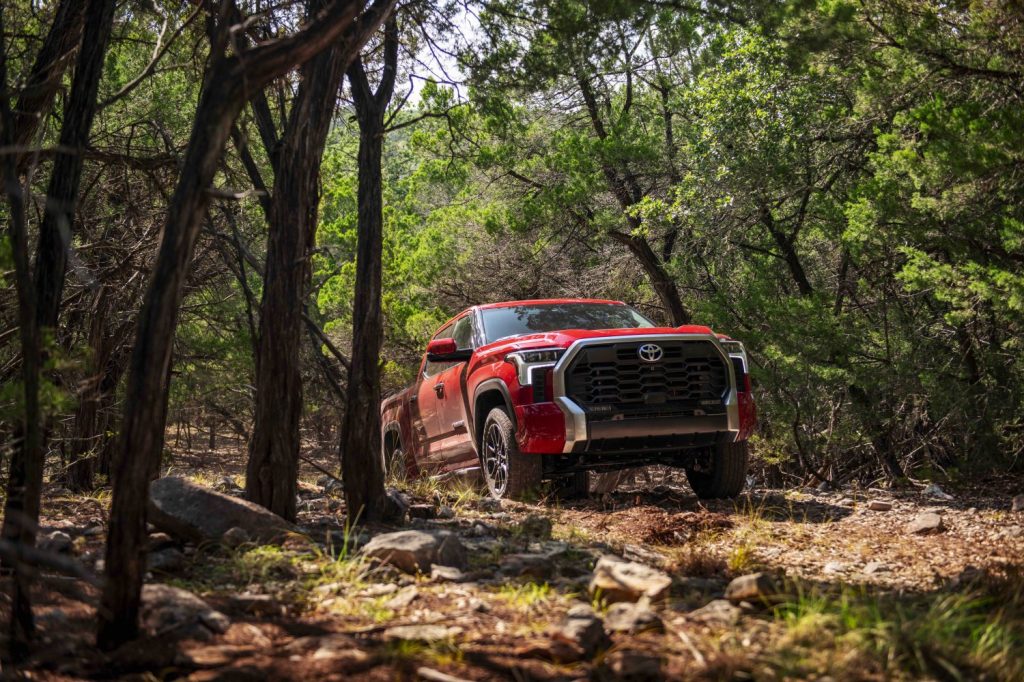
Hybrids are generally associated with fuel efficiency. An objective of the hybrid in the Tundra is not to pay tribute to the Prius, but to provide the kind of torque that truck drivers like. (Image: Toyota)

It does build the midsize Tacoma which is a leader in that segment despite the best efforts of GM and Ford. Yet GM and Ford best Toyota in the full-size truck segment (with the Silverado, Sierra and the F-150).

But Toyota continues on with the Tundra. And has just launched an all-new truck which, coincidentally enough, now shares its underpinnings with the Land Cruiser.

One could argue that neither Ford nor GM has anything that is in the Land Cruiser category, so that is something serious to be said about the 2022 Tundra.

On this edition of “Autoline After Hours” Mike Sweers, executive chief engineer in charge, among other things, of the Tundra, talks about how this new truck was developed with “Autoline’s” John McElroy, Joe DeMatio of Hagerty, and me.

Sweers is not only an engineer, but he happens to live on a small farm. Consequently, for him a truck isn’t just something he works on from the development point of view, but something that he uses in his off-hours. (Does someone who develops pickups and then uses a pickup at home ever really have off-hours?)

From how the suspension is setup so that it doesn’t “ride like a truck” to why they decided to use a composite box (e.g., it doesn’t break or corrode like aluminum and steel do) are among the topics that Sweers discusses.

And what is interesting to know is how a guy who really, really wanted a diesel (and Toyota has a new 3.3-liter diesel) discovered that a hybrid powertrain setup met his requirements for torque.

You can see it all here.

Kia Introduces Angular EV Concept

What the American family may be rolling in sometime in the not-too-distant future

The Concept EV9 is a concept EV SUV that Kia has introduced. It is a three-row vehicle that is 194 inches long, 81 inches wide, 70 inches high, and has a 122-inch wheelbase. It rides on 22-inch wheels.

Kia Concept EV9: a three-row family hauler with an EV powertrain. (Image: Kia)

While it is not clear exactly what the battery or motor are, according to Kia the Concept EV9 has a 350-kW charger that would allow the battery to go from 10 to 80% in 20 to 30 minutes. The driving range is said to be 300 miles.

The design of the vehicle is based on Kia’s “Opposites United” design language.

It seems that it might be influenced by a Ford Flex having a collision with a Tesla Cybertruck.

NACTOY Announces 2022 Finalists

There are some very, very good vehicles out there. . . .

By Gary S. Vasilash

Sitting on a plane this afternoon I was asked a question that many of my colleagues get from someone who finds out that we write about the auto industry:

“What kind of car should I buy?”

Once it was fairly easy to provide an answer, a specific make, a specific model.

And now, arguably, it has gotten somewhat easier.

My answer:

“Whatever kind of car you like.”

It is clear that with some outliers, the quality of cars, trucks and utes the are available on the market right now as really good. It would be hard to go wrong.

The game for all of the OEMs has been elevated.

There is not only attention being paid to quality but also value and features that consumers want.

The OEMs are providing vehicles that are not only things that people need to get to work or school or to run errands, but vehicles that people actually want to drive.

That as prologue, it is worth knowing that today the jurors of the North American Car, Truck and Utility of the Year (NACTOY) awards announced the finalists for the 2022 awards.

The vehicles are:

Car

  • Honda Civic
  • Lucid Air
  • Volkswagen Golf R, GTI

Truck

  • Ford Maverick
  • Hyundai Santa Cruz
  • Rivian R1T

Utility

  • Ford Bronco
  • Genesis GV70
  • Hyundai IONIQ 5

These nine vehicles were winnowed by the 50 jurors from magazines, newspapers, websites, and television and radio station from a group of 23 semifinalists.

What’s interesting is that in all three categories there are electric vehicles: the Lucid Air, the Rivian R1T, and the Hyundai IONIQ 5.

There is a compact sedan (Civic) and a set of hot hatches (the Golf R and GTI).

There is a pair of trucks that have a compact footprint (Maverick and Santa Cruz), something we haven’t seen for years.

There is a utility that is designed and engineered to take on the tough trails (Bronco) and another that have high levels of refinement (GV70).

It would be hard for a consumer to go wrong right now in the market (assuming that they can actually get a vehicle due to the supply chain issues).

It would be impossible to go wrong making a selection from that list.

(Full disclosure: I am one of the 50 jurors.)

Faraday Future Financials

Because building electric vehicles costs lots and lots of money

By Gary S. Vasilash

This doesn’t sound good:

“LOS ANGELES–(BUSINESS WIRE)–Faraday Future Intelligent Electric Inc. (“Faraday Future” or the “Company”) (NASDAQ: FFIE), a California-based global shared intelligent electric mobility ecosystem company, filed a Form 12b-25 notifying the SEC that it is unable to file its Form 10-Q for the fiscal quarter ended September 30, 2021 within the prescribed time period, and does not expect to file it by the extended filing date pursuant to Rule 12b-25. The Company is also unable to file its amended Registration Statement on Form S-1 (File No. 333-258993) (the “Form S-1/A”) at this time.”

But maybe that’s just a financial maneuver that has little to do with the actual development of the FF 91 vehicle, which the company says it “remains on track” to deliver to initial customers in July 2022.

However, the company has established a “special committee of independent directors to review allegations of inaccurate disclosures.”

Meaning financial things gone potentially awry.

The company is building a plant in Hanford, California, for the vehicle. It says that during Q3 it completed its first major milestone there, which is the installation of pilot equipment in the pre-production build area. It seems that if they’re going to be delivering production vehicles in little more than eight months, the “pilot” and “pre-production” are going to have to give way to the actual stuff.

And after Q3 it hit its second milestone, obtaining its “Certificate of Occupancy, which allows the Company to begin building additional pre-production vehicles for final testing and validation.”

The company is taking reservations for the FF 91 Futurist, which it descrbies as its “class defining, 1,050 hp and a revolutionary user experience designed to create a mobile, connected and luxurious third internet living space.”

Except for the 1,050 hp, it sounds like a cross between an Airstream and a Starbucks.

Auto Numbers: Something to Consider

The math is. . .surprising

By Gary S. Vasilash

A few numbers.

In the first three quarters of 2021, these are the U.S. sales numbers of the leading luxury brands:

  • 259,237 BMW
  • 245,864 Lexus
  • 230,855 Tesla
  • 213,708 Mercedes

That’s right: Tesla outsold Mercedes.

And then there is this, the market capitalization (on 11/11/21) of the three companies that were once known as the “Big Three”:

  • GM: $89.14 billion
  • Ford: $77.5 billion
  • Stellantis: $64.21 billion

(It is worth noting that in addition to Chrysler, Dodge, Jeep, Mopar and Ram, Stellantis includes Abarth, Maserati, Open, Alfa Romeo, Citroen, DS Automobiles, Fiat, Fiat Professional, Lancia, Peugeot, and Vauxhall. Meaning it is a much larger company back when it was part of the Big Three.)

Here’s the kicker:

  • Tesla: $1.068 trillion

Tesla could buy all three.

But then what would become of its value?

Three Words and You’re There in Your Lambo

But do you need to know the right ones?

By Gary S. Vasilash

Although how exactly this works isn’t entirely clear to us, but it is fascinating nonetheless.

Lamborghini has announced that it is deploying Alexa-enabled what3words into it Huracán line of vehicles for purposes of navigation.

The company what3words, which was founded in London in 2013, has divided the globe into 57 trillion three-meter squares. Each of these squares has a unique combination of three words.

what3words navigation. (Image: Lamborghini)

For example, the spot that provides the best view of the Golden Gate Bridge in San Francisco.

According to Chris Sheldrick, CEO and co-founder, “Traditional addresses aren’t suitable for voice input, and a lot of the time, the best spots don’t have an address at all.”

Apparently the square for that ideal spot in San Francisco is found by entering ///usual.trying.highs

Of course.

Toyota Advancing Safety Research

Something that ought to be top of mind, tends not to be. But it still is for Toyota

By Gary S. Vasilash

One of the areas in automotive development that doesn’t get the attention it deserves—probably as it is not particularly sexy—is safety.

But find yourself in the process of an accident and you hope that the OEM that built the vehicle you’re traveling in is on the leading edge of safety research.

Toyota, which established the Collaborative Safety Research Center 10 years ago with the objective of performing open research with universities and hospitals (the former have lots of smart people and the latter have lots of smart people who are on the receiving end of things gone wrong) is sticking with it, as it has announced a five-year, $30-million commitment to the CSRC.

The CSRC has three research tracks that it is pursuing:

  • Human-centric, or helping people understand what advanced mobility can do. Also, customer health and wellness are part of it.
  • Safety assurance, or looking into the intersection of human drivers and automated driving systems.  Let’s face it: there is going to be a mixed of the manual and the automated for some time to come.
  • Assessment, or helping individuals and industry participants understand appropriate decision making predicated on quantitative mobility safety measures.

Explained Dr. Danil Prokhorov, director of Toyota’s Future Research Department and CSRC:

“Humans are at the center of Toyota’s technology development strategy, so we are designing our new safety research in pursuit of ‘Safety for All.’ As part of this, our projects will explore the diversity of safety needs and analyze safe mobility options that accommodate different applications, physical characteristics and levels of accessibility for people and society.”

Safety may not be sexy. But neither is a visit to an ER.