AlixPartners Describe Auto Reality

The consulting firm couldn’t be much more clear

By Gary S. Vasilash

“Of course, everyone had hoped that the chip crisis would have abated more by now, but unfortunate events such as the COVID-19 lockdowns in Malaysia and continued problems elsewhere have exacerbated things,” said Mark Wakefield, global co-leader of the automotive and industrial practice at AlixPartners.

Certainly, that was the case. The chip crisis continues to make the forecourts of new vehicle dealership look like basketball courts: empty.

The comment about the COVID-19 lockdowns in Malaysia is a bit surprising.

Who knew that Malaysia had a role to play in the production of a crossover in Michigan?

Keep that in mind when people talk about (1) supply chains and (2) how there is truly a global network in goods. Those chains are long and those networks are complex.

AlixPartners’ Wakefiled continued:

“Also, chips are just one of a multitude of extraordinary disruptions the industry is facing—including everything from resin and steel shortages to labor shortages. There’s no room for error for automakers and suppliers right now; they need to calculate every alternative and make sure they’re undertaking only the best options.”

That’s resin as in the stuff used to make all of those plastic components that are part and parcel of vehicles. Steel shortages that are driving up the price of this ferrous material (shortages are contributing to rising sticker prices; no surprise there). And labor shortages just aren’t affecting that local restaurant down the street. Seems like workers everywhere have disappeared like that scene in the Marvel movie when the bad guy snapped his fingers.

As for the best options: Seems like OEMs are producing the high-ticket vehicles so as to maximize their venue potential.

A question, however, is whether this isn’t going to have some problems down the proverbial road assuming that the supply chain and network problems are resolved and there are people sitting there with exceedingly expensive vehicles in their driveways and exceedingly long payment schedules for said vehicles.


Euros to Make More EV Batteries

Mercedes joins Stellantis and TotalEnergies

By Gary S. Vasilash

If nothing else, you’ve got to give General Motors credit for naming the jv company it is running with LG Chem for electric vehicle battery development “Ultium,” because it sounds like something from the Marvel Universe, which isn’t an entirely bad thing when it comes to attracting younger buyers for the EVs GM will have in dealerships.

Contrast that name with a Europe-based battery company, one that had been established by Stellantis and TotalEnergies (the company that used to be simply named “Total” before it recognized the need to expand its portfolio beyond petroleum) and has now been joined by Mercedes-Benz:

Automotive Cells Company.

Hope no one stayed up too late at night trying to come up with that.

They should have had the packaging designers work on the name because it is suitably of-the-moment. (Image: ACC)

ACC is also being supported by the French, German and European authorities because they don’t want Europe to be left behind when it comes to battery tech.

The company is still young, having been established in August 2020. With the addition of Mercedes, the investment is on the order of seven billion euros. Each company has a one-third equity stake.

By 2030 it may be making 120 GWh’s worth of batteries.

Given that both Stellantis and Mercedes have aggressive EV plans, they’re going to need capacity.

Old Rolls Roll in the UK

From the “What Do You Do When You Have Time on Your Hands?” Department

By Gary S. Vasilash

Back in 1911 a Rolls-Royce Silver Ghost, which back then was an “Experimental Speed Car,” made a run from London to Edinburgh. For reasons not entirely clear, it made the drive in top gear. It had an average speed of 19.59 mph. Of course, the Great North Road was, well, probably not so great.

Would you drive that from London to Edinburgh? (Image: Rolls-Royce Motor Cars)

So 110 years later, the very same car that set the mark, now vehicle that is worth so much that one could probably buy several Rolls with the proceeds of a sale, took the same run earlier this run. To the extent that it could, the vehicle, registered as R-1075, took the same route. (The Great North Road wasn’t all that and more in the last century and now it is less.)

Again, it was locked in top gear.

This time, there was actually a fleet of Silver Ghosts wafting their way north: nine other cars of the same vintage took part, as did a brand-new, state-of-the-art, hand-built Ghost.

Andrew Ball, who heads Corporate Relations for Rolls-Royce Motor Cars, said of the feat, “It’s difficult to think of many machines that can still perform exactly as they did 110 years ago; this extraordinary car is a remarkable tribute to our predecessors who designed, engineered and built it.”

True.

But why does this matter?

Stellantis, Fiat & (RED)

Culture and addressing the needs of those who are at risk

By Gary S. Vasilash

The Fiat Lingotto factory in Turin, Italy, is probably known by people who aren’t automotive manufacturing aficionados because it is the plant with a test track on its roof. It opened in 1926 and closed as a factory in 1982. It was subsequently repurposed through the design of architect Renzo Piano and now stands as a multi-functional public space.

(Image: Stellantis)

Stellantis, the company that now owns Fiat, has opened a new museum dedicated to the Fiat 500, Casa 500, at Lingotto.

What’s more, the company has created La Pista 500, the largest roof garden in Europe: there are more than 40,000 plants on the 1.2-km track where cars like the 500 were once tested.

And coincident with those efforts, the company announced the launch of the New (500)RED , a trim model of the electric vehicle that s associated with (RED), the organization established in 2006 to initially fight AIDS, but which has subsequently expanded its efforts to other diseases.

Bono, a co-founder of (RED), said of the announcement, “This partnership with FIAT, Jeep and RAM is a powerful shot in the arm for (RED)’s fight against pandemics and the complacency that fuels them. It’s hard to believe that 15 years on from (RED)’s founding we are now fighting another tiny virus … but it’s even harder to see the virus of injustice that marked the AIDS pandemic is alive and well during COVID. Less than 5 percent of people in Africa are fully vaccinated, while vaccines are plentiful in Europe and America. We have to do more and fast to support the hundreds of millions of people who don’t yet have access to the vaccines, therapeutics or sufficient PPE. Because unless this pandemic is defeated everywhere, no one will be safe anywhere.”

FIAT, Jeep and RAM are committing a minimum of $4 million, between 2021 and 2023, to (RED).

22 Ford Expedition: Of Course They Did

Ford full-size SUV flagship gets an update. A serious update

By Gary S. Vasilash

Jeff Marentic, Ford North American general manager for Passenger Vehicles, says that since they launched the then-all-new Ford Expedition for model year 2018, the large SUV (it is 210 inches long, a.k.a., 17.5 feet long–and this is the standard-size vehicle) saw its numbers triple.

So as the vehicle manufacturer has decided to pretty much go all-in on things that aren’t cars (yes, there is the Mustang hanging in there as a “car,” but it is worth noting that when they decided to develop the Mustang Mach-E, the electric vehicle, they opted for the crossover look, not a fastback coupe), it has done a refresh for the Expedition, one that isn’t a tweak here or there, but even including two new versions, the Stealth Edition Performance Package and the Timberline model.

2022 Ford Expedition Timberline. You never know when that road somewhat non-improved, so the vehicle is. (Image: Ford)

(There are also the XL and the Platinum versions.)

What “Performance” Means

As for the Stealth Edition Performance Edition—yes, yes, there is a lot of black all around the vehicle, from the grille to the 22-inch premium alloy wheels—what provides the performance is the 440-hp, 510 lb-ft of torque 3.5-liter twin-turbo V6.

They are not shy about pointing ouit that the performance of that engine leaves the Chevy Tahoe RST’s 5.3-liter V8 at quite a deficit: the Stealth offers 85 more horsepower and 106 more lb-ft of torque. Not trivial differences.

Sorry, Jeep

Then as for the Timberline, know that back when the ’18 model came out, Jeep dealers didn’t have a Jeep Wagoneer on their lots. So the ’22 Expedition Timberline has the same engine as used by the Stealth, but it this case, the comparison is with the 5.7-liter V8 in the Jeep Wagoneer: Ford brings 48 more horsepower and 106 more lb-ft of torque.

What’s more, the ground clearance—an important factor when the surface under the 33-inch Goodyear Wrangler AT tires isn’t paved—for the Timberline is a standard 10.6 inches. That bests the Wagoneer by 0.6 inches.

Mike Kipley, vehicle chief engineer, notes that they’ve deployed the same steel skid plate that’s used on the Ford Raptor and the same Trail Turn Assist that’s found on the Bronco (it tightens the turning ratio of the vehicle, very useful when negotiating tight turns off road): Clearly Ford is taking advantage of the developments made for a couple of its iconic vehicles.

Amenities, Too

Lest you begin to think that Expedition has become some sort of family vehicle that can either go very quickly or is for just going to trailheads, know that the Expedition Platinum offers Ford BlueCruise hands-free driving assist tech. A 22-speaker Bang & Olufsen audio system is on offer. And there is an available 15.5-inch high definition touch display available.

The customers of these large vehicles should be pleased.

And the people in Detroit and Auburn Hills are probably unhappy.

Of course Ford went big on the Expedition.

2022 Toyota Tundra, Briefly

There hasn’t been an all-new Tundra since 2007. So given that they’ve been working on it for a while. . .

By Gary S. Vasilash

The specs speak for themselves. Especially for the 2022 Toyota Tundra with the i-FORCE MAX powertrain, which takes the standard 3.5-liter twin-turbo V6 (389 hp; 479 lb-ft of torque) and hybridizes it so that it produces 437 hp and 583 lb-ft of torque.

Yes, another full-size pickup truck with a hybrid.

But what is different about this approach being taken by Toyota is, explains Mike Sweers, senior vice president, Product Development Office and F1 Platform (i.e., what the new Tundra is based on) engineer, is that rather than trying to boost the fuel efficiency of the truck, the objective is to provide what he says most serious truck users are looking for, which is more power. (There is a 10-speed automatic for both engines.)

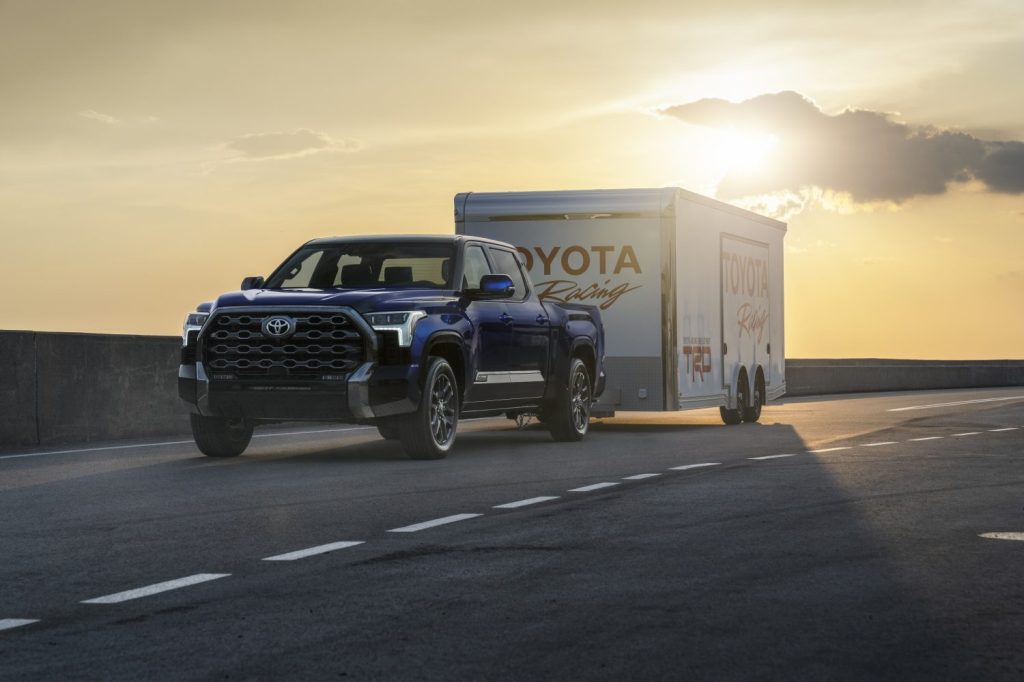
While the Tundra can certainly tow–as in up to 12,000 pounds–the vehicle is meant more for those who do recreational towing than commercial–which is more about the nature of the Toyota brand than anything having to do with the capability of the truck, because it is engineered to be fully capable–and then some. (Image: Toyota)

Framed

The thing about the ’22 Tundra is that there is a focus on overall robustness. They went from C-channel frame cross members to boxed, for example. While that improved stiffness, there was consideration taken for those who ride on a regular basis—loaded or unloaded—so there is a multilink rear suspension with the shocks mounted outside the frame rails to help improve the handling and ride comfort. (Even more comfort is provided by the available air suspension system that provides both manual and automatic leveling.)

The new Tundra can tow up to 12,000 pounds—which is an increase of 17.6% compared with the previous generation—and the load in the bed, which is based on sheet molding compound, which has been used on the Toyota Tacoma with excellent results, is 1,940 pounds, or an 11% increase.

Tugged

While on the subject of towing, it is worth knowing that there are two Tow/Haul modes. Activate the standard mode and the throttle response in increased. Activate the Tow/Haul+ mode and that response is amped up even more—and speaking of amps, the trucks with the hybrid powertrains have the electric motor constantly in operation during Tow/Haul+ and the engine Stop-Start function is deactivated.

And there is another towing-related aspect to the ’22 Tundra: Its design.

According to Adam Rabinowitz, chief designer at Calty who led the exterior design team for the truck, “We wanted to make it look like a premium towing machine.”

Toughened

Rabinowitz explained that the truck design is meant to deliver on it being more recreational than commercial—as in people with boats and trailers rather than people with tool trailers or earth movers.

And while they worked to show that it is tough enough to take it (e.g., there is a beam shape on the body side that is meant to convey the image of the truck’s frame), they also worked to assure that it looked sufficiently high-tech, such as through the use of the slim, high-mounted headlights.

Locked In

Benjamin Jimenez, studio chief designer at Calty, who led the interior design, echoed that “this is more of a recreational truck, so our approach was different than that of our competitors,” said that unlike the competitors, who generally use a vertical layout to the elements of the interior, they opted to go horizontal with all elements of the interior interlocking (e.g., doors with IP and trim) to provide a strong look: “We didn’t want this to feel weak in any way,” Jimenez sad.

Another way of indicating that the ’22 Tundra is more for adventure than work: upon startup, there is an image of one of five national parks indicated on the gauge cluster.

How Hyundai Is Becoming a Mobility Company, Explained

Explained with a remarkable level of enthusiasm by Olabisi Boyle

By Gary S. Vasilash

Without question, Hyundai is one of the most innovative companies in the automotive industry right now. The company has on offer vehicles with traditional engines, hybrids, plug-in hybrids, battery-electrics, and even fuel-cells. It has a joint venture with autonomous tech supplier Aptiv that’s called “Motional” that is developing self-driving vehicle tech. It has an urban air mobility operation that is developing that mode of transport.

If it is just a consideration of what it has on the road in terms of its cars and utilities, the level of design exceeds that of most any other automaker that isn’t providing vehicles that start at six-figure levels.

And while it once was that its quality was cringe—worthy, in the 2021 J.D. Power U.D. Vehicle Dependability Study Hyundai ranks seventh and is well above average.

Hyundai’s Boyle: Helping make the transformation to mobility. (Image: Hyundai)

To learn more about the company, on this edition of “Autoline After Hours” we talk with Olabisi Boyle, vice president of Product Planning and Mobility Strategy for Hyundai Motor North America.

Her duties range from short-term planning to pricing, from analytics to strategy.

Boyle joined HMNA from Visa, where she had been the vice president of Connected Commerce.

As she explains to freelance writer Nicole Wakelin, Jeff Gilbert of WWJ 950, and me, she was recruited by Visa because they were interested in her background—which includes some 20 years at both Ford and what was then Fiat Chrysler. (She had been the chief engineer of the Chrysler Town & Country and Dodge Grand Caravan.)

Notable for anyone in any industry, Boyle has a B.S. in industrial engineering from Columbia University, a M.S. in mechanical engineering from Columbia, and a B.S. in physics from Fordham University.

Just looking at her resume gives you the clear notion that this is someone who is really about achievement.

And the level of enthusiasm that she has is absolutely refreshing, as you clearly get the sense that she not only enjoys what she is doing, but that she recognizes that what she is doing is beneficial, not only for Hyundai, but for society at large (e.g., there are big efforts being made in the arena of using hydrogen for not only vehicles, but for other energy applications; this is a means by which there can be a significant reduction in carbon emissions).

You can see the interview with Boyle—as well as a discussion afterwards on a variety of topics, from EVs to the J.D. Power APEAL study—right here.

These Thai Cabbies Are Clever

When you can’t drive. . .garden

Two taxi cooperatives in Thailand—the Ratchapruk and Bovorn Taxi co-ops—have 500 cabs rolling in the streets of Bangkok, which means that there are some 2,500 vehicles sitting in lots, so a number of these static vehicles have become gardens, according to The Associated Press.

There are bamboo frames on the roofs of the vehicles and black plastic garbage bags stretched across the frames. The plastic is covered with dirt and veg including tomatos and string beans are planted.

Thapakorn Assawalertkul, an executive with the co-ops, told AP reporter Jerry Harmer, “The vegetable garden is both an act of protest and a way to feed my staff during this tough time.”

The tough time, of course, is the covid pandemic that has had a major impact on Thailand, with a reported 1.4-million cases and in excess of 14,000 deaths. The protest goes to the government, which apparently isn’t providing direct financial assistance to the cabbies.

Clearly the people there are resourceful. Here’s hoping that the drivers soon get back behind the wheels of more cabs and that the vegetables they eat sourced from markets once again, not from the roofs of Camrys.

Ford Lightning Pre-Production Underway

The first versions of the F-150 model are being built at the Rouge Electric Vehicle Center in Michigan

By Gary S. Vasilash

Ford is increasing its investment—to the tune of $250-million—at its operations at the Rouge Electric Vehicle Center, Van Dyke Electric Powertrain Center and Rawsonville Components Plant.

The reason?

The F-150 Lightning.

It also means 450 more jobs spread across the plants, all of which are in Michigan (Dearborn, Sterling Heights and Ypsilanti).

“We knew the F-150 Lightning was special,” said Ford executive chair Bill Ford, “but the interest from the public has surpassed our highest expectations and changed the conversation around electric vehicles.

“So we are doubling down, adding jobs and investment to increase production,” Ford added.

“This truck and the Ford-UAW workers who are assembling it in Michigan have a chance to make history and lead the electric vehicle movement in America.”

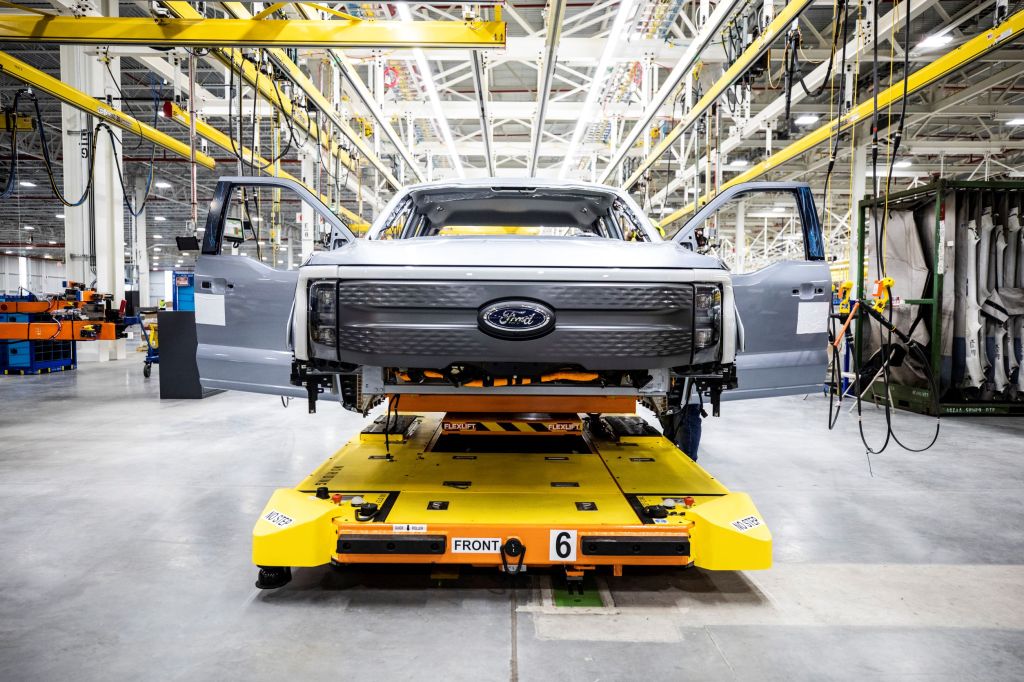
Pre-production underway for the all-electric F-150 Lightning. (Image: Ford)

Ford has taken more than 150,000 reservations for the full-size electric pickup that has an estimated range of 300 miles and a starting MSRP of $40,000. (It is worth noting that the reservations require $100—which is refundable.)

The Lightning is another in the F-150 offerings, which has been the best-seller in the U.S. for 44 years running.

Pre-production is underway for the Lightning, with consumer vehicles planned for availability in the spring of 2022.

How Autonomy Will Really Start

Why Ford, Argo AI and Walmart are going to be making a difference in the implementation of the tech

By Gary S. Vasilash

Although many people think—or imagine—that autonomous driving is going to occur from a company like Tesla, which will allow people to do whatever while their vehicle chauffeurs them to wherever, in point of fact, that is not going to be the case for a variety of reasons, not the least of which that sensors and processors are expensive, and even though there are some people who are willing to pay an exorbitant amount of money for something that claims to be “full” but is really more than half empty, OEMs are going to need to have assurance that there are going to be many more than a few who are willing to buy the tech.

But while consumers might not opt to spend the money, commercial carriers are likely to if they can determine that the tech is going to provide them with an economic advantage.

Ford, Argo AI and Walmart are driving autonomous tech forward. (Image: Ford)

Which makes the announcement by Ford, Argo AI and Walmart about the retailer using vehicles from Ford (Escape Hybrids) and self-driving technology from Argo AI to launch an autonomous delivery service for the “last-mile” in Miami, Austin, and Washington, DC, all the more significant.

These are mass-manufactured vehicles that are going to be put work by the world’s largest retailer in urban settings doing driving that will conceivably provide an ROI to Walmart, if not immediately, then at some point in the future.

Tom Ward, senior vice president of last mile delivery at Walmart U.S., said, “This collaboration will further our mission to get product to the homes of our customers with unparalleled speed and ease, and in turn, will continue to pave the way for autonomous delivery.”

The way this will work is that the Walmart online ordering platform will send information to the Argo AI cloud-based infrastructure, which will then calculate the necessary scheduling and routing.

The point is that this is all predicated on business processes.

And that’s what is going to make actual autonomy a real thing long before something shows up in your driveway that will take you from somewhere to somewhere else while you sit in the back seat eating a hot dog and watching Netflix.

Know that this is something of a journey as Ford and Argo AI have been testing their tech on city streets since 2018, the same year that Ford and Walmart ran a test in Miami. It takes time, effort and consistency of purpose.

The technology needs to be developed, tested, validated and verified.

It is not the consequence of an over-the-air update that follows a tweet.