About Charging the BMW iX3

It is quick. But that’s still slow

By Gary S. Vasilash

According to information about the new BMW iX3 (the UK version) we learn such things as the fact that there are 188 prismatic cells in the battery that have a gravimetric energy density that’s about 20% higher than that of the previous pack.
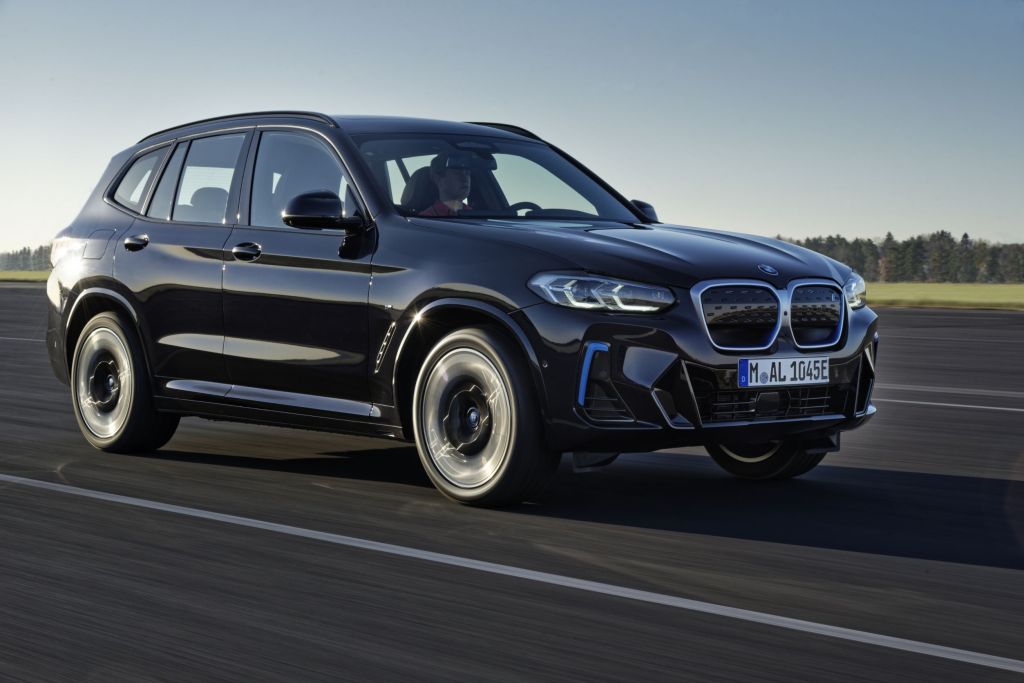
The new BMW iX3 has range on the order of 280 miles. (Image: BMW)

There is BMW’s fifth-generation eDrive technology that brings along a charging unit that provides power to both the 400V battery and the 12V on-board power supply.

As for the charging, when using AC it will permit single- and three-phase charging at up to 11 kW.

However, when plugged into a DC fast charger, it can charge at up to 150 kW. This means it can go from a 0% state of charge to 80% in 34 minutes.

There is another set of numbers that are striking. The BMW iX3 can charge the vehicle so that it can travel up to 62 miles (based on the WLTP test cycle, which is generally more generous than EPA figures) in 10 minutes.

While 10 minutes isn’t a whole lot of time, 62 miles of distance isn’t a whole lot of range.

According to the EPA, the average fuel economy for light-duty vehicles in 2020–cars, pickups, and cargo vans less than 8,500 pounds GVWR and SUVs and passenger vans up to 10,000 pounds GVWR—was 25.7 mpg.

The flow at your local gas pump (assuming you’re in the U.S.) is limited to 10 gallons per minute.  Which means that a light vehicle can get 257 miles of range in one minute.

Somehow people are going to have to get used to spending more time at a service station.
Porsche Exhibits Product Development

Yes, wrecking cars is part of the process

By Gary S. Vasilash

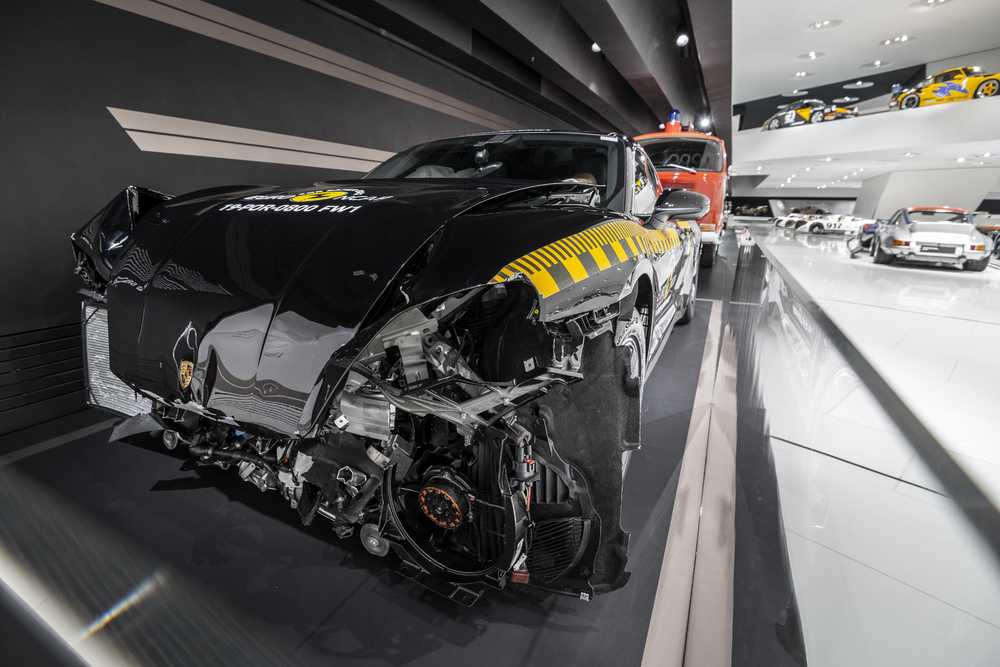
This is a picture of a Porsche Taycan after it hit—under controlled circumstances, not randomly—a barrier while it was going 50 km/h, a.k.a. 31 mph.

(Image: Porsche)

You think that slow-speed accidents aren’t a big deal?

Look at the picture and think again.

Now as you look at the picture you may notice that the setting is not some engineering facility.

Rather, it is the Porsche Museum in Zuffenhausen, where a special exhibition, “50 Years of Porsche Development at Weissach” opened today. It runs through December 5.

The objective of the exhibition is to show various aspects of how vehicles are developed, from concept through design, engineering, and so on.

Said Achim Stejskal, head of Porsche Heritage and Museum, “Sports cars for the road and thoroughbred race cars have been developed in Weissach for half a century. Dreams are designed, created and tested in the middle of idyllic countryside.”

And as that crunched Taycan shows, it is necessary to do unidyllic things during vehicle development to assure that when the vehicles are on the road or on the track the occupants have measures of protection.

Talking to Cars

A novelty, necessity or something else?

By Gary S. Vasilash

“Computer, tea, Earl Grey, hot.” So said Captain Jean-Luc Picard when he was in the need of a hot beverage on Star Trek: The Next Generation.

And the computer would orchestrate things such that he would be able to get a delicious drink.

If you think about it, it makes perfect sense for there to be a voice-activated interface on a starship, especially in the mess. After all, things like boiling water and whatnot would go on behind the scenes, anyway. Back in 1987, when the show premiered, people were using the Commodore Amiga and the 3.5-inch floppy disc had its start. Talking to a computer was certainly science fiction back then.

Now, as everyone is equipped with a computer that they keep in their pocket or purse—assuming that it is not in their hand—talking to the object is not given much of a second thought.

Of course, the device will tell you when The Next Generation aired or what the weather is. It will not provide you with a cup of tea.

I thought about the novelty of talking to an inanimate object when seeing a television ad for the Volvo XC40 Recharge, an electric vehicle.

One of the features of the car is Google Assistant. In the ad, the driver says “OK Google, turn up the temperature.”

If you think about it, Picard altered the computer with “Computer,” then went to the category (tea), type (Earl Grey) and condition (hot). Today it would be “Computer a cup of hot Earl Grey,” perhaps. Far more natural language.

But there is something about the ability to have a voice activated control of an HVAC system in an SUV and ordering a drink on a starship.

When you are behind the wheel of an XC40 Recharge, the ability to adjust the temperature is not even an arm’s length away. It is a simple act. Simpler than boiling water.

It almost seems as a pointless execution of a technological capability. Yes, you can do it. But do you need to?

One could make the argument—and it is a just one—that by having the ability to use voice commands in lieu of reaching over to make an adjustment is beneficial from a safety point of view: the driver maintains control of the steering wheel with both hands. Which is an absolutely good thing.

Of course, the reality is probably closer to someone using their hand to hold a cup from Starbucks, which probably doesn’t contain tea.

Trucks Still Need Engines

While we wend our way to the future, there are still a whole lot of medium-duty trucks to be built that need. . .engines.

By Gary S. Vasilash

You might think that every automotive-related company in the world is transforming itself into something that will be related to electric vehicles. And you would be not entirely incorrect in thinking so, as the transformation seems to be like an avalanche combined with a tidal wave.

But this seems worth noting: the signing of a global framework agreement between Daimler Truck AG and Cummins Inc. related to the development and production of engines for medium-duty engines.

Not “motors.”

Engines.

(Image: Daimler)

These engines will, according to the companies, meet the Euro VII emissions standards for the vehicles that use them.

Cummins is establishing a manufacturing facility for the engines on the site of the Mercedes-Benz Mannheim, Germany, factory. This will help maintain jobs.

But this seems somewhat odd.

When the agreement was first announced in February, a release from Daimler said, in part, “Daimler anticipates the partnership with Cummins will enable Daimler to increase and accelerate its development efforts on alternative and emerging technologies, including non-diesel engines.”

So Daimler will be investing in the future tech while it will rely on Cummins to provide the tried-and-true.

Perhaps Cummins is going to take the profits from the Mannheim products and invest them in something of an electric nature.

A Boat Launches the Name of an SUV

Well, the name does describe a wind, and it is a sail boat. . .

By Gary S. Vasilash

What you may not know—but what certainly won’t surprise you—is that Maserati is going to be coming out with a new SUV. Of course they’re putting out a new SUV. It has one, the Levante, but that’s certainly not sufficient because people all seem to want SUVs. More SUVs.

The vehicle will be unveiled in November.

The boat revealed the name of the SUV. (Image: Maserati)

The vehicle name was unfurled today.

Unfurled because it was on the main sail of the Maserati Multi 70, what is described by the company as a “laboratory boat.”

Yes, a boat.

The name of the new SUV is Grecale. It is the word for a north-east wind of the Mediterranean.

Of course it is.

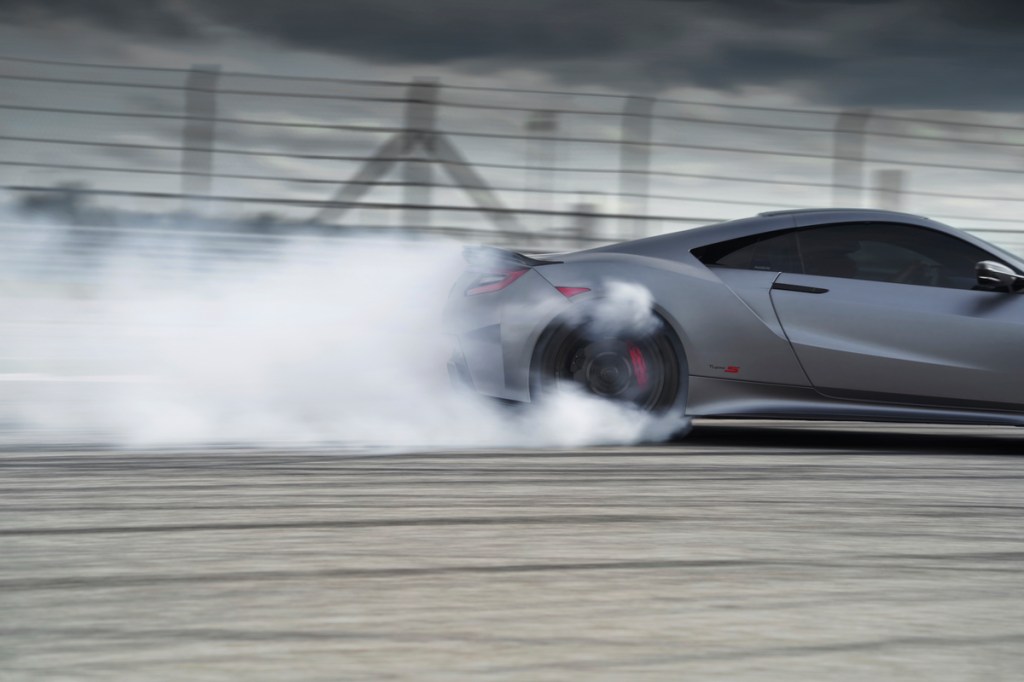
NSX Ending

A really wonderful supercar will come to an end. The reason? Probably because not many people are buying the car.

By Gary S. Vasilash

Yesterday the auto companies that announce sales figures on a monthly basis made their announcements.

American Honda was modestly happy, noting that for the month of July it delivered more than 135,000 vehicles, which includes 51,815 cars and 83,727 trucks for both the Acura and Honda brands.

One vehicle among the 135,542 units had sales of seven units. Seven.

Acura NSX; 22 is the final ride for production. (Image: Acura)

From January to July there have been 67 sold in the U.S.

Yesterday American Honda also announced that the NSX—the vehicle that isn’t selling well by almost any metric—will end with model year 2022.

The second generation NSX, which was launched in 2016, will have a limited run during its final year of production at the Performance Manufacturing Center in Ohio.

There will be 350 NSX Type S vehicles built. Period. Three hundred will be available in the U.S.

Given the sales of the NSX so far, the folks at Acura are evidently optimistic that there will be more than a few collectors looking to get their hands on the final edition.

Jon Ikeda, vice president and Acura Brand Officer, stoically said, “Acura is a performance brand, a company of enthusiasts, and we will continue moving forward, actively investigating what the next generation of sports cars should be in an electrified era.”

Seems like the answer to that might be: an SUV.

What Is an Automobile?

A brilliant take written because of the Automania exhibit at MoMA

“There are few consumables that have been designed since their inception to capture every sense and sensibility that humans have more than the car. It is the most practical yet mythic of inventions. It is machine and art. It is the product of genius and object of desire. Yet it is also a tool, and as such promotes good and destroys worlds.”—Steven Heller, Print

Why 2030 Isn’t Going to Be All That Different from 2020

Yes, there will be more electric vehicles. But not all EVs. So internal combustion engines need improvement.

By Gary S. Vasilash

Bosch, Sujit Jain, president, Powertrain Solutions for Passenger Cars, Commercial & Off-Road, and Electric Vehicles at the company’s North American operations, points out, has been advancing—and producing—technologies for the auto industry essentially for as long as there has been an auto industry.

And today isn’t any different.

The company is not only making massive investments for developing and utilizing Industry 4.0 capabilities, but it is investing heavily in the development and production of everything from microprocessors and fuel cells in order to advance the functionalities and performance in the auto industry.

It is committed to the electrification of vehicles, whether this makes the form of hybrids, full battery electrics or fuel cell powered vehicles.

But while Jain says company projections have it that the number of battery electric vehicles in the U.S. will grow from about 2% of the market in 2020 to 30% by 2030, that still leaves 70%, the large percentage of being combustion engines. Yes, they may be hybrids, but there is still gasoline or diesel being burned.

So one of the things that Jain and his colleagues are doing is developing the ways and means to increase the efficiency of those engines, both in terms of performance and emissions reduction.

Some of the things that they are pursing, Jain says on this edition of “Autoline After Hours,” include synthetic fuels, electrically heated catalysts to reduce cold-start emissions, and hydrogen fuel injection (i.e., instead of a hydrogen fuel cell, this would be a combustion engine running on hydrogen).

Jain talks with “Autoline’s” John McElroy, Kelsey Mays of Cars.com, and me on this show.

After Jain’s segment, the three of us talk about a variety of subjects, including former Nikola head Trevor Milton being charged with three counts of criminal fraud related to the company he founded; Tesla’s Q2 financials ($1.14-billion in GAAP net income), the possible consequences of it opening up its charging network to other brands, and the move from upscale-shopping districts for its stores and galleries to lower-end real estate; Magna’s growth and technological breadth; and more.

And you can see it all here.

Ahoy, Lambo

No wheels. Big engines.

By Gary S. Vasilash

So, want to talk about a Lamborghini with 4,000 hp?

It is a real thing.

But it is a yacht.

A yacht that is equipped with two MAN V12 2,000 hp engines.

Tecnomar for Lamborghini 63 (Image: Lamborghini)

It is the Tecnomar for Lamborghini 63 that was designed by Lambo and built by Tecnomar, a brand of the Italian Sea Group.

The first version of this limited edition yacht is said to be influenced by the design and details of the Sián FKP 37 hybrid sports car.

The yacht is constructed with plenty of carbon fiber, which means that it is in the “ultralight yacht” category. Under 24 tons.

While on the subject of numbers, they’re going to make just 63 of them.

Another number of possible interest: $3.5-million. The approximate starting MSRP of this floating Lambo.

Something About Tires We Still Don’t Know The Meaning Of

It’s not like we’ve spent a lot (or any) time in open-pit mines. . . .

By Gary S. Vasilash

Odds are you will never be in a vehicle that uses this tire. Unless, perhaps, you drive (pilot?) something like the Caterpillar 789 dump truck, the kind of vehicle that is used in open-pit mining: It resembles a giant box (giant as in having the capacity of 177 tonnes) that is supposed by giant tires with a cab tucked up front in between.

Just the thing for 200-ton trucks. (Image: Goodyear)

According to Eric Matson, Global OTR Field Engineering Manager, Goodyear, “The 40.00R57 has become Goodyear’s dominant fitment on 200-ton trucks, such as the Caterpillar 789. With a higher TKPH and load carrying capacity, the new Goodyear RH-4A+ tire size is a great option for customers who have converted their 789 fleets to this larger tire.”

TKPH? Tonne-kilometers-per-hour. We don’t know, either.

One of the features of this tire is that it is said to provide “higher productivity in hard rock underfoot positions.”

Bet that’s not going to be your concern the next time you go out tire shopping. . . .