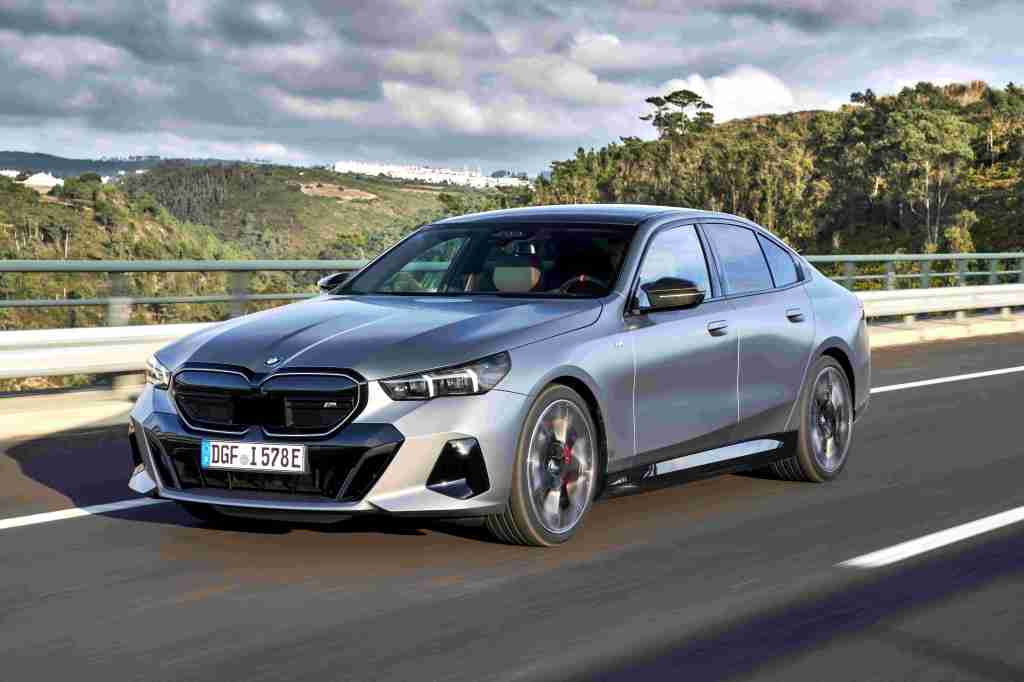
What’s the Real EV Demand?

(A Look at Western Europe)

By Gary S. Vasilash

Although Western European vehicle buyers have consistently been more bullish on buying electric vehicles, even there things are beginning to shift according to analysis by Schmidt Automotive Research.

According to its “European Electric Car Study,” there were 1.96 million battery electric vehicles sold in the West Europe region in 2023, a 28% year-over-year improvement, which means 16.9% of the total automotive market.

But it could it have better, as there was a 25% decline in December 2023 compared with the final month of 2022, which resulted in a decline for 5% for Q4 ’23 compared with ’22.

One of the reasons for the decline: “various purchase subsidies and lower tax incentives being stripped away.”

Looking ahead into 2024, Schmidt Automotive predicts:

“Auto executives will need to wrap up and buckle up as the market begins to see a chill easterly wind arrive, with discounting expected to be the keyword of the year, accompanied by protectionism to defend against an increasingly aggressive attack from Chinese manufacturers, as states hope to buy some time for key regional employers giving them space to restructure their business and become more competitive in the new e-mobility age.”

So let’s break this down:

  1. EV demand fell as consumer subsidies and tax incentives declined
  2. Discounting will be the condition this year, which means an advantage for the consumer and bad news for the manufacturers

The Chinese manufacturers are providing inexpensive products. Yes, they happen to be EVs, but would low-cost ICE vehicles be any less appealing?

At some point the “free money” for EVs is no longer going to be available.

Which leads to a question of what the real demand for the vehicles is.

Perhaps not as much as some OEM execs would like to think.

Buick: Wouldn’t You Rather Have One?

By Gary S. Vasilash

If there is someone who is quintessentially American, that person has to be Dale Earnhart, Jr. It is hard to imagine how difficult it would be to live up to the legend that his father was, but Dale Jr. was able to make his own way into the annals that is NASCAR.

Like many former drivers, Earnhart owns car dealerships. One of them is Dale Earnhardt Jr. Buick GMC in Tallahassee, Florida.

Like many dealer websites, there is an array of vehicles for sale presented and an immediate pop-up that shows they are willing to engage pronto with prospective customers.

But there is something that is different than is the case on many dealer websites, which is a Q&A section.

And one of the questions that is presented and answered is:

“Is Buick American?

And the answer begins:

“If you’re considering a new Buick vehicle as your next Thomasville, GA car or SUV, you may be wondering, is Buick American? The answer is yes.”

And it laudably goes on to acknowledge that the brand builds vehicles in places that aren’t within the U.S., like Bupyeong, South Korea (Encore GX), and Shanghai, China (Envision).

Yes, you read that right: the Buick Envision is built in China. Which is something to think about when the rhetorical question is raised: “Will Americans buy Chinese vehicles?,” as though this is some sort of question about the future. It isn’t. And the answer is yes.

The Buick Envista is also made in South Korea.

This leaves the Buick Enclave, which is made in the U.S., at the Lansing Delta Township plant in Michigan.

GM has been building vehicles in Lansing for a long time. Ransom E. Olds built a plant there in 1901. (Olds, unfortunately, ceased to exist in 2004.)

While some people wondered about the viability of Buick, here’s Duncan Aldred, vice president, Buick and GMC:

“As the fastest growing mainstream brand in the industry in the U.S.last year, 2024 promises more big things for Buick, spearheaded by the launch of the next-generation Enclave.”

Sketch of the 2025 Buick Enclave. No, it won’t have square wheels. (Image: Buick)

Last year Enclave sales, 39,411 units, were up 29.1% compared to 2022.

But Envision sales, 44,281 units, were up 71.2% and Encore GX, 64,149 units, were up 92.4%.

Which seems to indicate that at least so far as 2023 goes, they were busier in Bupyeong and Shanghai than they were in Lansing.

Perhaps the forthcoming version of the stylish Enclave will help boost things in Lansing.

And probably at Dale Jr.’s dealership in Florida, too.

GMC Going More Global

By Gary S. Vasilash

GMC sells its vehicles in three non-U.S. markets at present:

  • Canada, where its sales were up 10% in 2023 and where it has a market share of 5.5%
  • The Middle East, where its sales were up 15% compared with 2022
  • Mexico, where its sales were up 14.4%
  • South Korea, where it launched the Sierra LD pickup in 2023

How, you might be wondering, did it do in the U.S. in 2023?

Its retail sales were up 6.5% compared with 2022 and its total sales were up 8.9%, for a total 563,677 units.

GMC Yukon AT4. Presumably a nice vehicle on a snowy day. (Image: GMC)

(Which vehicle in its lineup were up 279.9% in ’23 compared with ’22? The HUMMER EV. It delivered 3,244. That vehicle has the distinction of being—with the exceptions of the Chevy Blazer EV and Chevy Silverado EV, both of which launched near the end of ’23, so these exceptions are not really comparative, especially as the HUMMER went into production in November 2021—the lowest-selling vehicle of all GM products.)

Feeling bullish about the global demand for vehicles of a large dimension, GMC announced that it will be rolling out the Yukon full-size SUV in Australia, New Zealand and China, with the last-named getting the vehicles in 2024 and the first two in 2025.

GMC sold 82,271 Yukons in the U.S. last year, essentially flat in the context of the 82,304 sold in 2022. While flat isn’t as good as the 279.9% of the HUMMER EV, it is better than the -19.3% of the Canyon, -14.8% of the Savana, or 17% of the Terrain.

Hybridized CUVs Matter

By Gary S. Vasilash

Here’s a fun fact: the Honda CR-V hybrid was the best-selling hybrid vehicle, bar none, in the U.S. market in 2023.

197,317 were delivered.

Honda CR-V Hybrid under its skin. (Image: Honda)

Meanwhile, over at Toyota, 161,125 RAV4 Hybrids were sold and an additional 26,073 RAV4 Primes, the plug-in hybrid, for a total of 187,198 hybrids.

GM has zero hybrids.

Ford has hybrid versions of the Escape, Maverick, Explorer, and F-150.

Combined, it delivered 133,743 hybrids.*

Ford sold 140,986 Escapes in 2023. That’s with all powertrain options.

Fewer than the Honda and Toyota hybrids.

Chevy sold 212,701 Equinoxes—none of which are electrified, and not all that many more than the CR-V hybrid (15,384, non-trivial, but when you take into account that Honda sold 361,457 CR-Vs in 2023, well. . . ).

Clearly, compact CUV hybrids are appealing.

Surprising GM is ignoring the market and Ford probably needs to ramp up its output.

Dodge has a hybrid version of the Hornet available, a crossover that launched last Spring, so its efforts are still nacent in this space. It sold a total 9,314 Hornets in 2023, of which 3,591 were the hybrid version, so there’s evidently some traction.

(Jeep has the Wrangler 4xe plug-in and the Grand Cherokee 4xe plug-in, of which it sold 67,429 and 45,684, respectively. Neither, of course, is likely cross-shopped with a CR-V or RAV4, but still nice numbers.)

*Here’s a big number–the electrified Toyotas sold in 2023: 565,800. With the exceptions of 2,737 Mirai fuel cell electric vehicles and 9,329 bZ4X BEVs, all hybrids.

Cheap EVs & The Steak Mentality

By Gary S. Vasilash

Admittedly the BYD Seagull (a.k.a., “Dolphin Mini” in Brazil and Latin America) is a small car—98.4-inch wheelbase, 148.8-inch length, 67.5-inch width, 60.6-inch height—there are two other characteristics worth knowing: (1) it is an electric vehicle with a range ranging from about 190 miles to 250 miles, depending on the battery used; (2) it has a starting price that’s approximately $11,000.

The BYD Seagull. Small. Cheap. Electric. Competitive? (Image: BYD)

Which leads to two other considerations:

  • Good thing Americans don’t like small cars
  • Good thing it isn’t available in the U.S. because while Americans may not like small cars, they do like low prices

And Kristin Dziczek, policy advisor, Federal Reserve Bank of Chicago, speaking at the 30th annual Automotive Insights Symposium, speaking on her own behalf, not the Fed’s, said that a car like the Seagull is something that worries her.

Dziczek said that BYD could conceivably sell the Seagull in the U.S. market for ~$15K, including the 27.5% tariff that the U.S. imposes on vehicles built in China, and still make money.

Given that the average transaction price for an EV in the U.S. in December was $50,786 according to Kelley Blue Book, given that $48,759 was the average transaction price for vehicles of all types last month, doesn’t well under $20,000 look appealing—even for a small EV?

Let’s say that a Chinese company builds a factory in Mexico. Isn’t it possible that, increased costs compared with China, it could take advantage of the USMCA and avoid the big tariff?

While there are some who argue that people want the amenities that are characteristic of vehicles with higher price points, some people prefer porterhouses over McDonald’s.

Seems as though the traditional domestic OEMs are interested in those who want steak.

Chevy, once the GM brand that was more economical, has a starting price for the Blazer EV at $56,715. . .just $1,875 less than the starting price for the Cadillac Lyriq EV.

Remember when the Chevy Silverado EV was announced and it was said that the starting price would be around $40,000? The actual MSRP is $74,800.

Affordability is a key concern for most people. Sure, there are those who buy far beyond their means for purposes of fashion.

But fashion is fickle.

And in the short and long run for many people, it is about what will get the job done at a price that meets their means.

While politics may impede the entry of Chinese vehicles in high numbers in the American market (the Buick Envision and the Polestar 2 are built in China and you can buy one at a dealer near you right now, but the sales for both are still somewhat small: for 2023 there were 44,281 Envisions sold and 10,350 Polestar 2s) it is going to likely happen at some point.

The question is how competitive the U.S. builders are going to be when that happens. Given that they’ve pretty much abandoned midsize and small cars (Toyota sold 290,649 Camrys last year and 232,370 Corollas, so it is not like there isn’t a market for those types of vehicles), there should be some serious concern.

EVs and Pricing Parity

By Gary S. Vasilash

In December 2023 18 of the 35 brands that Kelley Blue Book analyzed had year-over-year price declines.

This is understandable, given that it was the end of the year, and there is a tendency for product manufacturers of all types, not just vehicles, to want to move out as much inventory at the end of a period as possible (e.g., the classic recommendation about buying a car at the end of the month when the dealer wants to move just one more to make a quota and consequently provides a better deal).

So there was Volvo, which reduced its price by 6.7% and Land Rover, with a 10.2% reduction.

It should be noted, however, that both of those brands have a very minimal (<1%) share of the U.S. market, so it is not like their combined numbers have much of a consequence on the overall average retail price for vehicles in 2023.

KBB calculated that in December the average transaction price (ATP) for vehicles was $48,759.

Notably, the ATP was $50,798 for electric vehicles.

Said Stephanie Valdez Streaty, director of Industry Insights at Cox Automotive, “2023 was a milestone year with 1,189,051 pure battery electric vehicles sold, accounting for 7.6% of all new-vehicle sales.”

So that is good for the EV producers.

What’s more, the point at which price parity between vehicles with combustion engines and those with electric motors is reached is something considered by industry to be the point at which there will be a huge rise in the number of EVs purchased.*

An ATP difference of $2,039 for an EV is almost that, and certainly just a few bucks per month on a lengthy load.

But going back to the companies that had price cuts in December, there’s the company that accounts for 55.1% of the EV market, Telsa. (Tesla has, per Cox Automotive, 4.2% of the entire vehicle market, which is more than Mercedes, Volvo, Jaguar-Land Rover, Rivian, and Lucid combined.)

According to KBB it cut its prices an average 25.1%.

Let’s see: a price reduction of that magnitude, the possibility of getting as much as a $7,500 tax credit for a Model X or Y—well, were Chevy capable of providing those kinds of benefits to customers Malibus would be flying off lots.

People read books about negotiation strategies in order to get a few percent taken off the price of the vehicle they want to buy, coming in ready to take on the dealer by being wise to its tactics, and there was Tesla, slashing prices, presto-change-o. And the Feds offering serious money, too.

Amazing!

No other OEM can afford to make—or take—the kind of cut that Tesla made.

At some point (let’s not forget about the presidential election in a few months) those tax cuts are going to go away. And Tesla may simply being to ratchet its prices back up.

What then?

Perhaps that parity may be fleeting.

==

*Of course, given the continued issue regarding infrastructure, which an increased number of EVs would only exacerbate. . . well, people who have to drive around looking for available, working chargers are not likely to want to repeat that experience when they look for a new vehicle.

BMW and EVs

By Gary S. Vasilash

When it comes to discussions of electric vehicles, the topics seem to be, in order of frequency:

  1. Tesla. Anything. Mileage recalculations. Musk’s recreational habits. Labor issues. Massive number of vehicles being sold (which actually doesn’t get the attention that it should: when you subtract Tesla vehicle sales from electric vehicle sales, things don’t look quite as bullish as one might think).
  2. GM. Mainly its failure to produce notable volumes. For 2023 it delivered 9,154 Cadillac LYRIQs, 483 Chevy Blazer EVs, 461 Silverado EVs, 3,244 HUMMER EVs, 14 Zevo 400s, and 483 Zevo 600s (the last two are commercial vehicles). That is a total 13,838 vehicles. Out of 2,594,698 sold.
  3. Ford. One thing is the refocus on hybrids. The other thing is the changing prices for the F-150 Lightning, with the recent notable rise in MSRP. You might have imagined that when the vehicle launched the perceived demand was such that they would have quickly hit economies of scale that would cause prices to, well, not rise. For 2023 it sold 24,165 Lightnings, which is excellent in the context of GM. But when you take into account the total 750,789 F-Series trucks sold, that’s about 3%.

A company that gets little attention is BMW when it comes to EVs.

BMW i5: one of the electric vehicles in the company’s offerings–there are also the i4, i7 and iX. (Image: BMW)

Which is surprising given that in 2023 it delivered 45,417 EVs into the U.S. market.

That’s more than the GM EV sales and the Ford Lightning sales combined (38,003).

BMW 2023 EV sales account for 12.5% of its total sales.

If the number of plug-in hybrids BMW sold in 2023 (25,318) are added in to the EV number (so the number of “electrified vehicles”), it is 70,735 or 19.5% of BMW’s total sales in the U.S.

Those are some big numbers for BMW.

Seems like the lack of discussion isn’t keeping people from buying the company’s EVs.

Ford Sells a Lot of Trucks. Again.

By Gary S. Vasilash

For those of you still humming Mariah Carey’s “All I Want For Christmas Is You,” here’s a bit of context for an announcement Ford made this morning:

The year that the Ford F-Series started making its consecutive run as the best-selling truck in the U.S., Ms. Carey was seven.

The F-Series has taken the lead for 47 years in a row.* They’re looking at more than 700,000 of them driven off of dealer lots in 2023.

2024 Ford F-150 Platinum. So nice that you probably wouldn’t want to use it as. . .a truck (Image: Ford)

And underscoring the curious popularity of trucks in suburban driveways as well as on work sites (curious because I rarely see my pickup truck-owning neighbors doing anything with the boxes on the back of those vehicles that they couldn’t manage with a trunk), the F-Series has been the best-selling vehicle in the U.S. for 42 years running.*

There is, of course, the question of whether “the most” means “the best.”

After all, McDonald’s has sold more hamburgers than any other company in the world and there is probably no one who doesn’t know whether they can get a better burger.

But one thing it certainly means is that the F-Series provides an unparalleled level of value for more people than any other pickup.

While there may be specific attributes of trucks from other OEMs that are more appealing or necessary for some purchasers, which means those trucks are more valuable for those people, on an overall basis Ford is consistently delivering.

Credit where credit is due. (And you’ll probably need good credit to get a full-size pickup: according to Kelley Blue Book, the average transaction price (ATP) for one in November 2023 was $66,590. You could get an entry-level luxury car for an ATP of $57,889.)

(On a related-unrelated subject, the tremendous number of trucks sold by Ford—closely followed by GM and Ram—in the context of vocational or functional (i.e., towing, hauling) uses of the vehicles might indicate that people are less environmentally keen than might be expected. After all, light-duty pickups aren’t exactly fuel-economy leaders, so were people concerned about carbon, they’d be buying more efficient vehicles for their daily drives. Yes, there are an electric F-150 and Chevy Silverado and one coming from Ram, but from the point of view of resource utilization, as in the massive batteries that have to be constructed, if those trucks aren’t being used as, well, trucks, then that isn’t exactly the most-environmental choice.)

*As the announcement was made a couple days before the actual end of the year, it is a bit of estimation on behalf of Ford. A small bit.

Hyundai, Amazon & the Transformation of Dealership Transactions

By Gary S. Vasilash

The announcement that Hyundai and Amazon have entered into a partnership agreement which will have Hyundai models sold through the Amazon interface will have repercussions in automotive retail the likes of which have probably never been experienced before— perhaps those inflatable gorillas and floppy men had a fairly big effect, or so the traditional car-buying model might have it.

Now this doesn’t mean that the dealership model is kaput. Well, at least not in 2024, when the availability of Sonatas and Tucsons can be configured on the site.

Dealers are still part of the picture.

Customers can search on Amazon for the Hyundai of interest, configure it, and even select their method of financing. The vehicle will then go through a dealership for delivery.

And it is likely that individual dealerships will be able to establish their own storefronts on Amazon the way the purveyors of an array of products do.

A Change Is Coming. Fast.

One of the arguments that is made regarding people purchasing cars on the internet and why it isn’t going to make a difference is that people like to take test drives. People like to see the sheet metal. People like physically see what it is that they’re going to be spending tens of thousands of dollars for over a few years.

True.

But consider this: one of the things that nearly knocked out Best Buy was “showrooming”: People would go to a store to check out that big-screen TV and then go home and buy it on Amazon.

They’d, essentially, kick the tires, and then complete the transaction elsewhere. Best Buy did the work. It didn’t get the reveune.

The incredibly friendly Amazon interface will undoubtedly make it all the easier for Dealer A to promote better deals than Dealer B, so if the Dealer B is where the customer did their showrooming, then A may come out on top. While people can check on individual dealer websites to see what’s available, this setup with Amazon will undoubtedly facilitate that.

And what of the salespeople? Will any given dealership need as many going forward?

Dealership value is undoubtedly going to change profoundly—and not necessarily for the better.

Something like this was bound to happen.

And now it has.

(One of the things that must be considered vis-à-vis this partnership is that Hyundai is clearly positioned as a company that sees how the world works. People buy lots of stuff online. People want convenience. So Hyundai is facilitating that. Many other OEMs are busy perpetuating past practices despite their pronouncements about the future. Those OEMs are like Nokia. Hyundai is like Samsung.)

Polestar Says It Out Loud

By Gary S. Vasilash

Polestar is an electric vehicle company that, in effect, spun out of Volvo, but Volvo is owned by Geely, but is traded on NASDAQ (as PSNY), so let’s not even try to sort out where the Gothenburg, Sweden-headquartered company exists. (It has announced it will build the forthcoming Polestar 3 in a plant in South Carolina next year. . .the Volvo plant in South Carolina.)

Anyway, yesterday as part of its Q3 earnings presentation it announced a “strengthened business plan.”

Which is notable because the company has stated it is going to put margins ahead of volume.

(Image: Polestar)

Thomas Ingenlath, Polestar CEO, stated, “Margin over volume is our way forward, supported by a gorgeous line-up of four exclusive performance cars.”

Meaning that Polestar is going to focus on the premium end of the EV market.

It figures that as of 2025, when it has four models in production, it will have an annual volume of 155,000 to 165,000 cars, which in and of itself is a rather small number and is smaller when you take into account it is selling globally.

Consider This

According to Kelley Blue Book, in September the average transaction price of a luxury vehicle in the U.S. was $62,342, down 6.2% from September 2022.

Here’s the key to that: “Luxury price declines in 2023 are primarily driven by aggressive price cuts at Tesla, the luxury market leader.” The Model 3 price was down 26% compared to the previous year.

And in the EV space, the average transaction price in September was $50,683, or down about 22% from the previous year “led again by market leader Tesla.”

(Tesla, because of its margins, is really the only OEM that can build mass volumes of EVs and afford to cut its prices.)

The point is, the EV market in the U.S. is pretty much a premium market.

And in the U.S., EVs are pretty much a premium proposition.

When Chevy announced the Equinox EV it made much of the fact that it was going to be a $30,000 vehicle, but it covered itself with “about” and announced a starting price of $34,995. While that is below the average price of an EV, what are the odds there will be many $35,000 Equinox EVs available?

When Chevy announced the Silverado EV work truck earlier this year, pricing was to be just below $40,000, but as reality set in, the price is now above $70,000.

EVs are an expensive proposition.

Let’s face it: until there is some massive change in battery technology (batteries are where most of the cost of an EV is found), the EV market is going to be characterized by prices higher than the ICE market—KBB found that the average transaction price for compact cars in September was below $30,000.

Credit to Polestar for saying it is going to put its profit ahead of volume, something other OEM execs don’t seem to want to say out loud.