Last November Toyota announced a $240-million investment in its plant in Buffalo, West Virginia, its only combined engine and transmission plant in North America. The monies will be invested in a production line for hybrid transaxles.
And today the company announced that it was adding an additional $73-million to its spend for not only more hybrid transaxle production but to assembly rear motor stators.
All of which is to say that Toyota is amping up its spend on hybrid vehicle production capacity.
In addition, it is spending $17 million at its Toyota Motor Manufacturing Tennessee plant for casting hybrid transaxle cases and housings.
Last December Toyota announced that it would be launching 30 battery electric vehicles globally by 2030, which would represent sales of 3.5-million EVs per year.
Then it would, by 2035, have 100% of its global vehicle sales be EVs by 2035.
However, between now and then there will evidently be more hybrids available at Toyota and Lexus dealers in the U.S.
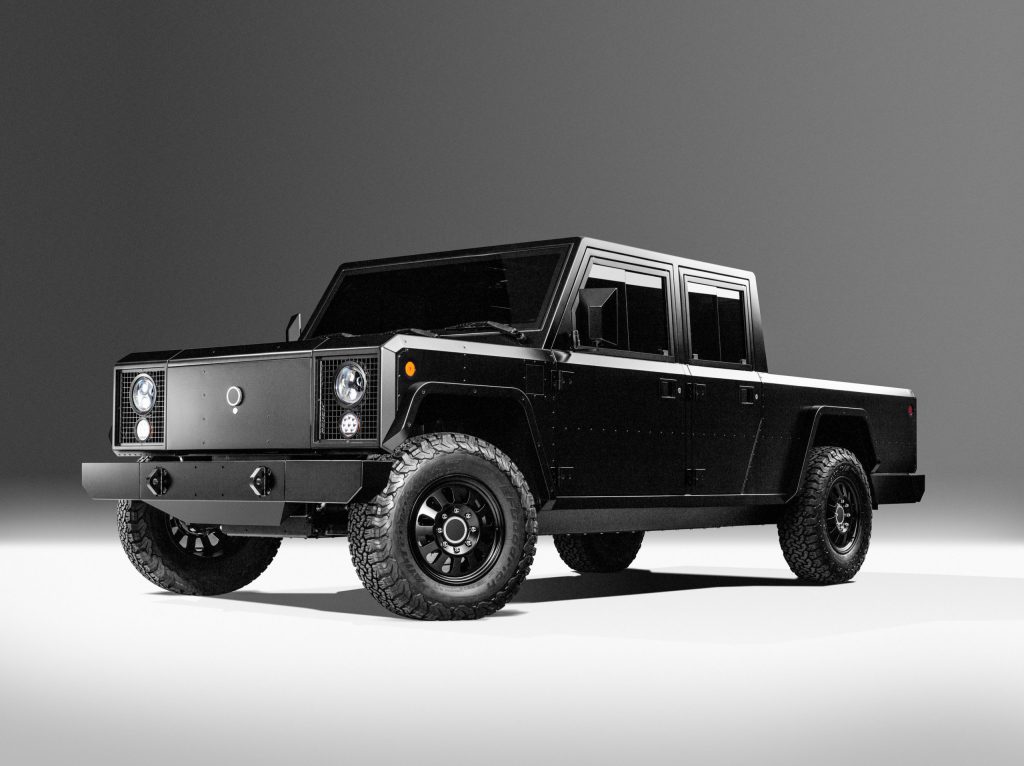
Back in 2017 Bollinger Motors revealed two vehicles, the B1 a bona-fide SUV (it actually has a frame, which makes it more SUV than crossover), and the B2, a Class 3 pickup.
Both are electric vehicles.
What was absolutely remarkable about the two is that there is a design aesthetic that is all about straight-up functionality rather than either copying the design, more or less, of an existing vehicle with an internal combustion engine or going completely futuristic. As there are more announcements of electric pickups the B2 stands in a place of its own.
And in 2019, when the company announced the pricing for the fully electric, all-wheel drive vehicles, some took in a quick breath: $125,000.
Bollinger Motors B2 (Image: Bollinger)
Be that as it may, reservations came rolling in to the company that had moved from New York to greater Detroit in order to be in the midst of automotive development.
On January 14, 2022, Bollinger Motors announced a change in direction:
“We started Bollinger Motors in 2015 with a dream and a desire to make the best trucks possible,” said Robert Bollinger, CEO of Bollinger Motors. “We’ve put countless hours of hard work and passion into making something that makes us proud. However, today, we’re postponing the consumer trucks’ development and shifting our focus to commercial trucks and fleets.”
The company would be focusing its efforts on vehicles in the class 3-6 category, trucks that are typically bought by businesses in volumes of more than one.
Bollinger engineers had developed the underpinnings for electric trucks in terms of the battery system as well as the structure, so that, rather than the exterior sheet metal, is where the company will now be focusing its development efforts.
So why the change?
On this edition of “Autoline After Hours” Robert Bollinger explains the thinking behind addressing the commercial market first rather than pursuing the personal, or individual, market. He notes that the work they’ve done beneath the skin provides the solid workings for commercial vehicles, a place where he—and many others—think that there will be a significant deployment of electric vehicles.
It is worth noting that the B2 was from the start a robust truck and so that is just being amped up for these new applications.
Bollinger discusses this move with “Autoline’s” John McElroy, Greg Migliore of Autoblog, and me.
It becomes clear that Bollinger isn’t just the guy whose name is on the company but a man who is deeply committed to the development of first-rate vehicles.
That is something that makes a tremendous difference between builders who want to make a quick buck and those who want to make something that people will appreciate.
If you were to draw an inverted triangle between Liverpool, Manchester and Crewe, with Crewe being the point at the bottom, that gives you a sense of the location in northern England where some 4,000 people work building Bentleys.
Bentley is 102 now. It clearly plans to be in the game for many more years to come. (Image: Bentley)
Today it was announced that Bentley is making a £2.5-billion investment in sustainability, which includes building at Crewe what is being called a “Dream Factory” for the production of electric vehicles.
Bentley’s first EV will be built at Crewe in 2025, and by 2030, when the brand is fully electric, there will be four more vehicles.
As Adrian Hallmark, chairman and CEO of Bentley, put it:
“Our aim is to become the benchmark not just for luxury cars or sustainable credentials but the entire scope of our operations. Securing production of our first BEV in Crewe is a milestone moment for Bentley, and the UK, as we plan for a long-term sustainable future in Crewe.”
Automotive manufacturing in the UK needs all the help it can get, and clearly the Volkswagen Group, of which Bentley is a part, is giving it some.
“Let’s determine what must be true to make it happen—and then let’s make it happen.”
Although it sounds rather simple, what Nicole Kraatz is referring to is the approach that she and her team took to product development under the restrictions that were presented to them because of COVID-19.
Business wasn’t as usual.
And what they were, and are, developing is something that is unlike what had been done before and absolutely important in the offerings of GM:
Kraatz is chief engineer of the Chevrolet Silverado EV.
Imagine: they had to develop a new vehicle while, in many cases, working at their kitchen tables, not the engineering center where there is immediate access to people and tech, not situations where you have to ask the kids to stop streaming because the Internet connection is wonky.
Determine what needs to be done. Then do it.
///
Pickup trucks are essential to the offerings of Chevy in particular and GM in, well, general.
In 2021 Chevrolet delivered a total 1,437,671 vehicles, of which 529,765 were Silverados.
GM sold a total of 2,218,228, vehicles, so Silverado is nearly a quarter of all of its sales.
2024 Silverado EV RST, style meets capability and electricity. (Image: Chevrolet)
In addition to which, GM is committed to transforming its vehicle portfolio to all-electric in the years to come, and is in the process of spending some $35-billion in transforming from combustion, including $2.2-billion at the Detroit-Hamtramck Assembly Center, which has been transformed to Factory ZERO, where the Siliverado EV will be built.
The 2024 model is interesting compared with the cross-town rival’s F-150 Lightning in that the Chevy is a new vehicle from the tires up, with nothing being brought over from the conventional truck, while the Ford is largely the combustion-based truck that is electrified.
(In the case of the Chevy, the Ultium platform is being used, an all-new EV battery-based architecture that provides a range of modularity such that pickup trucks and midsize SUVs—as in the Cadillac Lyriq—and other vehicles can be based on it.)
The Silverado EV will come in two versions at the start: the WT and the RST. The former is the work truck version, the sort of thing that contractors would be interested in as it will offer 8,000 pounds of towing and 1,200 pounds of payload.
The RST is the truck that someone will boast to their neighbors about was it offers everything from four-wheel steering to automatic adaptive air suspension, and when the Wide Open Watts mode is activated, it will have a 0 to 60 mph time of less than 4.5 seconds. (Remember: this is a full-size pickup truck.)
Both will have an estimated range of 400 miles on a charge and be capable of handling DC fast charging (up to 350 kW).
The Silverado EV represents an opportunity to Kraatz and her team to take the learnings of more than 100 years of GM trucks and make it something new.
Kraatz talks all about the Silverado EV on this edition of “Autoline After Hours” with John McElroy, Joann Muller of Axios What’s Next, and me.
At present, Stellantis has 33 electrified vehicles on offer to consumers. In the next 18 months it will be rolling out eight full battery electric vehicles.
By 2024 Abarth and DS will be all electric. Then Maserati in 25, Lancia in 26 and Alfa in 27. Opel and Chrysler go all electric in 28. Fiat and Peugeot in 2030.
Yet CEO Carlos Tavares was recently quoted as saying related to the European Union, “What is clear is that electrification is a technology chosen by politicians, not by industry.”
On the one hand, politicians are pretty much the last ones who ought to be making technical decisions.
On the other hand, given a choice between keeping the status quo and making a change, industry would opt for the former.
Were it not for the massive success of Tesla, what is the likelihood that either politicians or industry would be talking about electric vehicles?
The number of electric vehicles being offered–or announced that they’re on their way–by traditional OEMs is increasing with a beat that it reminiscent of that person in the apartment above yours tapping his or her giant foot: BAM! BAM! BAM!
And in addition, there is the influx of new manufacturers, which are seeing the opportunity to get into automotive manufacturing, something that, say, 10 years ago, was about as appealing as a session at an endodontist who had just run out of Novocain.
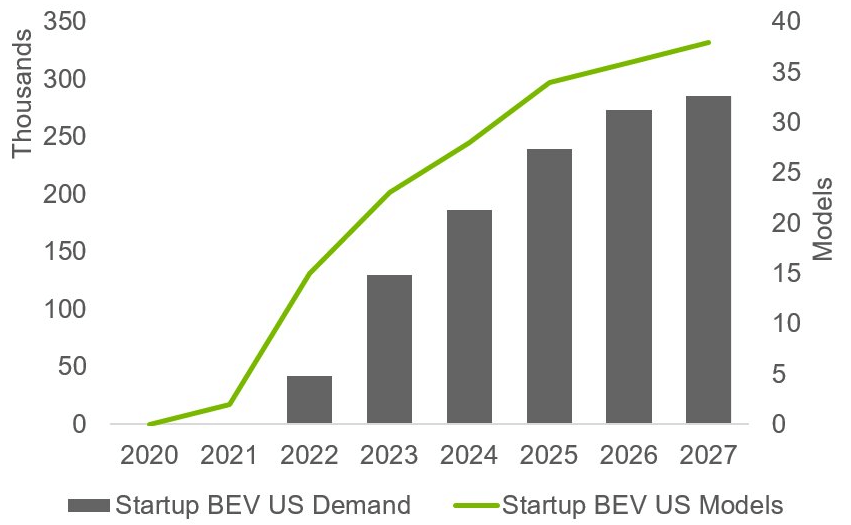
According to LMC Automotive, the startup EV brands in the U.S. are going to have nearly 40 models on offer in the U.S.
(Image: LMC)
However, LMC reckons that few of the new brands are likely to have sales of more than 50,000 units per year.
That said, a sufficient number of 50K-selling OEMs means that the sales are likely to be taken from the traditional OEMs.
However, LMC thinks that it is going to be costly for the upstarts that build factories. The firm calculates that the capacity utilization of a given plant is going to be on the order of 30%, which is about 60% less than it really ought to be. (I.e., 30% capacity utilization means that 70% of the personnel and equipment are not making vehicles, which is the whole point of their being there.)
“In 2020, 48% of all EVs on the road could be found in China — more than the combined figure for the US and Europe. China’s EV fleet will be 60% of the world’s total by 2030. Xi Jinping has extended both the sales tax exemption on EVs and subsidies for domestically built EVs to the end of 2022.
“China’s large domestic market, raw materials access, and favorable government policies mean it will continue to dominate the EV landscape and won’t be as disadvantaged by the lithium shortage. Xi Jinping has facilitated the growth of the domestic EV market, causing Tesla to lose market share in China to BYD. This is not only to cement China’s dominance in EVs but also to help meet the net zero target year of 2060.”–Amrit Dhami, Thematic Analyst at GlobalData
Volkswagen Group—Volkswagen, Volkswagen Commercial Vehicles, Škoda, SEAT, CUPRA, Audi, Lamborghini, Bentley, Ducati, Porsche—announced its combined electric vehicle sales on a global basis for 2021.
The company delivered 452,900 battery electric vehicles in ’21, a 95.5% increase over ’20 numbers, when it delivered 231,600 units.
The vehicles that are the biggest contributors:
Volkswagen ID.4: 119,600 units
Volkswagen ID.3: 75,500 units
Audi e-tron: 49,200 units
ŠKODA Enyaq iV: 44,700 units
Volkswagen e-up!: 41,400 units
Porsche Taycan: 41,300 units
Of that, the ID.3, Enyaq iV and e-up! are not available in the U.S. market. That represents a total of a non-trivial 161,600 units.
Here’s something to consider about that 452,900 EVs:
The Group delivered a total 8,882,000 vehicles in 2021.
One of the things that OEMs are touting is the range that their electric vehicles can travel before they need a charge.
This, of course, is a means by which the dreaded consumer “range anxiety” with EVs can be assuaged.
For example, when Mercedes introduced its VISION EQXX concept car last week one of the points that people stressed about this sleek concept is that it has a range on the order of 620 miles.
When Chevy introduced the 2024 Silverado EV it noted that it has an estimated range of 400 miles.
While not a Mercedes, think about a Hyundai Sonata Hybrid. Stylish. Seats five. Fully fitted with tech. Depending on which trim level, it returns a combined miles per gallon rating of either 52 mpg or 47 mpg.
So, with its 13.2-gallon fuel tank, this means that you have range of 686 miles or 620.4 miles. In a car that you can buy today. (Assuming that you can find one.)
Then the Silverado.
While the numbers aren’t available for the 2022 3.0L I-6 turbo-diesel, there are for the ’21 model with that engine. The 4WD truck has a combined miles per gallon rating of 26 mpg.
The Crew Cab has a 24-gallon tank.
So this means that the Silverado diesel has a range of 624 miles.
Somehow that electric 400-mile range is impressive only for an EV.
And then, of course, there is that whole thing about charging.
One of the features of the ’24 Silverado is that thanks to its fast-charging capability, one can get 100 miles of range within 10 minutes.
According to the American Petroleum Institute, it takes an average of two minutes to fill a vehicle with liquid fuel.
Somehow that 10-minute charge doesn’t seem all that impressive.
The morning of General Motors’ reveal at CES in Las Vegas of new electric vehicles—most notably the Chevrolet Silverado EV pickup truck and also the Chevy Blazer EV and Equinox EV, which will be coming in 2023 and ’24—the most-read op-ed column in The Washington Post was entitled, “Imagine Virginia’s icy traffic catastrophe – but only with electric vehicles.”
WaPo editorial writer and columnist Charles Lane relates the story of a Canadian semi driver stuck in the storm’s 40-mile backup on I-95 in Virginia earlier this week. A Tesla driver knocks on the semi’s door and tells the trucker that his kids are stranded in the car and there’s no way to recharge the EV. The truck driver, who told the story in his Twitter account @MyWorldThroughaWindshield, gave the Tesla driver water, a spare blanket and a mylar thermal blanket.
Lane points out that pure-electric vehicles lose range in cold weather and cannot be revived as easily as a petroleum-fueled vehicle. To make the Tesla driver’s prospects for recharge tougher, the power grid failed in parts of Virginia Monday night.
As Gary Vasilash notes in his post “Still the EV Charging Question,” there is no solution in sight for how to quickly re-charge electric vehicles that run out of juice between any two charging points.
But the source of the problem is far older than the accelerating shift from internal combustion engines to EVs. The core issue is the priority the U.S. gave in the last century to designing and building infrastructure centered around the automobile.
In his column Lane references GM’s EV commercial for last year’s Super Bowl, in which Will Ferrell satirically takes on Norway for its then-actual 54% EV market share (which increased to 65% in 2021). Norway is much colder than most of the U.S., though with a much smaller population, and it’s beginning to back out of “massive” EV subsidies. Then the columnist gets to the core of the country’s advantage regarding EVs: In Norway “a mere 10% of workers in the largest city – Oslo – commute by car.”
Eureka. Transportation alternatives are a way of life in places like Norway. That makes a big difference.
Meanwhile, back in Virginia after the huge mid-Atlantic storm, Senator Tim Kaine (D-VA) spent 26 hours, 45 minutes driving up I-95 to Washington, D.C., for a voting rights meeting—a drive that usually takes two hours. Kaine told NPR’s All Things Considered he once took a bicycle ride from Richmond to D.C. in an event with Virginia police officers one Memorial Day weekend, “basically the same ride up Route 1,” in 13 hours.
Now, I’m not the least-bit anti-car, and I’m not advocating a wholesale shift to alternative transportation sources. But our overcrowded highways, freeways and city streets have long been an anathema to any pleasure associated with driving.
The clean, efficient way to commute in that part of the country should be an electric-powered commuter rail system, though it’s far too late for that.
The best we can hope for is to face 40-mile snow-clogged traffic jams with EVs rated 400+ miles of range (probably 325-350 miles in cold weather) and a proliferation of recharging systems along the way. That’s assuming we can afford such EVs, as even ICE-powered new vehicles average more than $46,000. Middle-class commuters can always get a deal on a three-year-old off-lease EV featuring yesterday’s state-ot-the-art range, while the working class – the people who drive the snowplows, semi-trucks and emergency vehicles – get to work in our gas- and diesel-powered trade-ins.



 shinymetalboxes