Lyten Is Building a Better Battery

That’s the goal of on-going work in San Jose. It is using lithium sulfur and a 3D grapheme that it has developed.

By Gary S. Vasilash

One of the more interesting aspects of the on-going transition to electric vehicles (EVs) is that there are all manner of companies that are pursuing the technology, not only companies like Foxconn, more ordinarily associated with making things like iPhones rather than EVs, but a growing number of companies whose names are new, typically companies based in Silicon Valley who are busy developing things ranging from control software to batteries.

One such company is Lyten, which is based in San Jose, not exactly a place associated with motor vehicles (although the Tesla plant in Fremont is close, and there used to be a Ford assembly plant in San Jose, although it closed in 1983 and eventually became a shopping mall).

One of the cofounders of Lyten is Dan Cook, currently the company’s CEO. Cook began his career working at GM but has spent the better part of it in the tech space in northern California.

As he describes his professional point of view, “I’m half auto, half tech.”

Which is a good thing for someone who is working for a company that is undoubtedly hoping to become a supplier to a vehicle manufacturer.

Lyten is developing batteries.

The batteries it is working on are based on three-dimensional graphene and use a lithium-sulfur chemistry rather than the currently conventional lithium nickel manganese cobalt (NMC) chemistry.

Cook, on this edition of “Autoline After Hours,” explains why the three dimensional grapheme is important to the batteries and the benefits of using sulfur rather than NMC for batteries. Among the benefits are energy density, which means long range, and another is that the materials used can be domestically sourced, which is advantageous as regards the supply chains that we are so now very aware of.

As for the chemistry part of it, let’s just say that you should want the show because Cook provides a better description of it than any summary here could.

Cook talks with “Autoline’s” John McElroy, Christie Schweinsberg of Ward’s Intelligence, Dave Tuttle of the University of Texas Energy Institute, and me.

And you can watch it here.

A New Old Truck Concept from Ford

Something a couple of electric motors can do

By Gary S. Vasilash

Ford Performance, working with MLe Racecars and the Roadster Shop, has developed the F-100 Eluminator concept—an electric truck.

It is based on a 1978 F-100 pickup, which explains the retro styling (i.e., because it is retro).

F-100–customized with electric motors. (Image: Ford)

But bringing the truck up to the moment, it features two electric traction motors—front and rear—which are the same type as those used in the Mustang Mach E-GT.

The traction motors produce 480 hp and 634 lb-ft of torque.

Eric Cin, Ford global director, Vehicle Personalization, Accessories and Licensing. “Our F-100 Eluminator concept is a preview of how we’re supporting customers as they go all-electric and embrace zero-tailpipe emissions performance, even for our heritage vehicles.”

One can only imagine that were a truck like the Eluminator pull up along side a [fill-in-the-blank performance car] at a stop light it would get a glance from the other driver. . .who would then stare at the taillights as the truck has left him behind.

GM BrightDrop Announces EV600 Build

An approach to vehicle production at a fast rate: have someone else do it

By Gary S. Vasilash

General Motors is proud because in a rapidly changing industry, it shows that it can go fast.

“Getting our first electric vehicles on the streets in record time before another peak holiday shipping season is the best gift we could receive this year, especially when we consider the supply chain headwinds the world is facing right now,” said Travis Katz, BrightDrop president and CEO.

BrightDrop is the GM business that is developing products—such as electric delivery truck and associated material handling equipment—for companies like FedEx Express and Verizon.

The classification is “eLCV,” for “electric light delivery commercial vehicle.”

Katz is referring to the production of the EV600.

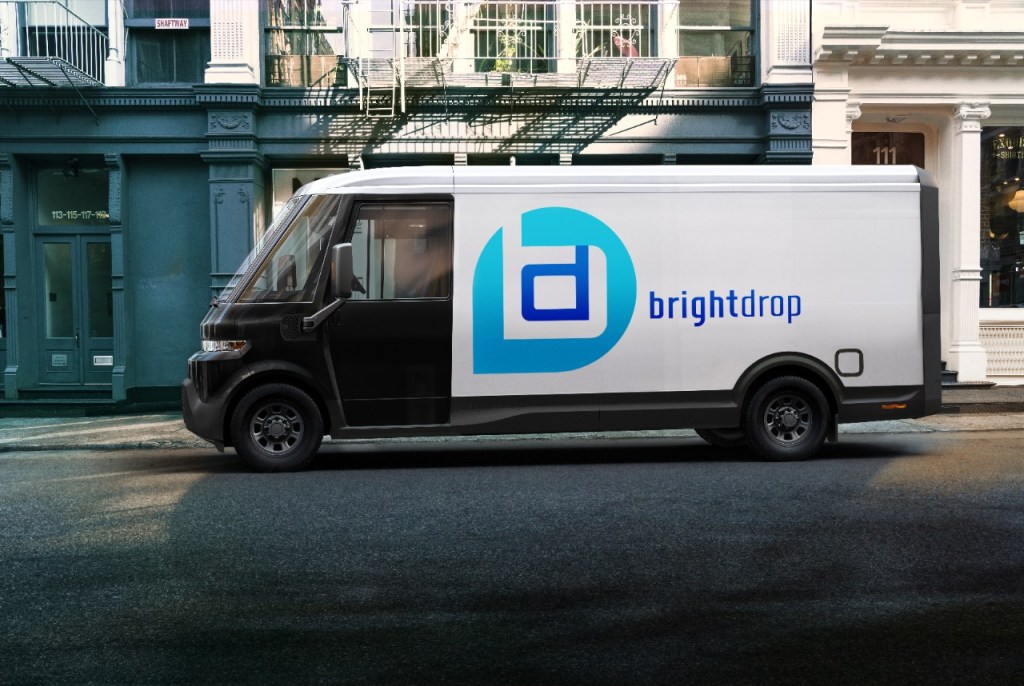
BrightDrop EV 600 (Image :General Motors)

From concept to development in 20 months.

Speaking of the build speed, Katz continued, “This is a strong statement to the market of how our unique operations setup, which marries the cutting-edge innovation, agility and focus of a technology startup with the scale and manufacturing might of a major automaker, can deliver real value to both customers and the planet.”

An interesting aspect of this.

The early builds of the EV600 were done for General Motors by automation supplier Kuka AG.

Perhaps that is the “unique operations setup.”

To be fair, GM will be building the EV600, the EV410 and possibly other vehicles at its CAMI Assembly Plant in Ingersoll, Ontario. The plant is currently being transformed for the production.

The first EV600 is expected to go off the line at CAMI in November 2022.

Or 13 months from now.

A Car, Not the Bond Film

Rolls-Royce getting somewhat closer to its first EV

By Gary S. Vasilash

Rolls-Royce Motor Cars (to give the full name its due) announced today that it is on the precipice (sounds fancier than “edge”) of testing its first full electric vehicle, named “Spectre.”

According to Rolls-Royce Motor Cars Chief Executive Officer, Torsten Müller-Ötvös, this is “an extraordinary new product that will elevate the global all-electric car revolution and create the first – and finest – super-luxury product of its type.”

Yes, it is absolutely true that it will be the first product of its type, as it will probably be the type.

As this is an electric vehicle (in disguise), presumably the smoke is supposed to evoke the name, “Spectre.” (Image: Rolls-Royce)

Citing the history of the company for some sort of presumed advantage in the EV space, Müller-Ötvös noted, “it was Charles Rolls who truly prophesied an electrified future for automobiles. In April 1900 he experienced an early electric motor car named the Columbia and declared its electric drive to be ideal.”

While that is certainly notable and impressive, that was also 121 years ago.

What’s taken Rolls (the company, not the man) so long?

And given that deliveries are expected to commence (better sounding than “start,” eh?) not until the fourth quarter of 2023, roughly two years from now, by which time it is hard to imagine that there won’t be EVs from essentially every automotive company on the planet, the excitement seems a bit, shall we say, outré.

Ford Lightning Pre-Production Underway

The first versions of the F-150 model are being built at the Rouge Electric Vehicle Center in Michigan

By Gary S. Vasilash

Ford is increasing its investment—to the tune of $250-million—at its operations at the Rouge Electric Vehicle Center, Van Dyke Electric Powertrain Center and Rawsonville Components Plant.

The reason?

The F-150 Lightning.

It also means 450 more jobs spread across the plants, all of which are in Michigan (Dearborn, Sterling Heights and Ypsilanti).

“We knew the F-150 Lightning was special,” said Ford executive chair Bill Ford, “but the interest from the public has surpassed our highest expectations and changed the conversation around electric vehicles.

“So we are doubling down, adding jobs and investment to increase production,” Ford added.

“This truck and the Ford-UAW workers who are assembling it in Michigan have a chance to make history and lead the electric vehicle movement in America.”

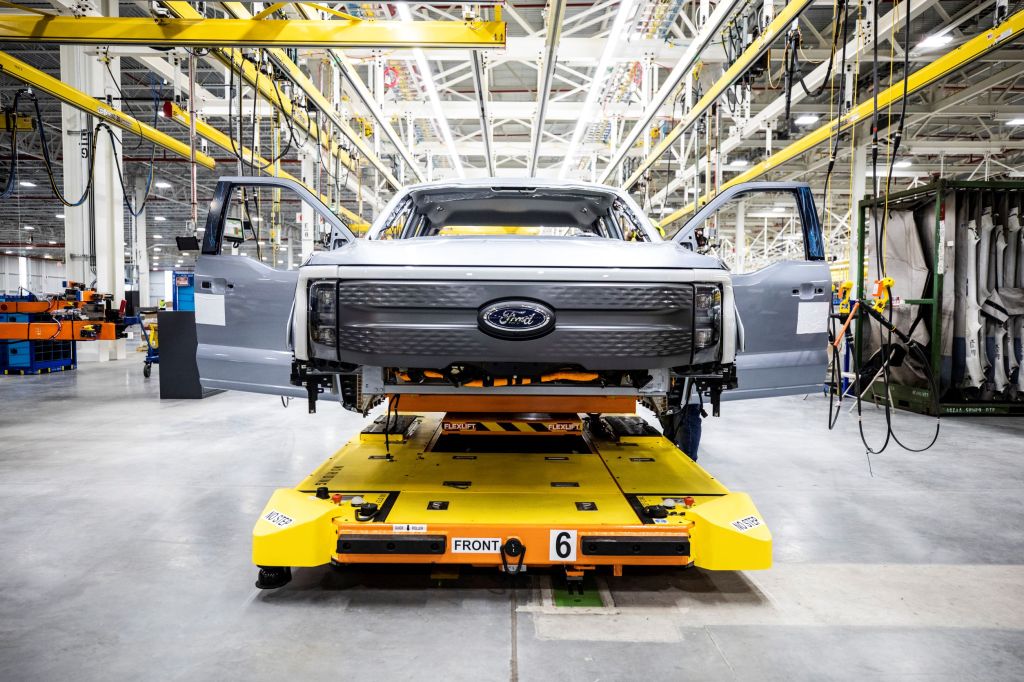
Pre-production underway for the all-electric F-150 Lightning. (Image: Ford)

Ford has taken more than 150,000 reservations for the full-size electric pickup that has an estimated range of 300 miles and a starting MSRP of $40,000. (It is worth noting that the reservations require $100—which is refundable.)

The Lightning is another in the F-150 offerings, which has been the best-seller in the U.S. for 44 years running.

Pre-production is underway for the Lightning, with consumer vehicles planned for availability in the spring of 2022.

Safer Is Better

Technologies that are beneficial when you’re behind the wheel or simply a rider

By Gary S. Vasilash

One of the factors of an electric vehicle that is often overlooked—unless you happen to be a first responder—is that when there is an accident and the vehicle needs to be quickly accessed, said vehicle can be “hot”—not (necessarily) a battery fire—but as regards the electrical current that is running through the vehicle.

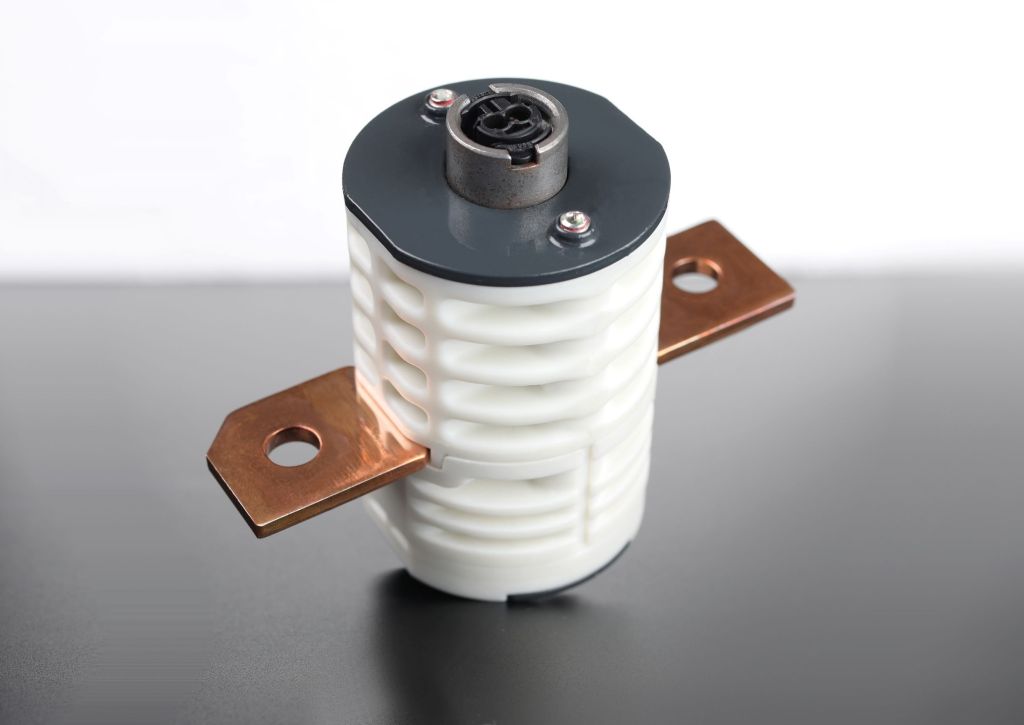
Device is pyrotechnically actuated to severe the high-voltage line in an EV should there be an accident. (Image: Joyson Safety Systems)

So to address this potential hazard, Joyson Safety Systems developed a pyrotechnic device that is triggered by a vehicle’s ECU in the event of an accident and cuts the electric high voltage connection within a matter of milliseconds.

This is just one of the clever products that has been developed by Joyson. Some of these devices are in use on vehicles right now (e.g., Tesla put that high voltage electric line cutter into vehicles in 2017; the system that monitors whether a driver is paying attention when GM’s Super Cruise is activated is a Joyson development, as well).

So to discuss these and other developments, on this edition of “Autoline After Hours” we are joined by Jason Lisseman, vice president, Global Product Line, Integrated Safety Systems, Joyson Safety Systems. Lisseman talks with “Autoline’s” John McElroy, Bengt Halvorson of Green Car Reports, and me.

One of the more interesting—and unusual, though absolutely useful—developments Lisseman describes is a sensor that detects and classifies the air quality within a vehicle.  As he explains, as there are shared, autonomous vehicles, it may be that whomever was in the vehicle before you was rather, um, fragrant, and so having a sensor that will be able to make a determination that the interior is odiferous and need some attention before other passengers climb in can make a big difference.

In addition, McElroy, Halvorson and I discuss a variety of other issues, including the GM battery problem with the Bolts, public charging issues and much more.

Which you can see right here.

Mazda: Looks Aren’t Everything

The MX-30 EV has a problem, and that is how it is engineered

By Gary S. Vasilash

When it comes to vehicle styling, Mazda is a stand-out company. It is remarkable how the company has consistently brought out vehicles with the sheet metal shaped and formed in ways that would only be in the “concept car” category for other OEMs, and even then they might hesitate.

And Mazda has kept the Miata (which is officially known as the “MX-5,” but even though that’s been the case for some years, it will always be the Miata) in production when those people wearing the proverbial green eyeshades would have struck it from the list of offerings a long, long time ago.

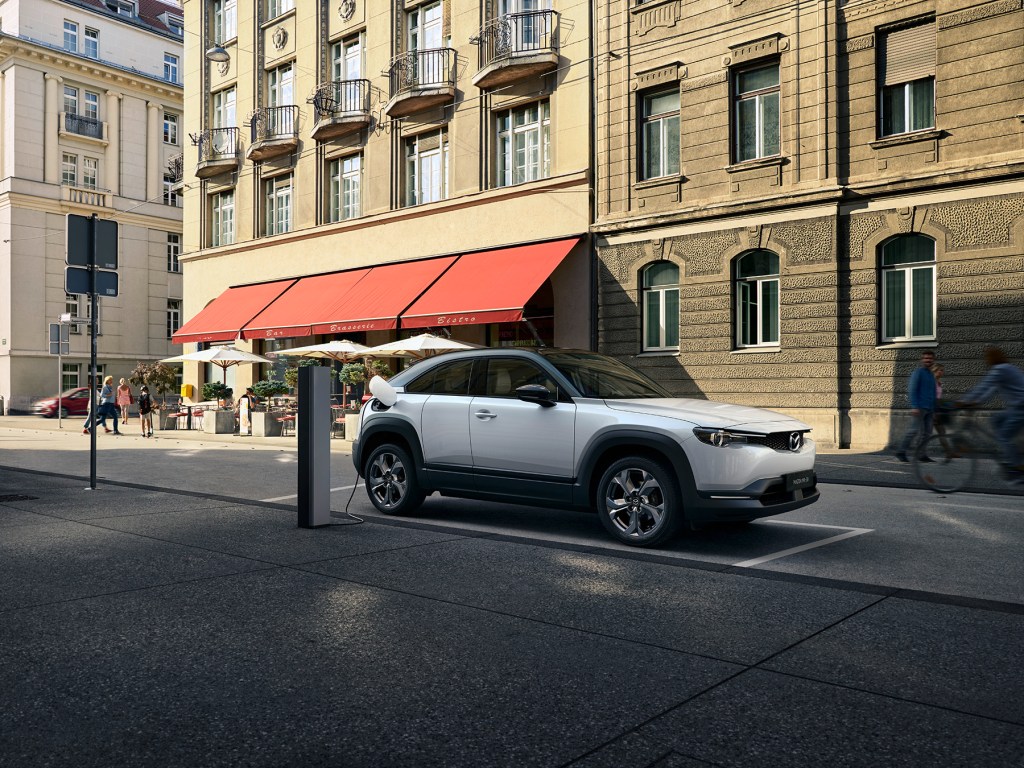
2022 Mazda MX-30 EV: Looks good. Doesn’t go far. (Image: Mazda)

That Mazda has continued is a testament to what could be called “pluckiness.”

And the auto industry is a better place for it.

Which brings me to the forthcoming 2022 Mazda MX-30 EV.

And why I think it is going to be, well, let’s just say not particularly successful.

Yes, it is a crossover, which is good in the market.

Yes, it continues with the Kodo design language, evolved, which is good for everyone who looks at vehicles.

Yes, it probably has a great interior, as this has been something that Mazda has been consistently brining to market. (Apparently the interior of the MX-30 features cork, a nod to the company’s founding more than a century ago as a cork manufacturer.)

Yes. Yes. Yes.

But.

It has an EPA estimated range of 100 miles.

That is absolutely insufficient.

Mazda evidently knows that because for owners of the MX-30 (and know that the vehicle will be available in California, not other markets) there is what it is calling the “Mazda MX-30 Elite Access Loaner Program,” which provides access to other Mazda vehicles—all of which have a >100-mile range—for up to 10 days per year for three years.

The base MSRP is $33,470. And just 100 miles?

Rivian’s Second Factory

And what about its first?

By Gary S. Vasilash

Word is that Rivian, the company that will be producing an electric pickup—the R1T—and an SUV—the R1S—at its factory in Normal, Illinois (quite a name for a burg, if there ever was one), where it is also producing commercial vehicles for Amazon, which is one of its investors (as are Ford, Cox Automotive and others), is looking for a plot of land upon which to build a second factory with a 200,000-vehicle per year capacity.

Seems like the company has big aspirations.

And on the subject of big, it also seems that Texas has the inside track on the factory.

But here’s the thing: the 2.6-million square foot factory in Normal has capacity of over 200,000 vehicles.

You’d think, perhaps, that they would want to make sure that (1) they have all of the bugs worked out of the processes and (2) that they would have sufficient demand for their vehicles before looking to spend a rumored $5-billion on a second factory.

Of course, factories don’t go up overnight.

That said: Might this not be a bit premature?

About Charging the BMW iX3

It is quick. But that’s still slow

By Gary S. Vasilash

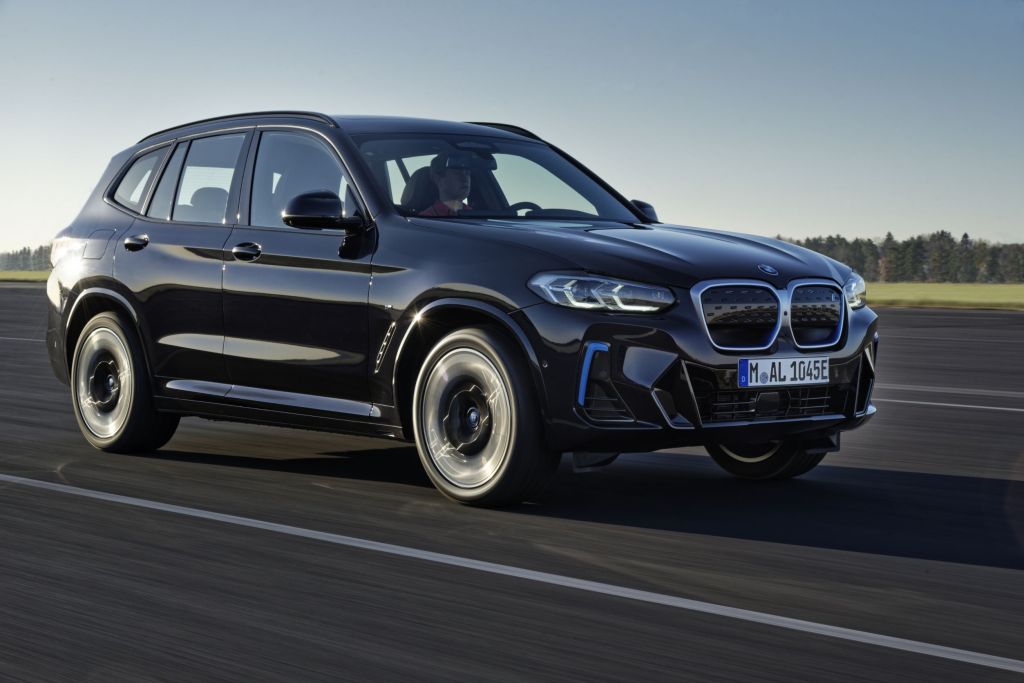
According to information about the new BMW iX3 (the UK version) we learn such things as the fact that there are 188 prismatic cells in the battery that have a gravimetric energy density that’s about 20% higher than that of the previous pack.

The new BMW iX3 has range on the order of 280 miles. (Image: BMW)

There is BMW’s fifth-generation eDrive technology that brings along a charging unit that provides power to both the 400V battery and the 12V on-board power supply.

As for the charging, when using AC it will permit single- and three-phase charging at up to 11 kW.

However, when plugged into a DC fast charger, it can charge at up to 150 kW. This means it can go from a 0% state of charge to 80% in 34 minutes.

There is another set of numbers that are striking. The BMW iX3 can charge the vehicle so that it can travel up to 62 miles (based on the WLTP test cycle, which is generally more generous than EPA figures) in 10 minutes.

While 10 minutes isn’t a whole lot of time, 62 miles of distance isn’t a whole lot of range.

According to the EPA, the average fuel economy for light-duty vehicles in 2020–cars, pickups, and cargo vans less than 8,500 pounds GVWR and SUVs and passenger vans up to 10,000 pounds GVWR—was 25.7 mpg.

The flow at your local gas pump (assuming you’re in the U.S.) is limited to 10 gallons per minute.  Which means that a light vehicle can get 257 miles of range in one minute.

Somehow people are going to have to get used to spending more time at a service station.

Why 2030 Isn’t Going to Be All That Different from 2020

Yes, there will be more electric vehicles. But not all EVs. So internal combustion engines need improvement.

By Gary S. Vasilash

Bosch, Sujit Jain, president, Powertrain Solutions for Passenger Cars, Commercial & Off-Road, and Electric Vehicles at the company’s North American operations, points out, has been advancing—and producing—technologies for the auto industry essentially for as long as there has been an auto industry.

And today isn’t any different.

The company is not only making massive investments for developing and utilizing Industry 4.0 capabilities, but it is investing heavily in the development and production of everything from microprocessors and fuel cells in order to advance the functionalities and performance in the auto industry.

It is committed to the electrification of vehicles, whether this makes the form of hybrids, full battery electrics or fuel cell powered vehicles.

But while Jain says company projections have it that the number of battery electric vehicles in the U.S. will grow from about 2% of the market in 2020 to 30% by 2030, that still leaves 70%, the large percentage of being combustion engines. Yes, they may be hybrids, but there is still gasoline or diesel being burned.

So one of the things that Jain and his colleagues are doing is developing the ways and means to increase the efficiency of those engines, both in terms of performance and emissions reduction.

Some of the things that they are pursing, Jain says on this edition of “Autoline After Hours,” include synthetic fuels, electrically heated catalysts to reduce cold-start emissions, and hydrogen fuel injection (i.e., instead of a hydrogen fuel cell, this would be a combustion engine running on hydrogen).

Jain talks with “Autoline’s” John McElroy, Kelsey Mays of Cars.com, and me on this show.

After Jain’s segment, the three of us talk about a variety of subjects, including former Nikola head Trevor Milton being charged with three counts of criminal fraud related to the company he founded; Tesla’s Q2 financials ($1.14-billion in GAAP net income), the possible consequences of it opening up its charging network to other brands, and the move from upscale-shopping districts for its stores and galleries to lower-end real estate; Magna’s growth and technological breadth; and more.

And you can see it all here.