Better Than Having the Mats Thrown In

Ford makes it easier for EV buyers to charge at home. What do Bronco buyers get?

By Gary S. Vasilash

Earlier this year the Boston Consulting Group released a report that says, in part, “perhaps the biggest challenge for OEMs is to produce the next generation of EVs profitably. We estimate that most OEMs currently lose around $6,000 on each EV they effectively sell for $50,000, after accounting for customer tax credits.”

Given that the current generation of EVs is what’s presently on dealer lots, that’s lots of money that the legacy OEMs are spending to move the metal.

But because of the billions of dollars they have spent on building out the capacity to produce EVs, they want to keep the production lines running.

Consequently, they are coming up with things that will make EVs more appealing to customers, the $6,000 be damned.

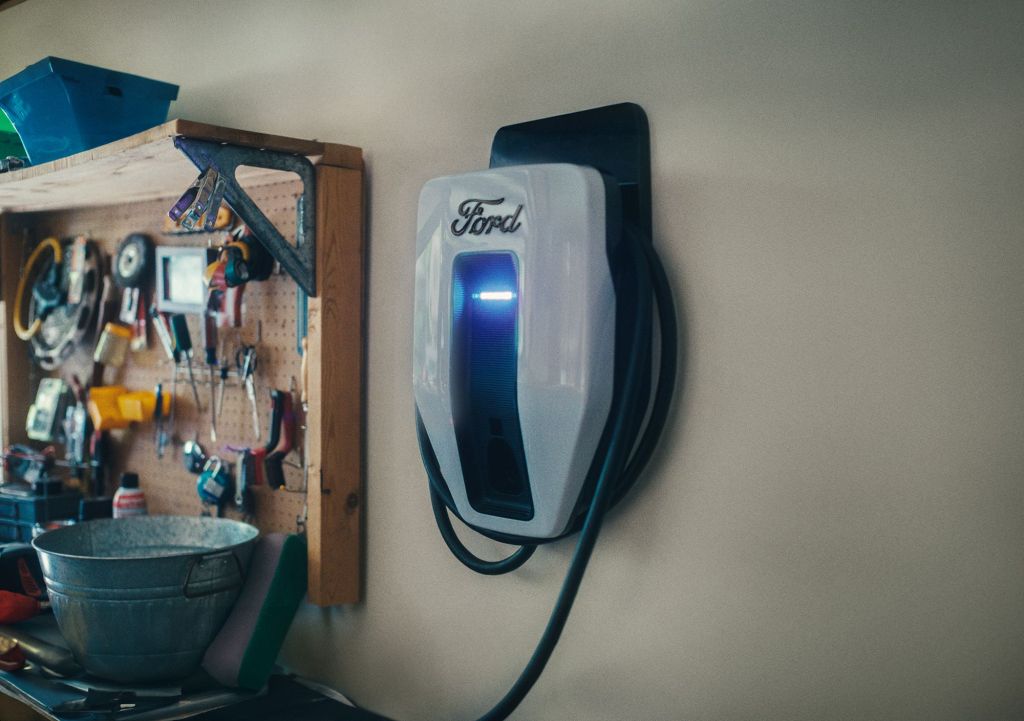
Buy an EV. Get a charger. (Image: Ford)

Earlier this week Ford CEO Jim Farley wrote, “Cheap lease deals on electric vehicles are popping up everywhere. Ford believes it will take more than jumbo rebates to truly break through with the estimated 19 million people in the U.S. interested in electric vehicles.”

Note that he writes “it will take more”—something additive. The rebates and incentives are still part of the game.

Farley goes on to provide details on how Ford is addressing this, through what they call the “Ford Power Promise.”

To provide ease of mind for people, this includes such things as complementary roadside assistance, expanded 24/7 advisor support, and the ability to use its Plug and Charge service that allows a driver to plug in at a charging station and have the electricity charged to the driver’s FordPass account.

But perhaps most significantly, Farley writes: “Buy or lease a retail Ford Mustang Mach-E, F-150 Lightning or E-Transit and take a complimentary home charger with you or have it delivered, and when you’re ready, an expert comes out to install it at no charge for a standard install.”

That’s right: Ford is paying for customers to have home charging capability, something that costs, on average, $1,000.

This could be a clever marketing approach to getting more people in Ford EVs now (the offer expires on January 2, 2025) and presumably next-gen EVs—after all, if the charger is there, people probably figure they might as well use it.

Consider that both the Mach-E and the E-Transit qualify for the IRA tax credit of $3,750 and the F-150 Lightning the full $7,500.

Go buy an Explorer or Bronco and the only tax-related thing will be the sales tax that you’re paying.

Seems that this EV transition is not only costing the OEMs an enormous amount of money, but let’s face it: the government isn’t magically making those credits appear, so all tax payers are kicking in, as well.

EVs: Still Waiting for that Moment

A few thoughts from the Cox Automotive Q3 assessment. . .

By Gary S. Vasilash

While new EV sales are growing—remember, this is from a small base, so the growth in total numbers is not all that impressive—used EV sales are really doing quite well, or so the numbers from Stephanie Valdez Streaty, director of Industry Insights, Cox Automotive, who has a keen focus on EVs, indicate.

That is, year over year there is an increase of 64.4% for used EVs while new ones year-over-year it is up 12.6%.

In August there was a 90-day supply of new EVs. There was a 38-day supply for used EVs.

Still Pricey

One likely reason for the increased used EV sales is that the average transaction price in August was $35,937, compared with $56,574 for new EVs.

Realize that the now-used EVs probably had an ATP north of $56,574 when purchased new, so the buyer of a used EV is undoubtedly getting quite a well-loaded vehicle for the money.

I wonder whether a second used buyer will be all that interested in a vehicle, given concerns about battery longevity.

Leases Matter

In the new EV market leasing continues strong, Valdez Streaty noted. At 39% she says it is almost double the industry average. This probably has something to do with the ability to get IRA tax credits for EVs assembled in the U.S. And luxury vehicles, of which there are still plenty with EV powertrains, tend to have more leases than mainstream vehicles, so it makes sense to lease.

Overall Numbers

Looking at the powertrains in vehicles in August, ICE vehicles are at 81.6%, EVs at 8%, hybrids at 8.5% and PHEVs at 1.9%.

If you think about it, as OEMs began to pour money into EVs they subtracted from hybrids (e.g., the Ford Explorer had been offered with a hybrid, but the ’25 model doesn’t have one).

The company that didn’t pull back on hybrids—which actually continued to expand its offerings—is Toyota. Valez Streaty says that in Q2 2024 Toyota had 47% market share for hybrids—more than twice Honda’s second-place 20%.

Ford, it is worth noting, came in third at 14%, undoubtedly thanks to the F-150 PowerBoost Hybrid model.

Hybrids are typically referred to as a “transitional technology.”

Seems that that transition is going to take a whole lot longer than those outside Toyota anticipated.

Honda: EVs and Beyond

How it is going to leverage manufacturing to advantage

By Gary S. Vasilash

Ostensibly the briefing was to see up-close-and-personal the Acura Performance EV Concept which had only otherwise been shown during Monterey Car Week.

Who doesn’t want to see what is likely to be very similar to the electric vehicle that is going to go into production in Ohio in late 2025?

Acura Performance EV Concept. (Image: gsv)

Two points about the concept:

  1. It is a concept vehicle, something that is becoming less and less common in the industry today—because of the time, effort, energy, and investment made in these full-scale models. Sure, there could be the argument made that this can all be done digitally. But Honda and Acura have those digital tools, too, and there is something to be said for a physical model.
  2. Dave Marek, who is executive advisor for Design for Honda R&D and Global Honda (which essentially means he’s the go-to guy for design considerations across the company), points out that Honda and Acura typically hew rather closely to their concepts when it comes to production vehicles, so the Acura Performance EV Concept, which he says features “hydrodynamic design” principles—think “superyacht”—may be something rolling off the line at what is being called the “Honda EV Hub.”

Which brings us to the second part of this, which is an explanation of the strategy and the tactics of the EV Hub by Mike Fischer, who is the lead on the project and an executive chief engineer to boot.

First of all, the “Hub” is not a singular place.

Rather, Honda is retooling the Marysville Auto Plant, the East Liberty Auto Plant, and the Anna Engine plant to have the capabilities to produce EVs in a highly efficient manner that produces high quality, consumer-valuable products, processes that are both human- and environmentally-friendly.

But here’s the thing, and not something that Fischer and his colleagues just came up with during the past few months when EV sales softened.

Fischer explains that this “reimagining of Honda manufacturing” is something that is predicated on flexibility.

So they are developing production capability that will allow them to build EVs, hybrids, and ICE-vehicles all on the same line.

(One way this will be accommodated is by having feeder lines that will do the subassemblies for the varying types of vehicles that then feed into the main line.)

Yes, they are developing a dedicated EV platform that will allow various models to be derived from it.

Yes, they are installing 6,000-ton high-pressure diecasting machines—there will be six of them—in the Anna plant to perform “megacasting” of the Intelligent Power Unit (IPU) case; the case houses the battery and associated electronics and functions as part of the vehicle platform.

But what’s notable is that in this undertaking, which the company is investing more than $5-billion and which will serve as a model for Honda facilities around the world, Honda is getting back to its manufacturing roots in essentially taking a clean-sheet approach to the way things are done.

While product certainly matters, the ability to produce those products so that they meet customer demands—cost, quality, availability—is something that Honda has shown itself to be superb at over the years, so while some argue that it is comparatively late to the game in terms of EVs, the flexible manufacturing capability Fischer and his team are developing will more than make up for any delay—and will provide Honda and Acura with the powertrain options that its customers are looking for.

That will put it not merely in the game, but quite possibly ahead of it.

BMW + Toyota = >H2

The hydrogen collaboration continues. . .

By Gary S. Vasilash

(Image: BMW)

You might recognize the building in the background. BMW headquarters in Munich. The four cylindrical towers (partially obscured here) that are meant to resemble the four cylinders in a combustion engine.

Then you look at the vehicles. The one on the left and the center are from Toyota, a Hilux and a Mirai; the one on the right a BMW iX5.

All of these vehicles are powered by hydrogen.

The two gents are Oliver Zipse, Chairman of the Board of Management of BMW AG (left) and Koji Sato, President and Member of the Board of Management (Representative Director) Toyota Motor Corporation.

The two are shaking on their further partnership in the development of fuel cell electric vehicle (FCEV) technology.

Toyota has had FCEVs available to consumers.

Soon—or at least by 2028—the same will be said of BMW.

Zipse:

 “This is a milestone in automotive history: the first-ever series production fuel cell vehicle to be offered by a global premium manufacturer. Powered by hydrogen and driven by the spirit of our cooperation, it will underscore how technological progress is shaping future mobility. And it will herald an era of significant demand for fuel cell electric vehicles.”

Whether that demand is going to become real remains to be seen.

Sato makes a solid point, one that other OEM execs probably wish they could make, even though they were probably feeling really good when Toyota was being criticized for not going all-in on battery electric vehicles:

“In our long history of partnership, we have confirmed that BMW and Toyota share the same passion for cars and belief in ‘technology openness’ and a ‘multi-pathway’ approach to carbon neutrality.”

For the foreseeable future, there isn’t going to be one approach to reducing carbon and those legacy OEMs that recognize that will be the market leaders.

Isn’t smart Small?

Once small. Not anymore.

By Gary S. Vasilash

When it was first launched in October 1998 the smart Fortwo was small. 2,540 mm (yes, millimeters) long and with a 1,810-mm wheelbase. The name of the car explained the number of people who could fit.

But with time there has been significant inflation.

Speaking of the vehicles offered by the company that is a joint venture between Geely and Mercedes, that is.

(Mercedes designs what are now EV-only models from the marque; Geely does all of the development and engineering.)

And now this. . .

smart has introduced a new model, the #5, a mid-size SUV.

The smart #5. The once innovative purveyor of small city cars is now producing mid-size SUVs like every other company. (Image: smart)

It is 4,705 mm long and has a 2,900-mm wheelbase.

Or nearly twice as long as the original smart.

That increased size is handy in one regard—if you plan to sleep in the #5.

According to smart, the seats can be folded so that there is the ability to create a “king-size, queen-size or single mode sleeping space.”

The #5, which has a range of 740 km (460 miles)—on the China Light Duty Vehicle Test Cycle—could be the ideal choice for Uber drivers who essentially live in their cars.

Given that with the exception of things that have undergone shrinkflation increased size seems to be desirable, perhaps a larger smart is a smart idea. (The necessity of another midsize SUV, however. . .)

Financial Experience Should Help Polestar

New CEO has CFO experience on his CV. . .

By Gary S. Vasilash

Earlier this year Polestar Automotive had a bit of difficulty with getting its annual report put together. That nearly had the EV company delisted from Nasdaq.

But it resolved that issue.

Then in July the company announced it “received notice from the Nasdaq Stock Market LLC that the Company is not currently in compliance with the $1.00 minimum bid price requirement, as set forth in Nasdaq Listing Rule 5450(a)(1).”

This means that it needs to have a closing price of at least $1 for 10 consecutive business days. (It has until January 2 to meet that requirement. Then it has the opportunity to get 180 days beyond that.)

Which is to say that it still isn’t out of the proverbial woods yet vis-a-vis Nasdaq.

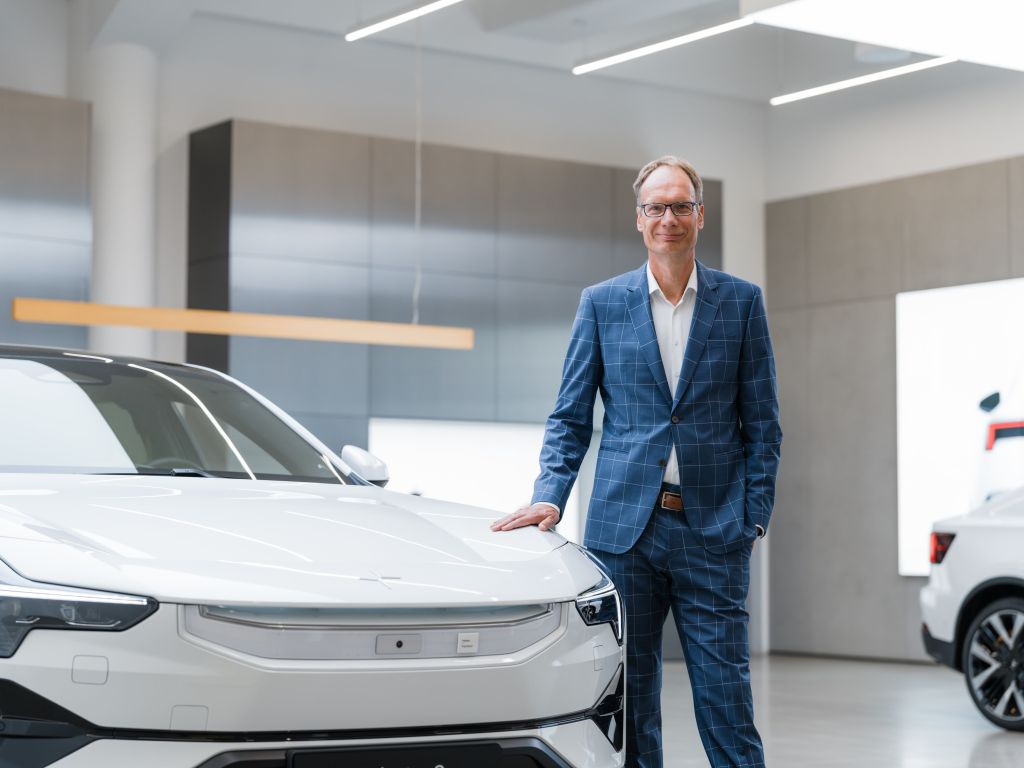
Today the company announced that its original CEO, Thomas Ingeniath, has resigned, effective October 1.

He is to be replaced by Michael Lohscheller.

Lohscheller has an extensive career in the auto industry.

Forthcoming CEO of Polestar, Michael Lohscheller. (Image: Polestar)

His resume includes being chief financial officer of Mitsubishi Motors and CFO at Volkswagen Group of America. (CFOs aren’t as flashy as CEOs or chief technology officers, but their guidance is essential to the operation of a company because at the end of the day, black ink

He was CEO of Opel.

In July 2021 he was named president of Vinfast. That lasted until late December 2021.

Next up, he went to Nikola Motor in February 2022 as president. That lasted until August 2023.

And now Polestar.

Presumably Lohscheller’s financial acumen will serve him well at Polestar.

He’ll need it.

The trying situations of his last two employers in the U.S. market should be good experience for Lohscheller.

2024 Toyota bZ4X Limited AWD

You’ve got to start somewhere. . .

By Gary S. Vasilash

This is the interior of the first-generation Toyota Prius (2000):

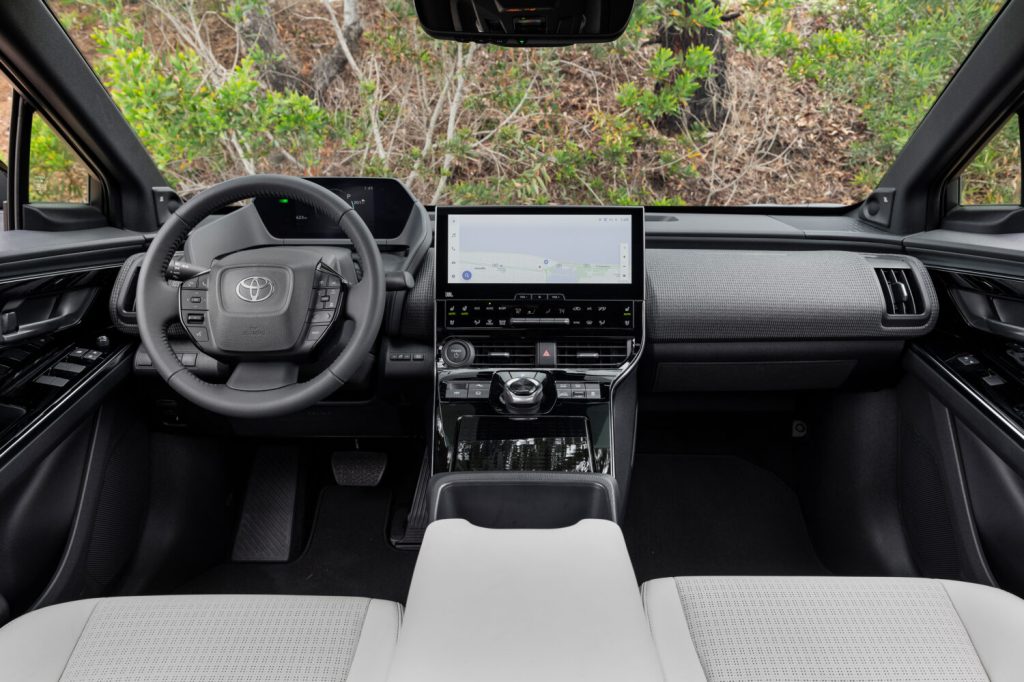
This is a similar shot of the first-gen Toyota bZ4X (2024):

Yes, there is nearly a full demographic generation separating the two.

But the bZ4X makes me think of that Prius.

If you look closely in front of the steering wheel on that early Prius you’ll note that there is no conventional gauge cluster.

That info is displayed in the horizontal slot in the middle of the instrument panel.

There is a more-conventional gauge cluster in the bZ4X in a more-conventional location.

But it is in a binnacle, set further back than is the norm for gauge clusters.

The rationale for both executions is arguably the same: the driver should keep eyes on the road.

While the Prius execution left something to be desired on that account—as in if the driver keeps eyes on the road, then there is the possibility that because there is no ready check of the speed, that could be problematic in terms of potential speeding tickets (although that risk was ameliorated by the lack of pep when you got on the throttle)—the bZ4X approach requires but a slight downward adjustment of one’s eyes to check the speed, a better approach.

The first-gen Prius instrument panel was completely different.

And while the bZ4X’s is more conventional, centered on the standard 12.3-inch touchscreen, there is something of a uniqueness to the interior, such as the use of a fabric on the interior even in places where some polymer would ordinarily be placed and the lack of a glove compartment.

Ten years after the first-gen Prius was released, in a retrospective Toyota acknowledged:

“Not all early reviews were flattering. One car magazine said, ‘With a real-world 35 mpg, this is a car that neither enthusiasts nor greenies can fully embrace.’”

And so far as the bZ4X goes, not all reviews are flattering because the electric vehicle doesn’t go particularly far vis-à-vis competitive electric crossovers:

  • XLE grade has an estimated 252-mile range in a front-drive setup; 228 miles for AWD
  • Limited grade is 236 miles FWD and 222 AWD

So here’s the thing about the bZ4X that needs to be taken into account: This one is the first Toyota EV, just as that Prius was the first back then.

People liked the first-gen Prius sufficiently well that they bought it and did so in sufficient numbers that there were the second generation and beyond.

People who buy the first-gen bZ4X will probably like it sufficiently well—and there is good reason to, mainly that it is a Toyota, and so it comes with all of the confidence that that brand brings to one’s driveway—and it will lead to future Toyota EVs.

And while they will be better, the current one isn’t bad.

(all images: Toyota)

EV Public Charging Isn’t Doing Much Better

J.D. Power sees improvement. But were we grading on the usual scale. . .

By Gary S. Vasilash

The J.D. Power 2024 U.S. Electric Vehicle Experience (EVX) Public Charging Study is out, and the research firm finds improvement in that experience.

Sort of.

Said Brent Gruber, executive director of the EV practice at J.D. Power, “While the customer satisfaction scores for public charging continues to prompt concern, the results offer reasons for optimism.”

He’s undoubtedly an optimistic individual.

The study found that on a 1,000-point scale, the satisfaction with speed at Level 2 chargers has dropped 4 points to 451.

DC fast charger speed is more satisfying, up from 588 in 2023 to 622.

While that 34 point bump is good, remember Power is using a 1,000-point scale, so if you were in school and got that 622 on a test. . . .

And then there is the issue of non-charging. As in showing up at a charging station and not being able to charge.

Power found 19% of the surveyed EV owners had that problem. A one-point improvement over 2023.

The researchers found that nationwide 61% said the reason there was a wasted visit was because the charger was out of service or didn’t work.

Huh?

The average transaction price for an electric vehicle in July was $56,520, according to the latest figures from Kelley Blue Book.

So someone buys an EV for that price, glides into a charging station—and nearly one out of five times has to leave because the damn thing doesn’t work.

Yes, some 80% of EV owners charge at home, but that means some 20% of EV drivers don’t.

In addition to which, some of the 80% of EV drivers who charge at home are likely to take trips at some point—vacation or business—which could likely mean they need to charge along the way.

And they’re likely to find some 20% of those chargers out of order.

Owls and EVs

Nature meets AI for an EV deployment

By Gary S. Vasilash

(Image: MAHLE)

Is this some sort of artwork in the style of Louise Nevelson?

No.

It is a section of a fan-blade developed by automotive supplier MAHLE for fuel cell and electric commercial vehicles.

About the design of the “bionic fan blade,” Dr. Uli Christian Blessing, Head of Thermal Management Development at MAHLE, said:

“We learn from nature, it inspires us in many areas! . . . With the help of AI, we analyzed the peculiarities of bats, swordfish and many other ideas from nature and finally ended up with the owl, the silent hunter, as the main template for our new fan.”

The fan is said to provide a 4 dB(A) reduction in noise compared with a conventional fan. That’s a cut of about 50%.

In addition, it is 10% more efficient and 10% lighter than a typical fan.

The company plans to extend the fan deployment to passenger cars.

Apparently one of the times when the noise abatement is key is during charging. MAHLE says the quieter operation “increases comfort for drivers and residents alike.”

As well as people taking a stroll through the Walmart parking lot, where plenty of charging occurs.

2024 Genesis GV60 Performance AWD

It can cause envy. . .

By Gary S. Vasilash

I had the interior designer from another car company in the 2024 Genesis GV60.

He looked at that glowing orb embedded in the center console of the vehicle that recently won the J.D. Power U.S. Automotive Performance, Execution and Layout (APEAL) study in the small premium SUV category.

Yes, that is a glowing orb in the center console. (Images: Genesis)

That orb is actually called the “Crystal Sphere.”

It glows.

When the vehicle is started the sphere rolls over and exposes a dial that allows the gear selection (which is perhaps not as accurate a term given that the GV60 is an electric vehicle, and while EVs do have gears, they don’t have traditional transmissions with multiple gears that have to be run through for motive power, which explains, in part, why EVs have that torque from the get-go and why they are more efficient than ICE vehicles because there aren’t the mechanical losses).

The designer was intrigued by the Crystal Sphere, which I suppose is why it exists in the vehicle, although I think that the fit and finish—as well as execution and layout—of the rest of the interior is sufficiently interesting in and of itself, as in things like the patterns on the seating surfaces (which, like other items in the interior, are made from eco-friendly materials, but materials that seem like they are leather, for example).

Intriguing, all.

He told me that he thought that it was quite cool.

But then he began wondering aloud about the level of difficulty of fixing it were it to go wrong.

And then going back and forth, weighing the pluses and minuses, he finally concluded:

“We would never be able to use anything like that.”

And I could detect a bit of regret in his tone.

Elementary. . .

It’s the first dedicated EV model from Genesis.

When it was introduced, Luc Donckerwolke, chief creative officer of Genesis, said: “The GV60 is a symbolic model that materializes the unique values and the sensibilities that Genesis stands for. It offers a satisfying experience to our customers who want something valuable, but different.”

It can be opened with your face. (There is a near infrared camera in the B-pillar.)

It can be started with your fingerprint. (Further underscoring the notion of this is more than a crossover, but a highly sophisticated, comfortable, computer on wheels.)

It has two 160 kW motors, one in the front, one in the back. Which means 320 kW or 429 hp.

It has a 77.4-kWh battery that can be charged on a fast charger (>250 kW) from 10 to 80% in 18 minutes.

It—as in the model in question here—does have eco-friendly, but the seats are Nappa leather, which comes from things with four legs.

It has a 14-way power adjustable driver seat that not only has power lumbar (four-way), but even a cushion extension. (Notably, all trims have this seat.)

It has an infotainment system accessed via a 12.3-inch LCD display. The “tainment” portion is predicated on a 17-speaker Bang & Olufsen sound system.

It can tow. 2,000 pounds.

It has 101.1 cubic feet of passenger volume (think five people but two happier ones if they’re not joined by a third in the back seat).

It has 24 cubic feet of cargo volume behind the second row.

It has a 0.71-cubic foot frunk (think small microwave oven).

It has an EPA estimated range of 235 miles.

It has a starting MSRP of $69,550.