Underwhelming Domestic OEM EV Sales

If you listen to the pronouncements of traditional OEMs about their EV efforts, you’d think that there is probably some sort of parity vis-à-vis their internal combustion engine business.

As in GM (remember: “All in” on EVs) selling plenty of EVs, and the Ford F-150 Lightning being in demand the same way the ICE versions of the truck are.*

So it comes as a surprise how few EVs the traditional OEMs are selling in the U.S.

According to the just-released Kelley Blue Book “Electric Vehicle Sales Report” for Q3, when it comes to General Motors, year-to-date it has sold:

  • 49,531 Chevrolet EVs
  • 5,334 Cadillacs
  • 1,216 GMCs

That’s a total of 56,081 EVs over nine months. If we include Brightdrop commercial vehicle sales, it boosts the number to 56,414.

The GMC HUMMER EV was introduced in October 2020. During the past three years, there have been 2,071 of them sold. (Image: GMC)

GM sold 65,255 Chevy Trax models, or 15,761 more units than sales of the Bolt EV/Bolt EUV sold through Q3.

Meanwhile, over at Ford:

  • 46,671

To put that in perspective: during the first three quarters of 2023 it sold 56,427 of its giant Expedition SUVs. So the Mustang Mach-E, Lightning and E-Transit commercial van summed are nearly 10,000 fewer.

And while adding things together: GM and Ford combined sold 103,085 electric vehicles.

Meanwhile, according to KBB Tesla sold 493,513 EVs.

Think about that: two of the biggest, most legendary OEMs in the U.S. together sold about a fifth of a company that was established 20 years ago.

*To be fair, Stellantis brands (Chrysler, Dodge, Jeep) sold 0 EVs.

Ex-Apple Exec Goes to Ford

By Gary S. Vasilash

“I love creating new services businesses and this is the perfect chance to do just that.

“The auto industry is undergoing an unprecedented transformation, from gas engines to electric vehicles and from human to autonomous driving.

“At the same time, the basis for differentiation is shifting from the vehicles alone to the integration of hardware, software and services. I’ll be in the middle of something truly historic and am particularly fortunate to do that at Ford, which has been democratizing automotive technology for 120 years and counting.”

That’s Peter Stern, former vice president of Services at Apple, now president of the newly formed Ford Integrated Services.

His role will be to help the automaker in its undertaking of “building sustained, always-on customer relationships and capturing new, high-margin services, subscription and other digital revenue.”

Apple’s service’s business is certainly robust.

So Ford wants to achieve the same. Thus, Stern.

(It knows how much money it can make on its hardware (e.g., F-150). There is undoubtedly a huge upside on how much it could make on connected digital products.)

It is the stuff of headlines and reportage (like this) when there are people from companies like Apple joining auto companies.

Wonder if it works going in the opposite direction?

Ford F-150 Lightning & the Potential of Scale

By Gary S. Vasilash

As is widely known, there is a pricing benefit when lots of something is made.

The technical term is “economies of scale.”

Companies get to buy components in bulk and, like a giant pack of paper towel or a vat of peanut butter from Costco, the prices are consequently reduced.

That said, Ford announced today that it is cutting the prices for F-150 Lightning models. The Pro model on Saturday had an MSRP of $59,974. Now it is $49,995. A reduction of $9,979. Some 16% off.

And probably figuring those who would buy a Platinum Extended Range wouldn’t need to have as great a reduction, today the MSRP is $91,995, or $6,079 less than it was Saturday.

In announcing the price reductions, Marin Gjaja, chief customer officer, Ford Model e (the electric vehicle part of the company), said, “Shortly after launching the F-150 Lightning, rapidly rising material costs, supply constraints and other factors drove up the cost of the EV truck for Ford and our customers.”

That was a situation where economies of scale were not working.

Gjaja continued, “We’ve continued to work in the background to improve accessibility and affordability to help to lower prices for our customers and shorten the wait times for their new F-150 Lightning.”

Arguably they are getting better scale.

But there could be something else at play here.

Through the first half, Ford delivered 8,757 Lightnings.

As of this fall it will have the ability at the Rouge Electric Vehicle Center to produce 150,000 per year.

At the current rate, it would take a long time to get to 150,000.

Jeep? Ram? Huh?

By Gary S. Vasilash

The first half (H1) 2023 results for FCA US LLC—that part of Stellantis that is often referred to by the shorthand “Chrysler”—are out.

And look odd.

It is generally considered to be the case that the real U.S. crown jewels that the company based in the Netherlands obtained when Fiat and PSA merged were Jeep and Ram, the brands that don’t offer things that in any way, shape or form resemble cars.

For the U.S. sales for the first half of 2023 there is only one Jeep model that has actually had greater sales compared with H1 2022, the Compass. And arguably the Compass is, by and large, the least Jeep-like Jeep of all Jeeps in the showroom.

Wrangler sales are off by 15% and the Grand Cherokee is down 7%. Those two vehicles are essentially the bookends of the brand.

There was great hope for the Wagoneer and the considerably more expensive Grand Wagoneer, but they are off 21% and 26%, respectively.

An argument could be made that Jeep had the segment to itself for a long, long time and now things like the Bronco Sport and Bronco are taking away sales. Which could, indeed, be the case because for H1 Bronco Sport is up 7.8% and Bronco 6.8%.

Another thing might be that post-pandemic the whole “overlanding” phenomenon is waning and those who are more likely to use their Wranglers as Wranglers are still buying Wranglers and the rest have moved on to something else.

As for the Grand Cherokee, it is possible that some of its sales have gone to the Dodge Durango. Its sales for H1 are up 82%. Realize that there are plenty of dealerships that have Jeep, Ram, Chrysler, and Dodge under the same roof, so someone shopping could easily see a Durango and opt for it because, say, a Grand Cherokee with the sought configuration isn’t available.

Overall Jeep brand sales are off by 12% compared with the same period last year.

Meanwhile, over at Ram, it is only off 2%–but it would seem that it should be up.

For example, Ford truck sales are up 23.1%. GM also shows black ink for truck sales, with all flavors of Silverado being up 1.6% in H1 and the Sierra portfolio up 20.2%.

What is strange about the Ram numbers is that the Ram pickup is down 9% for H1 and the only reason why the brand isn’t down more is because the two commercial trucks on offer—the ProMaster Van and the ProMaster City—are both up, 50% for the Van and 70% for the City.

As for the other FCA US brands, that Durango has really boosted Dodge H1 results: up 31%.

Even Chrysler brand is up 23% thanks entirely to the Pacifica minivan, which is up 26%. The only other vehicle in the Chrysler showroom is the 300, which is (a) down 5% for H1. And given that for the first half there were 73,845 Pacificas sold and 7,197 300s. . .well, it makes one wonder about the on-going value of the Chrysler brand.

So maybe a few years from now that shorthand identifier for the company will be something else. But what that is isn’t entirely clear at this point.

EV Trucks & Three-Card Monte

By Gary S. Vasilash

When Chevrolet announced the Silverado EV last year, it said that the price for the initial work truck version would have an “Estimated MSRP staring around $39,900.”

That was for the work truck version. Get the contractors in and those who are simply looking to look cool will follow. Possibly in droves.

What does the Silverado EV 4WT work truck, which is presently in production, cost?

$79,800.

There is a forthcoming 3WT version with a decreased range from the 4WT. The 4WT has an EPA rating of 450 miles per charge.

The 3WT will be tagged at $74,800.

What is shocking is that people aren’t more shocked by this estimation being off by some 50%.

When the 2024 Chevy Equinox EV was introduced last fall, the claim Chevy made was “a starting price of around $30,000.”

Mary Barra, GM chair and CEO, said, “With the flexibility of GM’s Ultium Platform, we are bringing to market vehicles at nearly every price point and for every purpose.”

Really?

The Cadillac Lyriq is on the Ultium platform. It starts at $58,590.

The GMC Hummer EV uses it, too, and good luck finding a price for it on gmc.com. The 2022 Edition 1 model started at $112,595, and while the subsequent models are less expensive, odds are that’s a relative reduction.

Every price point for Thurston Howell III, perhaps.

Kelley Blue Book has it that the average transaction price for an electric vehicle in May was down $9,370 from the price paid in May 2022. Now it is $55,488, or a 14% decrease.

There’s the Silverado EV 4WT 50% increase.

And what expectation should there be that there will be a $30K Equinox, and if there is a $30,000 Equinox will there be a sufficient number such that it won’t be like sightings of the Loch Ness Monster (“I think I saw one. . .”)?

This just isn’t a GM phenomenon.

Ford launched the F-150 Lightning Pro in May 2022 with a starting MSRP of $39,975. By August it was $55,974. At ford.com right now it starts at $59,974.

Of course, at the top of the page for the Lightning it says in a bright blue box:

“Select Models Currently Eligible for $7,500 in Potential Federal Tax Credits.”

Let Uncle Sam mitigate the price increases.

Tesla’s Price Hokey-Pokey

By Gary S. Vasilash

In January Tesla cut the price of various Model 3 and Model Y configurations by as much as 20% in the U.S. (there were also price reductions in other markets).

But after the U.S. Treasury Department adjusted its vehicle classification rules pertaining to federal tax rebates through the Inflation Reduction Act, Tesla made price adjustments—again.

This time up.

So there have been additions of as much as $1,500 to the base prices for Model Ys.

Part of this is predicated on those reversed rules.

Whereas the Model Y had been classified by the government as passenger vehicles, it (except for the three-row version) is redefined to be an SUV.

This is advantageous because the retail price cap for those looking for a rebate on an electric car was $55,000, which is pretty much an entry point for Model Ys.

SUVs, however, have a price cap of $80,000. So the Model Y pricing can go well beyond the mid $50Ks.

Presumably, Tesla figures it can do this because of the nature of its fan customer base.

Ford reduced prices on its Mach-Es in response to Tesla’s original move.

While it is unlikely that the company would make the same type of sudden increase in price of the Mach-E for the simple reason that the Ford customer wouldn’t be as financially pliable, it wouldn’t be at all surprising were there folks in Dearborn planning the means by which they can made price rises more palatable to potential customers (e.g., different trim packages).

Start of an EV Price War?

By Gary S. Vasilash

Last month Tesla did something that OEMs almost never do. (And in its history, Tesla has done lots of things that traditional OEMs almost never do, so at least in this regard it is being consistent.)

It cut the price of its vehicles in China, Germany, and the U.S.

These weren’t slight, either. In the U.S., for example, the Model Y Performance was cut by 19% and the Long Range version by 20%.

There were all manner of assessments as to why this happened. Some suggested that Elon Musk’s Twitter distraction was causing the company to lose sales. Others were pointing out that there is increased competition from some of the traditional OEMs. (Who, to be frank, are bigger on rhetoric about their electric scale today and tomorrow than they are in putting EVs in customer’s driveways.)

Tesla has some 2/3 of the U.S. EV market.

Mustang Mach-E: When does a popular vehicle–and it is popular–get a price reduction? (Image: Ford)

Consider: while the Ford F Series seems like a force of nature when it comes to sales, in 2022 there were 653,957 of those trucks sold—and GM sold 764,771 Silverados and Sierras combined, so it isn’t like either of the primary players have anything near 2/3. Yet a company that wasn’t taken all that seriously 10 years ago now dominates a category.

Shortly after Tesla made its announced cuts, the folks at Ford joined in on reducing the prices of its 2023 Mustang Mach-E models. The reductions ranged from $600 on the Select eAWD Standard Range model to $5,900 for the GT Extended Range.

Ford clearly wants to move metal. What’s curious, though, is that in 2022 it sold 39,458 Mach-Es, which is a 45.4% increase over the number it sold in 2021. It’s not like things were lagging. (Ford execs may have noticed that in July of last year GM cut the prices of the Bolt EV and Bolt EUV by $5,900 and $6,300, respectively, and those vehicles ended the year at 38,120 deliveries, not only close to that Mach-E number, but a 53.5% increase over 2021–greater than the Mach-E rise. Although it is hard to imagine the vehicles being cross-shopped..)

Everyone knows that EVs are more expensive than vehicles with internal combustion engines for a wide array of reasons. And while the overall percentage of EVs sold in the U.S. is still small—5.8%–it is growing, not declining.

So why were the cuts to prices made and will other OEMs follow suit?

Those are the primary questions raised and discussed on this edition of “Autoline After Hours.” Charlie Chesbrough, Cox Automotive Senior Economist, and Joe White, Reuters Global Automotive Correspondent, join “Autoline’s” John McElroy and me to talk about those topics and more.

And you can see the show here.

Some Surprising Toyota Numbers

By Gary S. Vasilash

One thing that is occurring is that OEMs are decreasing the number of types of vehicles that they have on offer.

Consider, for example, Ford.

If you want a “car,” then you’d better be happy with a Mustang because that’s all that’s available.

It has gone from arguably a “full-line” manufacturer to a SUV/truck manufacturer.

And it is doing well in that truck category, as the company announced that the F-Series is the best-selling truck in the U.S. for 46 years running, and that it sold more than 640,000 trucks in 2022 (this isn’t just the F-150 but the F-550 chassis cab, so it is a mix of personal and commercial vehicles).

Toyota RAV4 (Image: Toyota)

Toyota is a full-line manufacturer, as it builds cars, trucks and utes.

And while it might seem as though this spreading might cause some dilution of vehicle sales (i.e., with a range to chose from, a consumer might pick a car rather than a ute or a truck rather than a car, thereby diminishing the overall sales for a given vehicle), when it added up its 2022 U.S. sales it had some impressive numbers:

  • The Camry is the best-selling passenger car for 21 years running
  • The Tacoma is the number-one small pickup and has been for the past 18 years
  • The RAV4 is now the best-selling SUV for seven years in a row

While some might think that the car segment isn’t all that interesting, know that it sold 295,201 Camrys in 2022.

It also sold 222,216 Corollas (the number-one selling compact in the U.S.)

And there are other cars on offer: Supra, GR86, Mirai, Avalon, and Prius.

The Tacoma clearly is a truck with legs. There were 237,323 sold in 2022. A point of comparison would be the combined number of the Chevy Colorado and GMC Canyon: 117,016.

The RAV4 run is perhaps the most impressive of all. While Ford and GM can legitimately argue—as can the Stellantis Jeep brand—that they have deep, deep SUV know-how and capability, the RAV4, of which 399,941 were sold in 2022, just keeps leading the list.

Seems that offering a full line can have some advantages for the OEMs’ sales and the customers’ choice.

Toyota, GM, Ford; EVs, AVs and ADAS

By Gary S. Vasilash

Last week Norihiko Shirouzu of Reuters reported “Toyota is considering a reboot of its electric-car strategy to better compete in a booming market it has been slow to enter.”

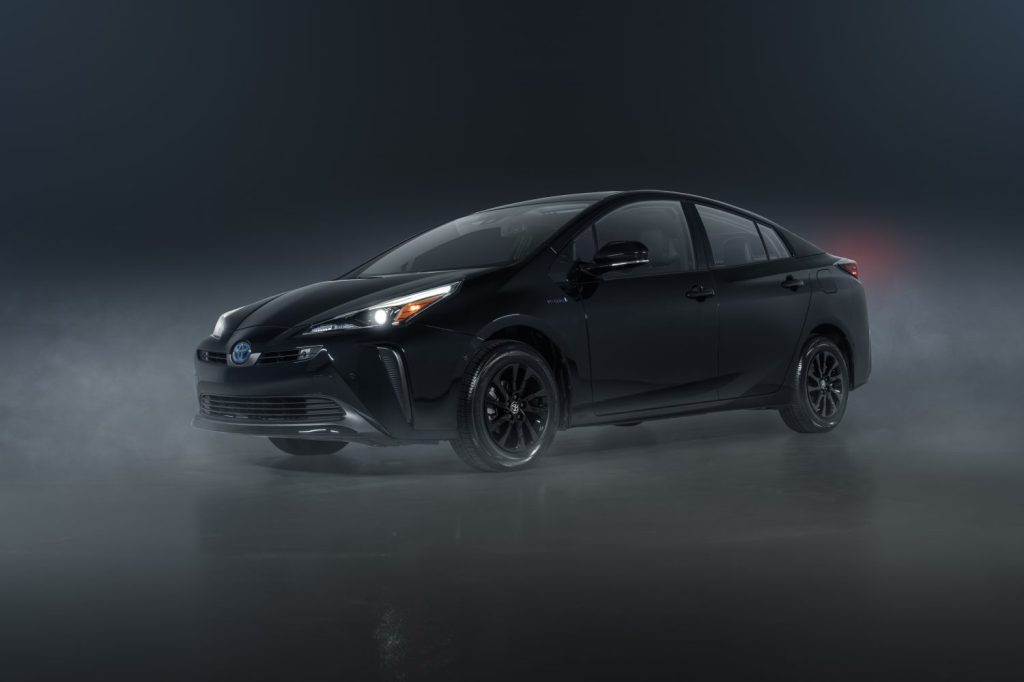
Toyota’s Prius is synonymous with “hybrid.” The company has pretty much hybridized everything. It argues—or maybe that would be “argued”—that it is better to build a whole bunch of affordable hybrids than a comparatively few electric vehicles that are comparatively more expensive: according to Kelley Blue Book, the average price of an electric vehicle in the U.S. in September was $65,291. The average transaction price for vehicles overall, KBB calculated, was $48,094. Which is roughly a 27% delta, which is certainly non-trivial.

Yes, this is a Prius. (Image: Toyota)

Be that as it may, Shirouzu’s sources indicated that “Toyota’s planning had assumed demand for EVs would not take off for several decades.” Which is decidedly not the case.

So is Toyota making a pivot? That is one of the subjects discussed on this edition of “Autoline After Hours.” Joining “Autoline’s” John McElroy and me are automotive consultant/analyst Jack Keebler and long-time auto journalist, currently freelancing at Autoweek, Todd Lassa.

Other topics discussed are the Q3 earnings of both General Motors and Ford, as well as those companies positions on autonomous driving: GM continues to be bullish on the prospects for Cruise, still anticipating revenue of $1-billion from the operation by 2025; Ford is far more conservative, as it announced that Argo AI, the AV company that was owned primarily by it and Volkswagen (each had 39%), was closing. Ford going forward would focus more on Level 2+ and Level 3 ADAS. (Ford CEO Jim Farley: “It’s mission-critical for Ford to develop great and differentiated L2+ and L3 applications that at the same time make transportation even safer.”)

The conversation is wide ranging and lively. And you can see it here.

How Innovative Is Auto?

In the Boston Consulting Group list of the top 50 most innovative companies in the world there are few surprises.

The top three are Apple, Microsoft and Amazon. Alphabet comes in at 4.

Not much of a surprise there. You could mix up the names and it would probably be about right.

The first automotive company, at number 5, is Tesla.

Again, not much of a surprise there, either.

But there isn’t another automotive company on the list until position 21. Toyota.

Bosch is down a few spots at 26, although one might argue that its innovation profile undoubtedly has something to do with its Industrial Technology, Consumer Goods, and Energy and Building Technology, too—not just Mobility Solutions.

Next is Hyundai, at position 33. It wasn’t that many years ago when Hyundai was considered to be not much more than a car company for people who wished they could buy a better car but couldn’t; now it is a highly innovative provider of some of the most remarkable vehicles on the road.

General Motors makes the list at 42, and crosstown rival Ford is just behind it at 43.

Mitsubishi is at 48, but odds are it is not for its motor vehicles (the company has a multiplicity of companies under its umbrella).

So if we subtract Mitsubishi but keep Bosch, there are 6 automotive companies on the list. Or 12%.

Still, it seems that there could be, should be, more.

To be sure, it is a whole lot more difficult to make significant developments in vehicles than in consumer electronics.

But one might imagine that with all of the ways that auto OEM execs are describing their companies the positioning on the list would have more than one company in the top 10 and more than two in the top 25.