Toyota leads in SUV sales in the U.S.–by a non-trivial amount
By Gary S. Vasilash
Although it might seem that when it comes to trucks and SUVs, “trucky” things, that Ford, General Motors and the company formerly known as FCA which was formerly known as Chrysler, would be dominant.
When it comes to pickups, yes. The numbers of F-150s, Silverados and Rams is truly extraordinary. Who knew that so many people were in need of boxes on the back of their vehicles? (Yes, people who actually do work with their trucks, do, but somehow that guy down the street who uses the bed to carry mulch once a year. . . .)
According to analysis firm Inovev, SUVs represented 53.5% of the U.S. market during the first quarter.
Toyota RAV4: best selling SUV in the U.S. (Image: Toyota)
And of them, most carried the Toyota “T.”
Inovev notes that Toyota has outsold both Chevy and Ford by about 50,000 units, with Toyota sales being just shy of 250,000 units and the other two slightly below 200,000 for Q1.
Inovev points out that Toyota also leads the Big Three in the sedan category (Camry, Corolla).
So if there are three big categories–trucks, SUVs and cars–the Big Three is now only dominant in one.
Yes, they are selling in the U.S. and Canada in great numbers, but the Mexican market still likes cars, LMC finds
By Gary S. Vasilash
Although SUVs (yes, including crossovers under that omnibus name) continue to proliferate in the U.S. and Canadian markets, turns out that things aren’t quite the same in the other USMCA country, Mexico.
According to LMC Automotive, while SUV sales surpassed those of cars in Canada in 2015 and in the U.S. in 2016, in 2020 cars outsold SUVs in Mexico. And not just by a little.
Nissan still sells cars in Mexico. (Image: Nissan)
The LMC data show that cars outsold SUVs by more than 2:1.
That said, there is growth in SUV sales in Mexico notes LMC Americas Vehicle Sales Forecasts analyst David Oakley, but there is an issue: “The overarching obstacle is cost, with SUVs still carrying a larger price tag than many high volume cars.”
Complicating matters for Mexican consumers is the fact that Ford and Chevrolet have pretty much given up on cars, about which Oakley says, “these brands seem to have jumped the gun with regard to Mexico’s readiness for such a shift.”
Although it is estimated that cars and SUVs will reach parity in sales by 2030 in Mexico, there are still several years of sales between now and then, sales that will probably go to brands like Hyundai and Nissan.
Let’s face it: the future of personal transportation isn’t gasoline or diesel fuel
By Gary S. Vasilash
Hau Thai-Tang, Ford chief product platform and operations officer (think of him as the guy who is in charge of product development) points out that the company has announced that it is in the process of investing $22-billion in electrified vehicles through 2025.
And because making a transformation from a dependence on engines that run on liquids to motors that run on electricity is no mean feat, Thai-Tang says that the company is kicking in an additional $185-million, this for developing and equipping a 200,00-square-foot facility that will be known as “Ford Ion Park.”
That’s ion as in a net electrical charge.
The learning lab, which is going to be located somewhere in southeastern Michigan (let’s see: Ford HQ is in Dearborn; it has a Battery Benchmarking and Test Laboratory in Allen Park; it is restoring the Michigan Central train station in Detroit where it will be creating an innovation hub), will be a place where they will be able to not only determine the best ways and means to develop batteries—lithium-ion and solid-state types—but also how to pilot the production of them.
Don’t try this at home! Mary Fredrick, Ford battery validation engineer, and Dane Hardware, Ford design and release engineer, measuring the voltage of a battery at the Ford Battery Benchmarking and Test Lab. (Image: Ford)
There will be some 150 employees (manufacturing, engineering, product development, purchasing, quality, planning) at the site.
Given the success of things like the Mustang Mach-E, which Thai-Tang says is on dealer lots for about a week before it is snapped up by a customer, an inventory turn time that is nothing short of astonishing in an industry that typically has vehicles on dealer lots for a few months, not a few days (although this has been changed by the global microchip shortage that came right on the proverbial heels of the factory shutdowns last year caused by COVID-19), Ford sees that there is a need to get the wherewithal to produce more EVs (an electric Transit is coming later this year; the electric F-150 by mid-22), and so it is creating the capacity that will allow it to ramp batteries faster.
Thai-Tang notes, of the overall drive toward electrification: “We will no longer take an approach of hedging our bets.”
With the billions it is spending, seems like it is pretty much pushing in a lot of chips.
You’d be surprised at what can be done with what might otherwise seem to be organic waste. Like using it to create car parts
By Gary S. Vasilash
Dr. Deborah Mielewski is a Technical Fellow at the Ford Motor Company.
Two things to know about that: (1) Ford employs about 87,000 people in the United States (more if the people from elsewhere are added, but she works in Dearborn, so we’ll use that number). (2) There are 16 Technical Fellows at Ford.
Yes, she is a rare individual.
She obtained her PhD in Chemical Engineering.
You might be thinking: “Technical Fellow. . .one of 16. . .chemical engineering. . .snooze.”
And were you to be, you’d be wrong.
Mielewski, whose focus is on sustainability, is one of the most enthusiastic and engaging individuals who talks about the environment and recycling and closed-loop processes who isn’t on the Discovery Channel or some outlet like that.
In fact, she probably ought to be.
But for the Earth Day episode of “Autoline After Hours” we have Debbie Mielewski talking about what she and her colleagues are doing in the lab to help make the crossovers, trucks and cars that Ford produces more environmentally sound—and doing so in ways that are not, well, what you might imagine.
One of her earlier undertakings was to develop seat foam using soybean oil. Unbeknownst to her at the time, Henry Ford had been a big proponent in using soybean oil for a number of applications, such as in paint and for body panels.
Ford was once so big on soybean that it built a processing plant on the grounds of the Rouge Complex in Dearborn. (Image: Ford)
The foam that they were creating in the lab took a while to come to a usable form (to say nothing of finding a way to attenuate the rather unpleasant fragrance emitted), but they worked at it and the material debuted on the 2008 Mustang.
Then they’ve had a variety of other atypical materials that they’re using.
She says—at least partially in jest—that while driving home from work one Friday night she thought about having a margarita when she got home. And that she would get in touch with Jose Cuervo on Monday to find out whether there might be some materials they could source (other than tequila, that is).
To obtain the juice that turns into the beverage the heart of the agave plant is roasted, ground and compressed. And then there is a whole lot of plant matter, fibrous, left over. While the Jose Cuervo company uses some of it, as do local artisans, there is still a large quantity left over.
The Ford scientists determined that the fibers are good for plastic reinforcement.
She says she likes coffee. Thinking about that led to the discovery that when coffee beans are roasted, their skin, chaff, comes off. Millions of pounds of the stuff. Ford and McDonald’s are working together to use the chaff as a composite reinforcement material instead of the traditional talc. It is lighter. Better. And is otherwise waste.
Wheat straw. Dandelions. Shredded paper currency. These and a whole lot more are being used and investigated by Mielewski and her team.
She tells a story about telling one of her colleagues to go collect some of the post-processed hemp at a Detroit medical marijuana distributor. (He was a bit reticent. . . .) Another fiber that may have application in automotive component production.
This is a fascinating look at a subject that will become only more important explained by someone who has spent more than 30 years of her career working on it.
Mielewski recalls that early on, when some of her other colleagues from the more traditional product engineering teams looked askance at her presentations, Bill Ford, known for his environmental leadership, had her back. Now the whole approach is becoming more pervasive. And not just on April 22.
Not all that long ago the Japanese Big Three were Toyota, Honda and Nissan. Nowadays the last-named seems to have lost its momentum in the market while the other two keep driving forward. Why?
By Gary S. Vasilash
“Remember when driving was fun?” actress Brie Larson opens a new Nissan commercial rhetorically asking before she blitzes her way through the array of new vehicles that Nissan has launched, or is about to.
At one point she’s being the wheel of the Z Proto and acknowledges that there are three pedals down there. Enthusiasts will get it. Others may be confused.
Will Brie boost Nissan? (Image: Nissan)
Nissan is rolling out 10 new or improved products over 20 months, so its showrooms will be fresh with sheet metal.
For those who are interested in one-pedal driving, Larson drives in a Nissan Ariya, the new EV that is anticipated to launch this year. (EV drivers will get it. Others may be confused.)
Although Nissan showed improvement in the first quarter, with its sales up 14.8% from Q1 2020, it really isn’t a good reflection of what it has on offer right now.
Consider: the Nissan Division had sales of 266,482 units. That’s Versa, Sentra, Altima, Maxima, LEAF, 370Z, GT-R, Kicks, Frontier, Titan, Pathfinder, Armada, Rogue, Murano, NV, and NV200.
Ford sold 277,233 trucks. F-Series, Ranger, E-Series, Transit, Transit Connect, and Heavy Trucks. 203,797 of those were F-Series.
What accounts for Nissan’s lack of traction in the market is certainly mystifying.
The question is whether Captain Marvel will save the day.
Yes, customers are back. But some of what they’re buying is surprising.
By Gary S. Vasilash
Although it was April Fool’s Day when the first quarter 2021 numbers for U.S. sales were announced by OEMs, the smiles were real in offices across the land as the SAAR (seasonally adjusted annual rate) rose to approximately 16.5-million units, or about a 12% sales increase compared to Q1 2020, which, of course, contained the first month of the pandemic in America.
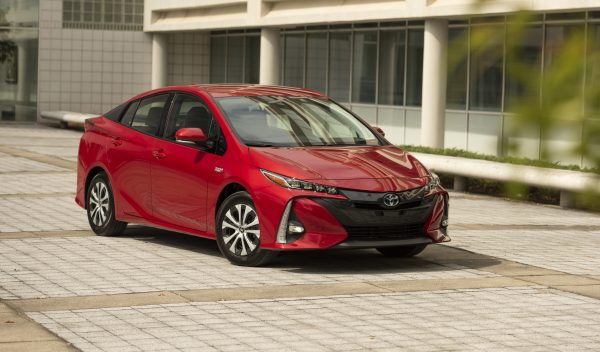
2021 Toyota Prius Prime. There was a 70.6% sales increase for the model in Q1 2021. Who saw that coming? (Image: Toyota)
This wasn’t supposed to happen
Plenty of people who seem to have a particular affection for liking the use of fossil fuel and has therefore been gloating over the fact that Toyota Prius sales have been dropping must have gotten a surprise. Despite that fact gasoline prices have been low for the past several months and still under $3.00 per gallon ($2.85 in the U.S. as of now, according to the Energy Information Agency), Prius sales rose 22.4% in Q1, to 14,050 units. (For a not apples-to-apples comparison: Chevy sold 7,089 Camaros during Q1.)
What is more striking is that all Toyota hybrids had a combined 152% increase, to 125,318 units. (“Thank you, RAV4,” they must be saying down in Plano.)
***
The Big Three?
Remember when that was General Motors, Ford and Chrysler?
GM is still big. Overall sales of 642,250 vehicles.
The other Two, however:
Ford, including Lincoln, had sales of 521,334.
FCA, including Chrysler, Jeep, Dodge, Fiat, Alfa Romeo, had sales of 469,651.
Toyota, including Lexus, 603,066. That’s a lot more than either Ford or FCA.
***
This wasn’t supposed to happen, 2
Everyone knows that (1) sedans are nearly dead in the market and (2) economical vehicles are so 2010.
Nissan, including Infiniti, had a good first quarter, with overall sales of 285,553 vehicles, which is a 10.8% increase over Q1 2020.
But there are two absolute standout vehicles in the Nissan lineup:
Versa: 22,394 vehicles, or an 83.9% increase
Sentra: 37,238 vehicles, or a 55.9% increase
Admittedly, crossovers like the Kicks (24,421 units) and the Rogue (86,720) were big contributors, the fact that the Versa and the Sentra did so well ought to make some analysts reconsider that whole “Cars are on life support” position.
For some reason, 3D printing seems to be wizardly popular. This is not to say that it isn’t an exceedingly interesting way that things can be produced, even geometries that couldn’t otherwise be at all produced, but there are some processes that are simply more effective, efficient and economical, especially when it comes to things needed at automotive volumes.
Like, for example, injection molding.
Which is predicated on taking a resin that flows and injecting it into a mold, where it hardens and becomes a part.
Ford announced, “Ford and HP Collaborate to Transform 3D Waste into Auto Parts, an Industry First.”
Which it probably is.
It not like there has been such a volume of 3D printed parts being made in auto that there is a whole lot of waste that can be turned into much.
But there is some powder used in 3D printing that doesn’t become a part. There are some portions of parts (e.g., supports) that are printed then eliminated from the final part.
Ford is collecting things like that.
But there is another waste stream: SmileDirectClub, which produces more than 40,000 teeth aligners per day on its more than 60 HP 3D printers.
The waste from the various operations is being collected by a company named Lavergne, which turns them into high-quality plastic pellets.
Which are then used to injection mold fuel-line clips for the Super Duty F-250 truck by supplier ARaymond.
This is a good thing.
But somehow the tying this to the magic of 3D printing is a far reach.
One can only wonder how much sand the engineering team had to wash out of their clothes. . .
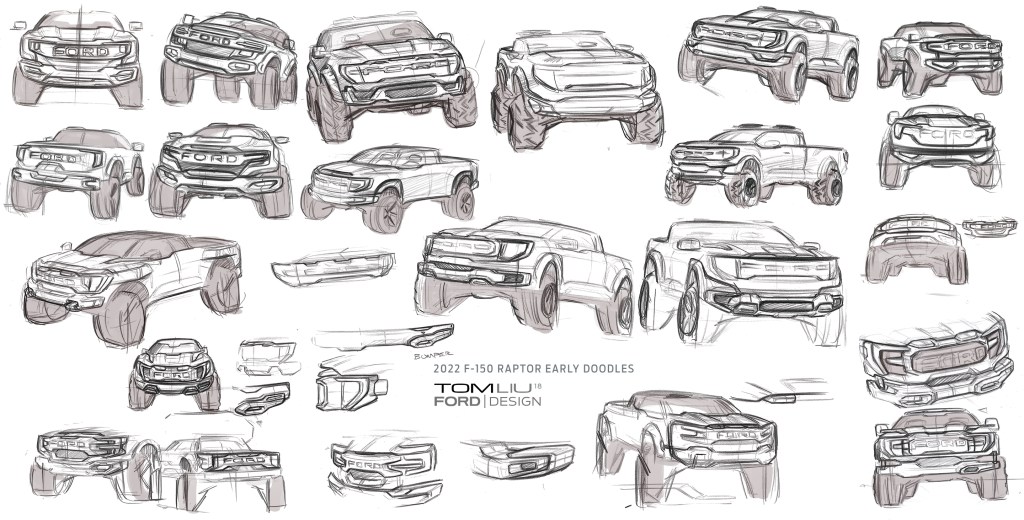
Although the official name is the “2021 F-150 Raptor,” now in its third generation, the vehicle is more commonly known as, well, “the Raptor.” While it is certainly based on the F-150, it is an extreme execution of a vehicle that is engineered to do the sorts of things that even outlier owners of conventional F-150s would never even think of.
Sketches that led to a Raptor. (Image: Ford)
Notes Tony Greco, Ford Program Manager, F-150 Raptor, “It has never been as differentiated from the F-150” as it is now.
While the team behind the development of the conventional F-150 spent a lot of time with contractors and serious DIY homeowners, and while members of that team certainly own and use trucks on a daily basis, Greco says on this edition of “Autoline After Hours,” “I work with a lot of passionate off-road guys.”
So it is not entirely surprising when Greco is asked to list the top things that he says differentiate the Raptor from other vehicles, he lists:
The suspension
The enhanced steel frame
The 37-inch tires
Fox—the supplier of the internal bypass shocks with SOA electronic control technology, the largest shocks (3.1-inch diameter) ever offered on a Raptor—becoming more than a supplier, working with the team like a partner
You may notice from the list that there is a lot about the suspension, which is what Greco says they spent a lot of time concentrating on. For example, he said that when they were looking at the rear suspension, they went through the considerable parts bins at Ford—including Ford Performance, the real home of the vehicle—and didn’t find what they were looking for. So they developed a five-link suspension with extra-long trailing arms—the better to deal with the toughest terrain.
Then there are those 37-inch tires, which required frame modifications for accommodation. Why not even larger? Simply because they wanted to make sure that a full-size spare tire could be handled under the vehicle, not put in the bed, which would take away from the ability to haul stuff. Remember—while this truck can do Baja, it can also carry things on that weekend Home Depot run.
Greco also notes that the design of the Raptor pushes things to an extreme that speaks to the capability of the truck.
While there is another truck that has come on the scene of late that challenges the Raptor—the Ram 1500 TRX—Greco says with the Raptor, which debuted in MY 2010, they created a segment and are not giving it up—to anyone. He also says that the team knew what they wanted to achieve when they started on the 2021 vehicle, and kept to it, regardless of the introduction of the new competitor.
Greco talks with “Autoline’s” John McElroy, freelance writer (and truck guy) Mark Williams, and me on the show.
In addition McElroy, Williams and I discuss a variety of other subjects, including the MY 2022 Nissan Frontier (the third generation of that midsize pickup); the acceptance of the truck community of new vehicles coming from new companies that happen to have electric motors; the California DMV automated vehicle disengagement performance in 2020 by GM Cruise and Waymo; and a whole lot more.
Watch this edition of “Autoline After Hours” right here.
Americans are big. Really big. Which might explain the absence of small cars (or almost any cars) being offered by the major OEMs
The accepted wisdom seems to have it that one of the primary reasons why vehicle manufacturers are getting out of cars and pouring more resources into crossovers is because they can make better margins on the latter. Which may be true, but is likely only part of the story.
According to the Centers for Disease Control and Prevention, American adults are, well, large. The average male over 20 is 5-foot 9-inches, weighs 199.8 pounds and has a 40.5-inch waist. The average female is 5-foot 3.5-inches, tips the scales at 170.8 pounds, and has a 38.7-inch waist. According to the CDC, 73.6% of adult Americans are overweight.
Seems like a fairly compelling rationale for large vehicles.
So what’s someone who wants to buy a small car to do? Well, the answer to that is “Look for something that is not all that small.”
That is, of the U.S. Big 6 automakers—GM, Ford, Stellantis NA, Nissan, Toyota and Honda—only GM has a car that can be considered “small.”
Chevrolet still offers the Spark. This car has a 93.9-inch wheelbase, is 143.1-inches long, 62.8 inches wide, and 58.4 inches high. It has a passenger volume of 83 cubic feet, and a cargo volume behind the rear seat of 11.1 cubic feet.
2021 Chevy Spark. Small. But big. (Image: Chevrolet)
The next smallest is the Fiat 500X, although the company positions it as being a crossover rather than a car, but for the sake of argument, let’s include it since it has a design that is very much like the now-departed (and tiny) 500. The 500X is gargantuan compared to the Spark, with a 101.2-inch wheelbase and length, width and height dimensions of 167.2, 73.2 and 63.7 inches, respectively. It has a passenger volume of 91.7 cubic feet and cargo area behind the rear seat of 14.1 cubic feet.
Then there’s the Nissan Versa. It has a wheelbase of 103.1 inches—9.2 inches more than the Spark—and an overall length of 177 inches, or almost three feet longer than a Spark. Its other dimensions are 68.5 inches width, 57.3 inches height, a passenger volume of 88.9 cubic feet and a cargo volume of 14.7 cubic feet.
Whereas people might associate “Honda” with “small cars,” with the Fits remaining on dealer lots the only ones left, the smallest car in the lineup is the Civic Hatch. Which isn’t all that small. It has a 106.3-inch wheelbase, is 177.9 inches long, 70.8 inches wide and 56.5 inches high. It has a passenger volume of 97.2 cubic feet and a cargo volume of 25.7 cubic feet.
The smallest Toyota car is now the Prius, which has a wheelbase of 106.3 inches and an overall length of 180 inches—or more than three feet longer than a Spark. It is 69.3 inches wide, 57.9 inches high, and offers 93.1 cubic feet of passenger volume and 27.4 cubic feet of cargo capacity.
Finally, there’s Ford, the company that was the first mass producer of passenger cars, the company that is now shifting its offerings away from, well, passenger cars. It currently has two cars on offer, and production has stopped for the Fusion, so that leaves the Mustang. Which is a completely bizarre thing to have in the context of a Spark. But here it is. The Mustang has a 107.1-inch wheelbase and an overall length of 188.5 inches. It is 81.9 inches wide, 54.3 inches high, and has a passenger and cargo volume of 82.8 and 13.5 cubic feet, respectively.
But consider this: the Spark actually offers more passenger volume than the Mustang. Not much more (0.2 cubic feet, or about the size of a football). But more.
So it might be a reasonable choice for a big American looking for a small car.–gsv
If there is any company that really needs its next launch to go off well it is Mitsubishi Motors North America. The vehicle in question is the 2022 Outlander, an SUV.
For 2020 its sales were down in the U.S. by 28%–a big hit to any company—but what makes matters worse, the total number is just 87,387, or about the number of Lincoln SUVs sold in 2020 (87,893)—and let’s face it, Lincoln SUVs have better margins than the Mitsubishi models so the Mitsubishi number is less good than it might be. (Or to be more apples-to-apples, Ford sold 178,496 Escapes in 2020.)
The Outlander has a lot riding on it.
As there seems to be a growing interest in vehicles with off-road cred, Mitsubishi is in good shape given its experience in rally racing, including the Dakar. Kentaro Honda, segment chief vehicle engineer, said of the new Outlander, “We took everything we know about on- and off-road driving from the rally experiences to apply the latest Super All-Wheel Control technology in our newly developed platform. We also specifically developed a new drive mode selector to provide confident driving at all times and in all weather conditions. We hope that many customers will have great experiences with the enhanced driving performance of the all-new Outlander.”
Presumably, this means the vehicle will be off-road worthy—and yet make it simple enough for the likely intended buyer (think someone living in the snowbelt—but in the suburbs, not some mountain top) to be able to dial-in what’s needed without having had a training course at Moab.
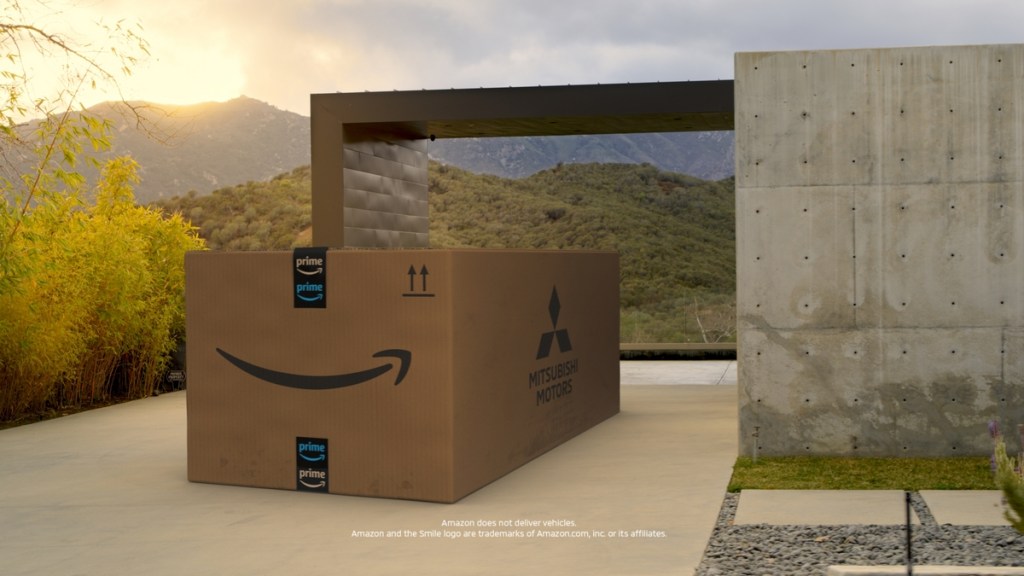
2022 Mitsubishi Outlander to be revealed on Amazon Live February 16. But no, they won’t deliver one to your house with Prime. (Image: Mitsubishi Motors North America)
To address that demographic, the global reveal will occur on Amazon Live, Tuesday, February 16 at 6 p.m. EST.
Despite the venue, you cannot get a 2022 Outlander through Amazon Prime.
(Although I’m betting that in the not-too-distant future, Amazon will someone work its way around dealer franchise laws and. . .)





 shinymetalboxes