Polestar Says It Out Loud

By Gary S. Vasilash

Polestar is an electric vehicle company that, in effect, spun out of Volvo, but Volvo is owned by Geely, but is traded on NASDAQ (as PSNY), so let’s not even try to sort out where the Gothenburg, Sweden-headquartered company exists. (It has announced it will build the forthcoming Polestar 3 in a plant in South Carolina next year. . .the Volvo plant in South Carolina.)

Anyway, yesterday as part of its Q3 earnings presentation it announced a “strengthened business plan.”

Which is notable because the company has stated it is going to put margins ahead of volume.
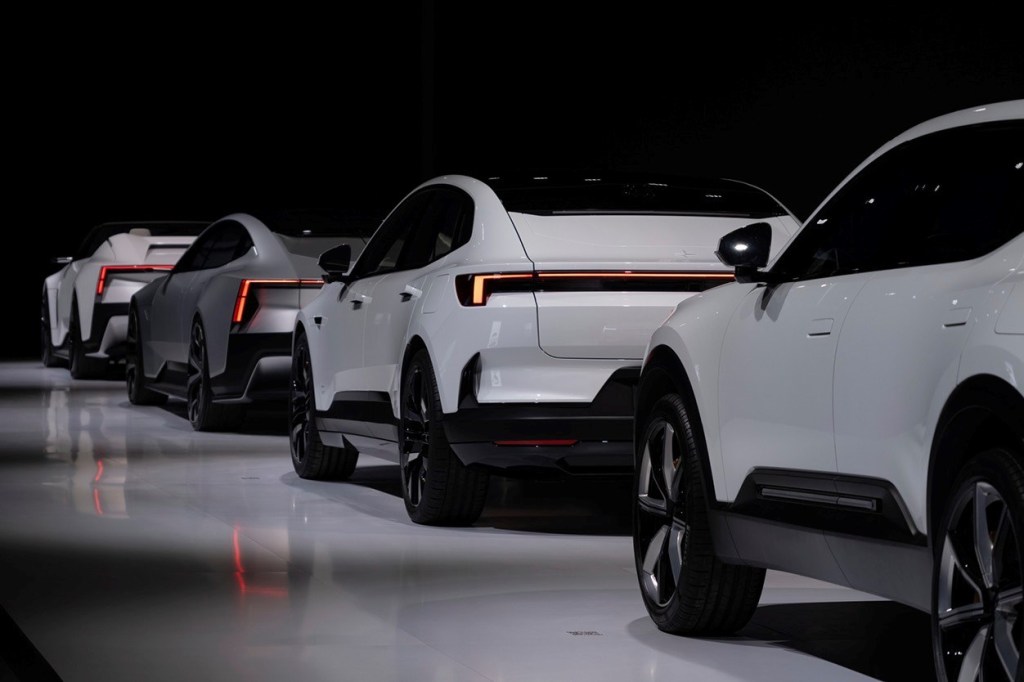
(Image: Polestar)

Thomas Ingenlath, Polestar CEO, stated, “Margin over volume is our way forward, supported by a gorgeous line-up of four exclusive performance cars.”

Meaning that Polestar is going to focus on the premium end of the EV market.

It figures that as of 2025, when it has four models in production, it will have an annual volume of 155,000 to 165,000 cars, which in and of itself is a rather small number and is smaller when you take into account it is selling globally.

Consider This

According to Kelley Blue Book, in September the average transaction price of a luxury vehicle in the U.S. was $62,342, down 6.2% from September 2022.

Here’s the key to that: “Luxury price declines in 2023 are primarily driven by aggressive price cuts at Tesla, the luxury market leader.” The Model 3 price was down 26% compared to the previous year.

And in the EV space, the average transaction price in September was $50,683, or down about 22% from the previous year “led again by market leader Tesla.”

(Tesla, because of its margins, is really the only OEM that can build mass volumes of EVs and afford to cut its prices.)

The point is, the EV market in the U.S. is pretty much a premium market.

And in the U.S., EVs are pretty much a premium proposition.

When Chevy announced the Equinox EV it made much of the fact that it was going to be a $30,000 vehicle, but it covered itself with “about” and announced a starting price of $34,995. While that is below the average price of an EV, what are the odds there will be many $35,000 Equinox EVs available?

When Chevy announced the Silverado EV work truck earlier this year, pricing was to be just below $40,000, but as reality set in, the price is now above $70,000.

EVs are an expensive proposition.

Let’s face it: until there is some massive change in battery technology (batteries are where most of the cost of an EV is found), the EV market is going to be characterized by prices higher than the ICE market—KBB found that the average transaction price for compact cars in September was below $30,000.

Credit to Polestar for saying it is going to put its profit ahead of volume, something other OEM execs don’t seem to want to say out loud.

Underwhelming Domestic OEM EV Sales

If you listen to the pronouncements of traditional OEMs about their EV efforts, you’d think that there is probably some sort of parity vis-à-vis their internal combustion engine business.

As in GM (remember: “All in” on EVs) selling plenty of EVs, and the Ford F-150 Lightning being in demand the same way the ICE versions of the truck are.*

So it comes as a surprise how few EVs the traditional OEMs are selling in the U.S.

According to the just-released Kelley Blue Book “Electric Vehicle Sales Report” for Q3, when it comes to General Motors, year-to-date it has sold:

  • 49,531 Chevrolet EVs
  • 5,334 Cadillacs
  • 1,216 GMCs

That’s a total of 56,081 EVs over nine months. If we include Brightdrop commercial vehicle sales, it boosts the number to 56,414.

The GMC HUMMER EV was introduced in October 2020. During the past three years, there have been 2,071 of them sold. (Image: GMC)

GM sold 65,255 Chevy Trax models, or 15,761 more units than sales of the Bolt EV/Bolt EUV sold through Q3.

Meanwhile, over at Ford:

  • 46,671

To put that in perspective: during the first three quarters of 2023 it sold 56,427 of its giant Expedition SUVs. So the Mustang Mach-E, Lightning and E-Transit commercial van summed are nearly 10,000 fewer.

And while adding things together: GM and Ford combined sold 103,085 electric vehicles.

Meanwhile, according to KBB Tesla sold 493,513 EVs.

Think about that: two of the biggest, most legendary OEMs in the U.S. together sold about a fifth of a company that was established 20 years ago.

*To be fair, Stellantis brands (Chrysler, Dodge, Jeep) sold 0 EVs.

What Do Potential EV Pickup Buyers Think?

By Gary S. Vasilash

It is always interesting to see surveys that ask about how people perceive autonomous vehicles because most people have only seen an AV on TV.

Things are a bit better with electric vehicles. But still, if you take Tesla out of the calculations (in the first half of 2023 Kelley Blue Book calculates that there were 556,707 EVs sold in the U.S., of which 336,892, or 60% of the total were Teslas), there aren’t all that many EVs out there for people to buy.

Cox Automotive (which, incidentally, owns KBB) recently ran a study of pickup shoppers who are planning to buy a truck within the next two years.

The information related to those considering EV pickups is interesting.

For example, consideration for an EV from a brand that one already owns is solid, which perhaps help explain why the Ford F-150 Lightning has the highest level of consideration.

What’s more, Cox found Lightning is clearly the most appealing to people.

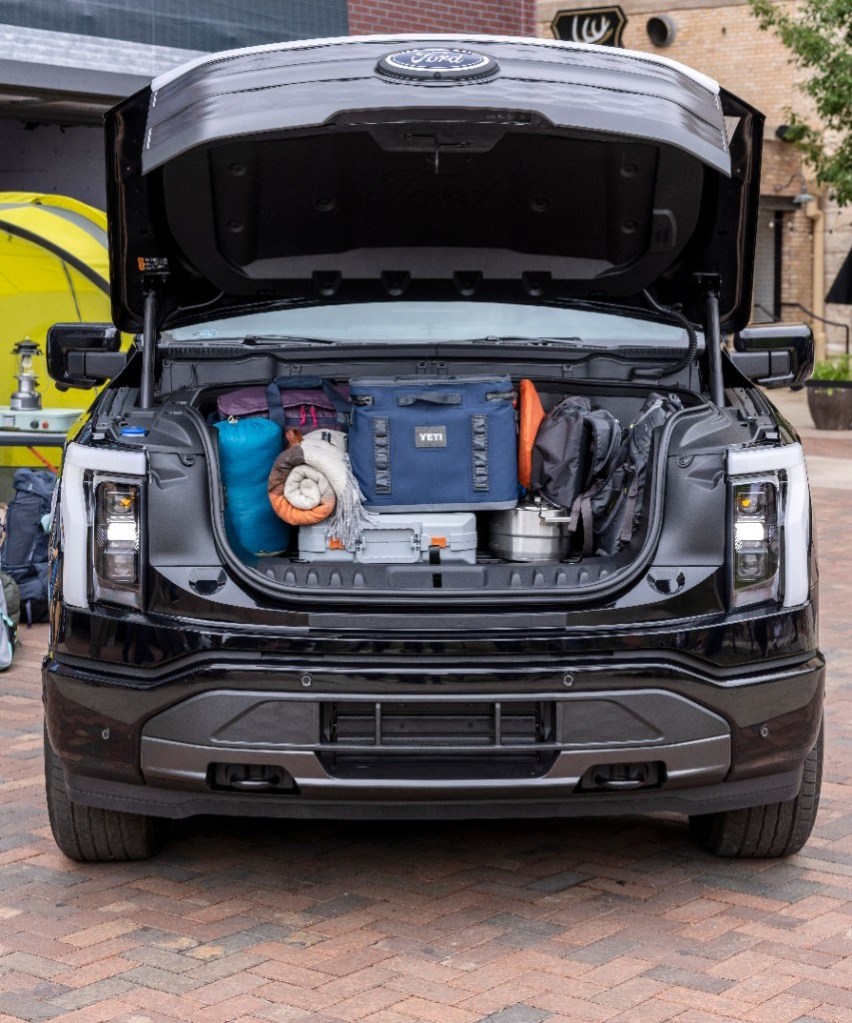
Ford F-150 Lightning frunk. (Image: Ford)

When asked about appeal before a truck was revealed and consideration after the reveal, of the Ram 1500 REV, Chevy Silverado EV, GMC Hummer EV pickup, Rivian R1T, and Tesla Cybertruck, and the Lightning, only the Lightning had a higher post-reveal consideration number.

And when looked at from the perspective of the following metrics, the Lightning got the top score in all of them:

  • Mileage range/fuel efficiency
  • Driving performance
  • Price
  • Overall look/styling
  • Technologically advanced

Which brings us back to the aforementioned survey about AVs.

Of the vehicles on the list, only the Lightning, Rivian R1T, and Hummer EV pickup are out there, and the number of Hummers is capable of being parked in a strip mall lot with spaces to spare.

How do people know about driving performance?

And how does the Lightning, with a top range of 320 miles, out score the Silverado EV, which has an estimated range of 450 miles?

When it comes to technology, it is hard to figure how the Lightning is more advanced than the R1T—unless it is that the Lightning has a 14.1-cubic foot frunk and the R1T’s is just 11.

EV Trucks & Three-Card Monte

By Gary S. Vasilash

When Chevrolet announced the Silverado EV last year, it said that the price for the initial work truck version would have an “Estimated MSRP staring around $39,900.”

That was for the work truck version. Get the contractors in and those who are simply looking to look cool will follow. Possibly in droves.

What does the Silverado EV 4WT work truck, which is presently in production, cost?

$79,800.

There is a forthcoming 3WT version with a decreased range from the 4WT. The 4WT has an EPA rating of 450 miles per charge.

The 3WT will be tagged at $74,800.

What is shocking is that people aren’t more shocked by this estimation being off by some 50%.

When the 2024 Chevy Equinox EV was introduced last fall, the claim Chevy made was “a starting price of around $30,000.”

Mary Barra, GM chair and CEO, said, “With the flexibility of GM’s Ultium Platform, we are bringing to market vehicles at nearly every price point and for every purpose.”

Really?

The Cadillac Lyriq is on the Ultium platform. It starts at $58,590.

The GMC Hummer EV uses it, too, and good luck finding a price for it on gmc.com. The 2022 Edition 1 model started at $112,595, and while the subsequent models are less expensive, odds are that’s a relative reduction.

Every price point for Thurston Howell III, perhaps.

Kelley Blue Book has it that the average transaction price for an electric vehicle in May was down $9,370 from the price paid in May 2022. Now it is $55,488, or a 14% decrease.

There’s the Silverado EV 4WT 50% increase.

And what expectation should there be that there will be a $30K Equinox, and if there is a $30,000 Equinox will there be a sufficient number such that it won’t be like sightings of the Loch Ness Monster (“I think I saw one. . .”)?

This just isn’t a GM phenomenon.

Ford launched the F-150 Lightning Pro in May 2022 with a starting MSRP of $39,975. By August it was $55,974. At ford.com right now it starts at $59,974.

Of course, at the top of the page for the Lightning it says in a bright blue box:

“Select Models Currently Eligible for $7,500 in Potential Federal Tax Credits.”

Let Uncle Sam mitigate the price increases.

The Cost of Cars & a Considered Alternative

By Gary S. Vasilash

According to the most-recent numbers from Kelley Blue Book, the average transaction price paid for a vehicle in May 2023 was $48,528. And this is even though, KBB found, the average price paid was $410 below sticker, not some wild figure well above it, which people were paying as a result of the pandemic: KBB notes that in May 2022 the price paid was $637 above sticker.

S&P Global Mobility reports that account-level delinquency rates of auto loads 60+ days past due are now up 26 basis points from Q1 2021, from 1.43% to 1.69%.

While that is a non-trivial jump, the folks at TransUnion and S&P Global Mobility point out that this is a situation that is being faced by a segment of the consumers and lenders, those who are in the subprime category and more than likely to be buying a used car.

So since that $48,528 MSRP may not apply to those people, know that according to Cox Automotive, the average used vehicle listing price in May was $27,256, “the highest since early January.”

Meaning, new or used, vehicle are pricy.

But this statement related to the loan delinquencies is somewhat startling:

“The interest rate rise is squeezing the monthly budget for the average American consumer. Consumers set aside money monthly for housing, vehicles, and insurance, but may not pay other obligations with the same frequency, such as medical bills and credit cards. People need their vehicles to get to work to make money and pay their obligations.”–Jill Louden, product management associate director for S&P Global Mobility

Something of a vicious cycle: buy a car, go into debt, use the car to go to work, pay for the vehicle and other things, but rack up even more debt for things like health care and presumably things like food.

If some company comes to market with appealing vehicles that have a low price—and this might be a Chinese company, 25% tariff notwithstanding—then this industry could be upended.

Presumably there is a considerable percentage of people who use their vehicles strictly for transportation and not as a signifier of their wealth or coolness. If the vehicle can do the job and do so reliably–without seeming like vehicular penance–then being able to acquire such a vehicle would be the way to go.

Let’s face it: not everyone—even those who are well above subprime—can afford an electric vehicle, which Kelley Blue Book found had an average transaction price of $55,488 in May—down 14% compared to May 2022, but probably because of Elon Musk adjusting the prices of his cars in a way that is completely uncharacteristic of traditional OEMs, so probably not something that can be counted on going forward.

Everyone talks about the transition to EVs and OEMs are tripping over one another to make this change to their showrooms.

But consider: How many people will be left by the side of the proverbial road by OEMs those consumers could once count on for reliable, affordable vehicles?

Interesting EV Numbers

The good news for EV enthusiasts (as in those who enthusiastically support the proliferation of EVs not necessarily because of any environmental considerations but simply because (a) they have one and figure that others should, too, or (b) they simply think it is cool tech, and while they can’t afford it—according to KBB.com, EVs had an average retail price of $65,291 in September—they still think it is cool for those who can):

According to Elizabeth Krear, vice president, electric vehicle practice, J.D. Power: “October breaks a three-consecutive month decline in EV consideration.” More people are thinking about getting an EV.

J.D. Power data have it that 27.4% of people who are going to be in the market for a new vehicle in the next 12 months are “very likely” to consider an EV.

While that is a move in the right direction for EV sales, Krear has some other figures that are less propitious:

“Adoption has been flat for the past six months with the retail monthly share for BEVs hovering at 5.6%. The top two reasons for EV rejection are lack of public charging and price.”

As for that all-important price component, she points out that affordability has decreased by 15 points during the past 12 months and the recent rise in interest rates is having an effect, as well.

But the federal EV support money for EV purchases as well as an increase in the number of models (J.D. Power has 51 in its data set; two years ago it contained 27) are at least helping people consider EVs, even though they still might opt for that ICE model.

EV Is VE: Very Expensive

The average transaction price for an electric vehicle this past August—that is, the average price that a real person paid to get the vehicle off the lot—was $66,524, according to Kelley Blue Book. A full-size pickup truck (presumably powered by gasoline) was less costly: $63,456. (Here’s something random to consider: That is a $3,068 difference. If gasoline is $5 per gallon, then that would buy 613.6 gallons. If the vehicle gets 18 mpg, then one could drive said pickup 11,044 miles.)

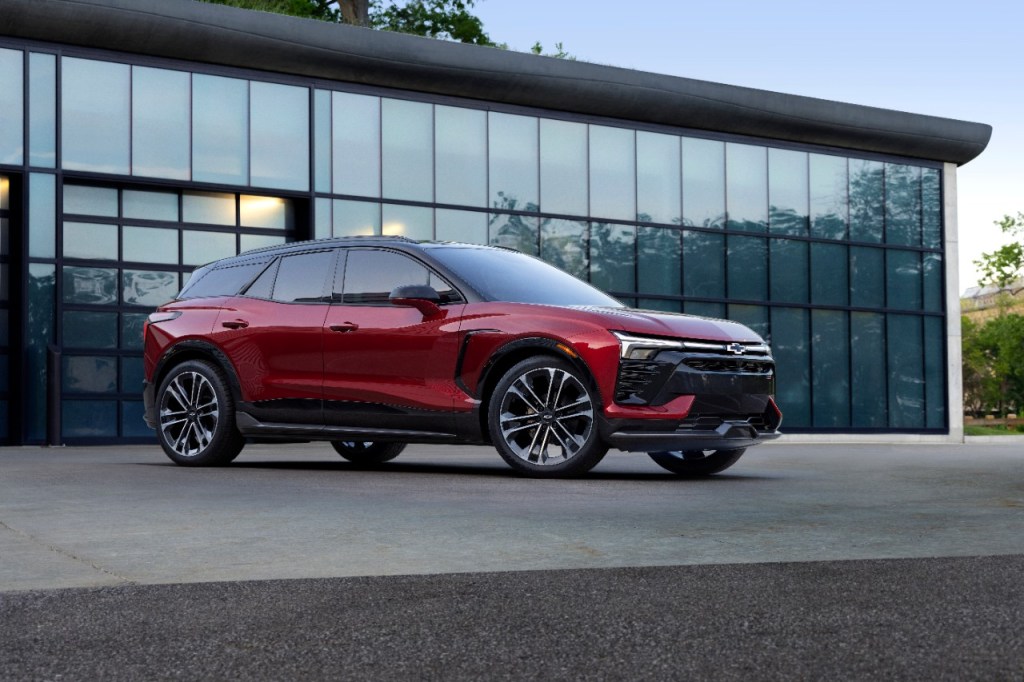
Forthcoming (albeit pre-production) 2024 Chevrolet Blazer EV SS. (Image: Chevrolet)

Next fall Chevy is to bring out the Equinox EV with an announced, anticipated, starting price of $30,000. The company will also be bringing out the Blazer EV, that has an “estimated MSRP starting around $44,995.” The photo on the webpage has a photo of a preproduction version of the Blazer EV. The “as shown” price for that midsize SUV: $67,990.

Somehow that $30,000 is likely to be closer to $40,000 for someone going for an average transaction.

Or more.

Some Notable Numbers

Let’s face it: vehicle sales in the first half of 2022 were not great in terms of volume.

What’s more, they weren’t great for customers who were looking for something affordable—according to Kelley Blue Book, the average transaction price for a new vehicle was a record $48,043.

They were great for OEMs and dealers, because higher prices mean bigger profits.

Be that as it may, it is interesting to look at how the leading OEMs made out in terms of one another when it came to sales.

In first place there is General Motors, which sold 1,087,761 vehicles. Based on that, here is the sales delta between pairs of subsequent companies (i.e., how many more the first named company sold than the company that follows it in sales ranking):

  • GM to Toyota:                  42,064
  • Toyota to Ford:                135,965
  • Ford to Stellantis:            95,900
  • Stellantis to Hyundai:       110,867
  • Hyundai to Honda:           196,668
  • Honda to Nissan:             73,683
  • Nissan to Volkswagen:      173,162

The gap between Toyota and Ford is surprising. And the gap between Ford and GM is even more surprising: 178,029.

Hyundai (as in the Group, meaning Kia, too) is certainly coming on strong. And Honda seems to be fizzling.

Realize that all of these companies are dealing with supply chain snafus and chip shortages, so it is a matter of (1) those who did a better job of managing their way through adversity and (2) a range of products (generally large SUVs and light-duty pickups) that consumers were interesting in acquiring.

What Vehicles Are People Considering and Why?

By Gary S. Vasilash

Kelley Blue Book puts together an interesting study on what people are interested in by examining what they are searching for automotive-wise both on desktops and mobile.

For Q1 22 in the non-luxury space the number-one brand is Toyota, with 34% brand consideration. In Q4 21 it was Ford on top. They’ve switched places. Ford is at 32%. Chevy is on the rise because in Q4 it was at 25% but has risen by five percentage points.

What is somewhat sad is Fiat, which was at 0% in Q4 and is at 0% in Q1.

And just above it are Mitsubishi and MINI, both at 1%, which is where they were last quarter, too.

Perhaps people just know all they need to about those brands.

Ram Laramie 1500: Imposing and comfortable. (Image: Ram)

KBB slices, dices and rices data in various ways. Like looking at four categories: SUVs, Cars, Pickups, and Minivans.

The top SUV is the Honda CR-V (besting the Tahoe, Durango, RAV4 and Highlander).

The #1 car is the Honda Accord, edging out the Civic (sibling rivalry). The Camry, Charger and Challenger follow.

In Pickups it is the Silverado 1500, followed by the F-150, F-250/F-350/F-450, the Silverado 2500/3500 HD, and the Tacoma.

In Minivans it is the Sienna followed by the Odyssey, Pacifica, Pacifica Hybrid and Voyager.

Of those categories, 66% looked at SUVs, 37% Cars, 35% Pickups, and 5% Minivans.

Perhaps there is some life in Cars, although the considerations were down 31% in the last quarter and 33% in the last year, so clearly things aren’t moving in the right direction.

Another potentially encouraging sign for Cars is that in the top 10 models considered, there are three Cars on the list (Accord, Civic and Camry), which is the number of SUVs on the list (CR-V, Tahoe, Durango).

What are the top three factors driving consideration?

Durability/reliability is in the top spot, which is not a surprise, nor is the fact that Toyota is the one that takes it.

Second is safety, and while you might imagine that would be Volvo, Subaru is actually in that position.

And third is driving comfort. This is taken by Ram. Who would have thought that a pickup truck would win the comfort honors?

Top Tech According to KBB

Kelley Blue Book has come out with a list of top vehicular tech for 2022.

One thing that you may immediately notice is that this technology isn’t exactly new in most cases.

But it is a list of things that you might want to be aware of should you be out there looking for a new vehicle.

Of course, finding an affordable new vehicle is all the more difficult nowadays because of the on-going shortage of semiconductors–and it is worth noting that by and large these technologies are predicated on. . .semiconductors:

  • Advanced Driver Assistance Systems (ADAS)
  • Automatic Emergency Braking
  • Connected Mobile Apps/Digital Key (the latter uses a phone as a device to unlock and start the vehicle)
  • Teen Driver Tech (squeals to Mom and Dad if the kids go too fast, for example)
  • Safe Exit Assist to Protect Cyclists (blind spot detection of bike rides—helps save them and the driver’s door)
  • Wireless Smartphone Connectivity and Charging
  • 360-degree Camera
  • Emergency Services/Stolen Vehicle Tracking Software (when is the last time you heard anyone mention LoJack?)
  • Blind-Spot View Monitor (not just that little yellow light in the sideview mirror but an actual image of what’s where)
  • Video Rearview Mirror (switches the reflective mirror to a video display)

Drive carefully even if you don’t have any of this stuff.