John F. Smith worked at General Motors at the same time that John F. Smith worked at General Motors.* The latter was to become GM CEO. The former was appointed by the latter to a number of executive positions within GM.
Perhaps the most notable was in 1997, when he was named head of Cadillac.
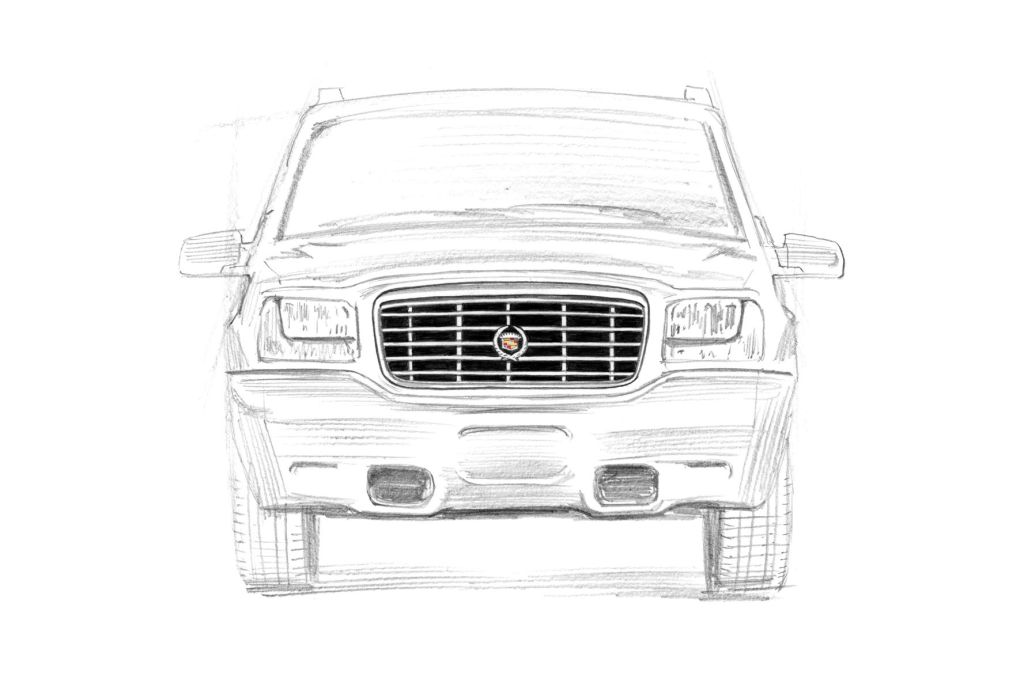
Things weren’t great at that brand back then. Hard to believe, but there was something that is now intrinsic to Cadillac that was absent: the Escalade, the massive truck-cum-SUV that has had visual presence on the road for a little more than two decades now.
The original Escalade. (Image: GM)
The Escalade was to come to be under John Smith’s period at Cadillac, helped into existence by the other John Smith, who was known as Jack.
John Smith talks about his career at Cadillac in this edition of “Autoline After Hours,” as well as a book he has recently had published about some of his adventures in the auto industry, Fin Tails: Saving Cadillac, America’s Luxury Icon (see how important Escalade was/is?).
Also on Smith’s resume are positions including vice president of Planning at General Motors International Operations in Zurich as well as president of Allison Transmission. Which is to say that he has a broad perspective on the auto industry, one broader than just Cadillac.
On this edition of “Autoline After Hours” Smith spends the hour talking with “Autoline’s” John McElroy, Doron Levin, who, among other things, writes about the auto industry at Saving Alpha and me.
Gen Z adults, of all the generational cohorts, are the most on the move.
In the past month 35% rode a subway, 44% a bus, 31% a local commuter train, and 52% used a ride-hailing app. That according to Morning Consult.
To put those numbers into perspective, the averages for all U.S. adults are, respectively, 15%, 21%, 15% and 25%.
Or in all cases Gen Z is double the average.
What’s more, 57% of Gen Z adults said they’d taken a road trip during the past month, which puts that group at the top. . .although Millennials are at 56%, so it isn’t like they’re comparative stay-at-homes. That description would apply to the Boomers, as only 26% of them reported a road trip.
There is, evidently something to the notion of youthful wanderlust—although it is worth noting that 82% of all U.S. adults reported using their household vehicle during the past month to. . .drive to work.
Here’s something that you probably don’t know about Bob Boniface, director of Global Buick Design, even if you know Bob Boniface.
He began his career. . .working at a mutual fund in Boston after receiving his undergraduate degree. . .in psychology and economics.
Boniface did go to the College of Creative Studies in Detroit and while there was hired as an intern to work at Chrysler which led to a job offer from then-head of Chrysler Design, Tom Gale.
Buick Wildcat EV concept. If Buicks look like this, then the brand has a bright, electric future. (Image: Buick)
Boniface was to work at Chrysler for 12 years, during which time he worked on a variety of projects including the second-generation Dodge Intrepid, the Dodge Intrepid ESX (a diesel hybrid with wheel motors), the Stow ‘n Go seating for the minivans, the 300C, and the Jeep Liberty.
In 2004 Boniface moved across town to General Motors. The first thing he worked on was the GM Sequel—a fuel cell-powered vehicle. Then the gen-five Camaro.
Boniface says, on this edition of “Autoline After Hours,” that he was, in effect, employee #1 on the Chevrolet Volt.
Then he moved to Cadillac for six years. He worked on XT4, XT5, CTS, CT6 and. . .he says the best part was working on the V-Series, the CTS-V and the ATS-V. (He says one of the engaging parts of the V programs was the level of commitment across all the functions involved: by having everyone working toward making something special, the results is–something special.)
Boniface moved to Buick in 2016 and has worked on vehicles including the Enclave and the Envision.
He points out that a lot of his work involves overseeing the studios in Korea and China. The China market is huge for Buick—roughly four times that of the U.S. market, so that part of the world is important. He notes that a lot of developments in the interior space are occurring in that part of the world, and interiors are part of his portfolio.
But then there’s the Wildcat EV Concept.
Realize that Buick arguably gave rise to the whole notion of the concept vehicle with the 1938 Buick Y-Job. The brand has had a number of vehicles with striking designs since then, such as the Wildcat I and II of the 1950s to the Velite in 2004 to the Avenir in 2016.
Back in 2018 Boniface says that they went to work on developing not so much a new vehicle as a new design language. But that exercise gave rise to the Wildcat EV Concept, a 2+2 coupe that is an expression of the electric future of Buick and that expression includes a new face—although being new, it also includes a nod to the brand’s design paste (e.g., high lamps, body-mounted badge).
Again: it is the language that they created and the vehicles to come will be spelled with those words.
If you have any interest in automotive design over the past 30 years, then this edition of “Autoline After Hours” is must viewing.
Joining the discussion are Greg Migliore of Autoblog and Joe DeMatio of Hagerty Media.
In reporting its global sales for the first three quarters of 2022 Porsche noted that its ales in China—its largest single market—were down. Only down by one percent, but down.
Still, overall the company is up two percent compared to the same period in 2021.
Sales in North America were also down. By four percent.
So that means the #1 and #2 markets for the sports car manufacturer were down.
The case in China, Porsche said, was largely caused by the COVID-related lockdowns imposed there various times this year.
As for the North America, the company cited logistical challenges.
Turns out that Europe, including the home market in Germany, made the difference.
In Europe minus Germany sales were up 11%, to 42,204.
Germany had a rise of nine percent, to 20,850 vehicles.
China sales were 68,766 units and in North America the number was 56,357.
In total, the company sold 221,512 units.
The electric Taycan deliveries were down by 12%, to 25,452, which Porsche attributes to “supply chain-related bottlenecks and declining parts availability.”
Doesn’t seem all that long ago that the Taycan was really going to take it to Tesla. Even though the Model S, refreshing notwithstanding, is long in the proverbial tooth, doesn’t seem that much of a bite has been taken out of it.
Arguably there were two things at play when it came to the rental car situation in the U.S. in the Age of COVID a couple years back.
On the one hand, people weren’t traveling, so the rental fleets figured that it would be OK to offload some of those cars that were just sitting there in parking lots around airports.
On the other hand, car manufacturers figured that they could make more money selling the limited number of vehicles they could build (because of supply chain issues overall and chip shortages in particular) to individual consumers than to rental fleets. (Let’s face it: rental car companies aren’t going to buy a whole bunch of loaded SUVs or pickups.)
When travel came back with an amazing zeal (forget those Zoom calls; beaches beckoned; it is nice to see far-flung family again. . .) plenty of those travelers discovered that the rental car companies seemed ill-prepared to accommodate them.
The cars that weren’t there in the lots. The cars that were there and seemed rather, well, tired. Unhappiness abounded.
According to the J.D. Power 2022 North American Rental Car Satisfaction Study, satisfaction among renters was not good in 2021 and it hasn’t gotten any better this year.
One of the factors contributing to this is that prices are up 14%.
“When it comes to rental cars,” says Michael Taylor, managing director of travel, hospitality and retail at J.D. Power, “price is the biggest factor affecting satisfaction, and the combined effects of inflation and high fuel prices are really pushing customers to their limits—and could affect brand image.”
On a 1,000-point scale, Enterprise is #1 at 865. Thrifty is in last place, with 780.
The industry average is 829.
(Avis evidently doesn’t try harder any more, as it comes in below industry average at 816.)
Taylor: “If rental car companies want to offset the influence of these cost increases on customer satisfaction and their brand loyalty, they are going to have to work hard to deliver outsized value by ramping up service.”
Back in May, Lucid Group, which produces the magnificent Lucid Air line of electric vehicles, thought that it would produce from 12,000 to 14,000 of those vehicles in 2022.
But, as they say, stuff happens.
After delivering 679 vehicles in Q2 it adjusted its guidance to be at 6,000 to 7,000 for the year.
Lucid Air Sapphire. Starts at $249,000. (Image: Lucid)
It just announced its Q3 production figures, which had 2,292 vehicles built at its plant in Casa Grande, Arizona.
So far this year it has built 3,697 vehicles.
To reach 6,000 units it would need 2,303 more.
That seems eminently do-able.
While the numbers are small, the Airs start at $87,400 and go north of $249,000.
Bigger numbers would be better. But in that context, small isn’t bad.
One of the things that isn’t often considered when OEMs announce still another new electric vehicle is that just as is the case with their vehicles with internal combustion engines, suppliers make a considerable number of the parts and systems that go into those vehicles.
This puts suppliers in something of a tricky situation because chances are they have the capacity to produce parts for ICE vehicles and now, assuming that they want to continue to have business, they have to acquire or develop the wherewithal to make the EV componentry.
And let’s face it: this EV transition isn’t going to happen overnight, so there is still the need to supply the things for the ICE vehicles.
Consider the situation at GM, an example that is simply representative of the industry as a whole.
Buick has four vehicles in its lineup and zero EVs. Cadillac has seven and one EV. Chevy has 18 vehicles and one (or two if you could the Bolt EV and Bolt EUV as two, but they count it as one). And there is GMC with eight vehicles and one EV.
It should be noted that there were 22,830 EVs delivered in the U.S. by GM through Q3—out of a total 1,650,827 vehicles.
Still, suppliers see the proverbial writing on the wall and as such they are looking to what they can do to make the transition to electric.
One of the top global auto suppliers is Schaeffler. And on this edition of “Autoline After Hours” we talk to Jeff Hemphill, chief technology officer of Schaeffler Americas.
Hemphill explains how the company is making the transition to electrification, providing everything from motors that are used in hybrid systems to complete e-axles for battery electric vehicles. The company is both responding to what OEMs want and working to develop the tech that is expected to be needed.
(Remember: EVs are still pretty much a nascent technology for most OEMs–and suppliers–even though it seems fait accompli.)
Hemphill talks with “Autoline’s” John McElroy, Mike Austin of Guidehouse and me about how the company is working to provide OEMs with what they need now—and will need tomorrow.
In the Boston Consulting Group list of the top 50 most innovative companies in the world there are few surprises.
The top three are Apple, Microsoft and Amazon. Alphabet comes in at 4.
Not much of a surprise there. You could mix up the names and it would probably be about right.
The first automotive company, at number 5, is Tesla.
Again, not much of a surprise there, either.
But there isn’t another automotive company on the list until position 21. Toyota.
Bosch is down a few spots at 26, although one might argue that its innovation profile undoubtedly has something to do with its Industrial Technology, Consumer Goods, and Energy and Building Technology, too—not just Mobility Solutions.
Next is Hyundai, at position 33. It wasn’t that many years ago when Hyundai was considered to be not much more than a car company for people who wished they could buy a better car but couldn’t; now it is a highly innovative provider of some of the most remarkable vehicles on the road.
General Motors makes the list at 42, and crosstown rival Ford is just behind it at 43.
Mitsubishi is at 48, but odds are it is not for its motor vehicles (the company has a multiplicity of companies under its umbrella).
So if we subtract Mitsubishi but keep Bosch, there are 6 automotive companies on the list. Or 12%.
Still, it seems that there could be, should be, more.
To be sure, it is a whole lot more difficult to make significant developments in vehicles than in consumer electronics.
But one might imagine that with all of the ways that auto OEM execs are describing their companies the positioning on the list would have more than one company in the top 10 and more than two in the top 25.
The average transaction price for an electric vehicle this past August—that is, the average price that a real person paid to get the vehicle off the lot—was $66,524, according to Kelley Blue Book. A full-size pickup truck (presumably powered by gasoline) was less costly: $63,456. (Here’s something random to consider: That is a $3,068 difference. If gasoline is $5 per gallon, then that would buy 613.6 gallons. If the vehicle gets 18 mpg, then one could drive said pickup 11,044 miles.)
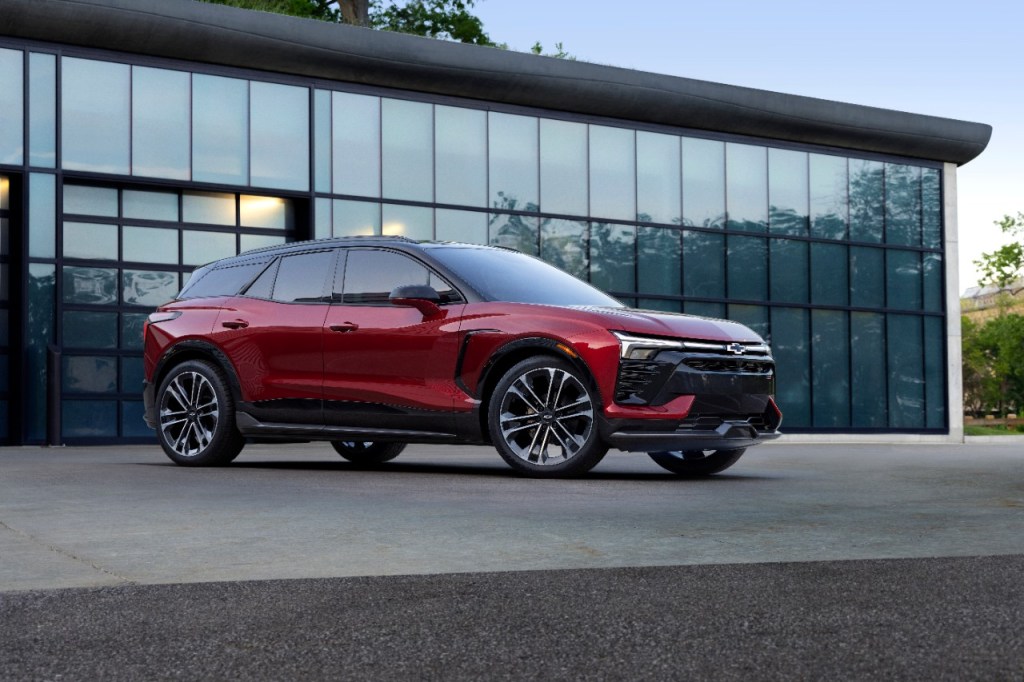
Forthcoming (albeit pre-production) 2024 Chevrolet Blazer EV SS. (Image: Chevrolet)
Next fall Chevy is to bring out the Equinox EV with an announced, anticipated, starting price of $30,000. The company will also be bringing out the Blazer EV, that has an “estimated MSRP starting around $44,995.” The photo on the webpage has a photo of a preproduction version of the Blazer EV. The “as shown” price for that midsize SUV: $67,990.
Somehow that $30,000 is likely to be closer to $40,000 for someone going for an average transaction.
Perhaps more controversial than Dylan going electric in 1965. . .
If you think about “Dodge,” you have a pretty good idea of what it is: A lineup of muscle cars. It is a brand that has pared itself down to an essence, as things like the Journey and Caravan have gone away, leaving the bulk of the brand on the shoulders of two vehicles, the Charger and the Challenger. (The Durango is still in the showroom.)
The positioning of the brand is unapologetically the “Brotherhood of Muscle,” although all genders are encompassed within the club.
One might think that this whole muscle car thing is an anachronism. HEMI engines don’t seem to a thing that would resonate in the age of Greta Thunberg.
However, in the first half of 2022, Dodge outsold Chrysler, Fiat and Alfa Romeo combined: 84,761 to 73,010.
There is a defined niche of buyers for whom muscle cars matter. And they buy them.
Although the platform underpinning the Charger and Challenger is, by contemporary standards, vintage, the people at Dodge have kept things going by introducing special editions and packages for the cars (e.g., the SCAT Pack Swinger, a tribute to the late ‘60s and early ‘70s).
Tim Kuniskis is the CEO of Dodge. And on this edition of “Autoline After Hours” he explains how Dodge will keep being propelled forward with cars even though he admits “cars are dead”—albeit dead for those who don’t necessarily consider their vehicles to be a representative of who they are. The Brotherhood of Muscle knows what matters to them and prove it every day.
Still, Kuniskis and his team are fully aware that the market is changing, moving away from HEMIs to electric propulsion.
So rather than pretending that it is otherwise, they have rolled out with “Last Call” editions of the Charger and Challenger and revealed the bad-ass battery electric Charger Daytona SRT Concept.
They are putting the proverbial pedal to the metal as they drive toward an electric future.
As Kuniskis points out in the show, people who drive muscle cars think somewhat differently than ordinary car consumers.
For example, do you think someone with a supercharged 6.2-liter HEMI Hellcat high-output V8 under the hood—a 797 hp or 807-hp engine, depending on package—is at all concerned with the fact that they may get a combined mpg of 15? Given that, what is the likelihood that someone getting an electric muscle car is going to be concerned whether the range is 300+ miles or a fraction of that—as long as the car moves like a bat-out-of-hell (which explains why the propulsion system in the concept is named “Banshee”)?
Ordinary EV buyers are largely concerned about range. Dodge EV buyers will focus on performance. (OK: some of them will be concerned with range, but they’re going to want to make sure that their cars seem to be hellacious performers.)
Kuniskis talks about the present and the future of Dodge with “Autoline’s” John McElroy, Chris Paukert of Edmunds, Mike Musto of Hemmings and me.
Even if you aren’t particularly interested in muscle cars per se it is a fascinating look at how a brand that is as intensely focused on one segment as Dodge can make a transition to a different technology model without disaffecting its customer base.
One can imagine that the Dodge switch to an electric future will become a business school case study, which you can learn about now, for free, here.




 shinymetalboxes