On the 2023 NACTOY Semifinalists

Since 1994 the North American Car, Truck and Utility Vehicle of the Year (NACTOY) Awards have been presented by a group of journalists, all of whom work for a variety of outlets, print, digital, television, audio. They determine what are the most important vehicles introduced during a given year, vehicles that are deemed to be ones that consumers ought to pay attention to when they are in the market.

Last week at the North American International Detroit Auto Show the semifinalists for the 2023 awards were announced.

They are:

Car:

  • Acura Integra
  • BMW i4 eDrive40: Sedan
  • Genesis G80 EV
  • Genesis G90
  • Mercedes-Benz C Class
  • Mercedes-Benz EQE
  • Nissan Z
  • Subaru WRX
  • Toyota Crown
  • Toyota GR Corolla

Truck:

  • Chevrolet Silverado ZR2
  • Ford F-150 Lightning
  • Lordstown Endurance

Utility vehicle:

  • Audi Q4 e-tron
  • BMW iX xDrive50
  • Cadillac Lyriq
  • Genesis GV60
  • Honda CR-V
  • Honda HR-V
  • Kia EV6
  • Kia Sportage
  • Lexus RX
  • Mazda CX-50
  • Nissan Ariya
  • Rivian R1S
  • Volvo C40 Recharge

On this edition of “Autoline After Hours” “Autoline’s” John McElroy, Jill Ciminillo of “Pickup Truck + SUV Talk,” Bengt Halvorson of Green Car Reports and I—all NACTOY jurors—talk about the nominees, most of which all or some of us have had first-hand experience with. (The others we will when we drive them next month during a comparison drive.)

And you can see it all here.

Volvo Service Replaces Privately Owned Cars

You would think that a company that is in the business of manufacturing vehicles would want people to buy more vehicles.

But Volvo Cars seems to have a different idea.

It has been running a shared mobility operation named “M” in Sweden since 2019. It has 250,000 registered customers. There have been almost a million rides.

Evidently it is deemed a success because the company is rebranding it as “Volvo On Demand.”

Here’s the thing:

“External analysis shows that one shared car from Volvo Car Mobility currently replaces the need for up to nine privately owned cars in Swedish cities.”

Arguably, this means eight cars that don’t need to be purchased.

Environmentally beneficial. But as the service becomes more successful, the greater the number of vehicles that Volvo (or other OEMs) won’t sell.

(Brownish) Green Acres

Although agriculture is not something that we ordinarily (or ever) write about here, activities that Bridgestone Americas is undertaking in the southwestern portion of the U.S. is of note:

It has invested more than $100-million in research into guayule, a woody desert shrub that grows in places where many other plants would wither, and has just announced an additional $42-million to develop the means by which there can be commercialized planting and harvesting of the shrub at scale.

No, Bridgestone is not getting into the nursey business for cacti and the like.

Rather, it is developing guayule as a source of natural rubber.

Yes, rubber that can be used to produce tires.

It made its first guayule-based tire in 2015, and as part of its continuing of its developmental work, the Big Machine Music City Grand Prix IndyCar race that was held in Nashville (home of Bridgestone Americas’ HQ) earlier this month had the tires as alternates for the race cars.

The guayule plant and a tire made with rubber from the shrub. (Image: Bridgestone Americas)

While it has a 281-acre guayule farm in Eloy, Arizona, the new investment will include working with farmers and Native American tribes to up the acreage to about 25,000 between now and 2030.

Nizar Trigui, Chief Technology Officer and Group President, Solutions Businesses, Bridgestone Americas, Inc., said, “With guayule, we can reduce the environmental impacts that come with overseas sourcing while also realizing a more sustainable agricultural system for parts of this country that are facing persistent and worsening climate conditions, so it’s really something with many benefits for our environment and our economy.”

According to Bridgestone, more than 90% of the world’s natural rubber come from para rubber tree plantations that are located in Southeast Asia. Although the trees originated in Brazil, in the early 20th century South American Leaf Blight hit the crops, which is why there was the shift to the other side of the world.

That said, turns out that white root rot disease is on the rise there, so presumably guayule is a really good idea for simply being able to make tires going forward.

Mike Ramsey on Autonomy and Electrification

By Gary S. Vasilash

Mike Ramsey, as a vp and analyst for Gartner on the topics of Automotive and Smart Mobility, spends his time researching and thinking about those two topics and consulting with a wide array of people in the auto industry on the subjects. And on this edition of “Autoline After Hours” Ramsey talks to “Autoline’s” John McElroy and me about, primarily the subjects of autonomous vehicles (AVs) and electric vehicles (EVs).

Although AVs are getting far less attention than EVs, Ramsey suggests that work continues apace on the development of the technology. One of the factors that is going to play a big difference for the greater availability of AVs, Ramsey says, is a decrease in the cost of sensor technology (e.g., lidar). This will help make the calculations for the function more in line with what are automotive economics.

Ramsey suggests that with the amount of data that Tesla is collecting from its vehicles it may be in a prime position to make the move to actual full self-driving capability—but Ramsey underscores that it is probably not going to be with the present setup of sensors that are currently used for the various Tesla models.

EVs are going to be more widely accepted, Ramsey says—but this will require that the price points of the vehicles have to go down in order for people to be able to get into the vehicles, with most of the models out there being in the luxury pricing strata.

Another thing that needs to be addressed vis-à-vis EVs is the charging infrastructure, which many consumers have found to be quite disappointing. Ramsey thinks that automotive OEMs are going to have to think long(er) and hard(er) about what their role in charging needs to be because no matter how good the product is, if the charging experience is a negative one (a recent J.D. Power study on charging found that people are not exactly pleased with their experiences), then that will reflect poorly on the whole undertaking.

You can see the show here.

Sandy Munro on Tesla and Other Electric Vehicles

By Gary S. Vasilash

Sandy Munro is a Tesla teardown artist.

“Teardown” as in Munro and his team at Munro & Associates taking apart Teslas—and other electric vehicles—and then carefully cataloging and assessing each element that goes into making an entire vehicle.

Munro brings to the activity a 30+ year understanding of what it takes to build a vehicle with best practices. And because he is deeply versed in things like design for manufacturing, he is able to identify where those best practices aren’t being performed.

While Munro had done extensive work on analyzing vehicles that have internal combustion engines, he says that that is behind him for the simple reason that he believes that electric vehicles are going to take a considerable portion of the new vehicle market.

He says that somewhat analogously to Moore’s Law in computing, there is Munro’s Law that has it that if 2022 has electric vehicles at 5% of the new car market, then it will be 10% in 2023, 20% in 2024, 40% in 2025, 80% in 2026.

Given the amount of money global OEMs are spending on developing battery production capacity, it seems that they don’t disagree with Munro.

One of the interesting things that has happened to Munro’s career is that whereas the suburban Detroit firm that he heads once performed its work in relative obscurity, some of the work that the company is doing—like his teardowns of the Model 3 and Model Y—have been put on a YouTube channel, which has led Munro to considerable fame or notoriety—depending on your point of view—particularly within the Tesla community.

On this edition of “Autoline After Hours” Munro talks with “Autoline’s” John McElroy and me on a variety of subjects, including his fame among nine-year-olds. Seriously. (Munro points out one reason why an increasing number of EVs will be sold is predicated on kids influencing their parents, and he thinks that OEMs who ignore the young do so at their peril.)

You can watch the entire show here.

Foxconn in Ohio

Monarch Tractors–which is located in Livermore, California, which is about 45 minutes east of Mountain View so it is Silicon Valleyesque yet still has something of the region’s former agricultural glory about it—has developed an electric tractor.

The MK-V, which produces up to 70 hp, and is fitted with a swappable battery that has a runtime of ~10 hours, is described as being “smart.” There is a screen on board that provides the ability to access live video, weather and other farming-related information.

But what is even more interesting is that it is “driver optional.”

The tractor can be operated remotely.

Apparently your favorite local restaurant isn’t the only place that has trouble finding workers.

The MK-V can mitigate some of that labor shortage for ag.

Also interesting is the company that has just signed on to manufacture the tractors for Monarch: Hon Hai Technology, which is better known as “Foxconn.”

The tractor is scheduled to go into production at Foxconn’s facility in Lordstown, Ohio.

Foxconn acquired the factory last May from Lordstown Motors. Foxconn is to build the Lordstown Endurance electric pickup in the plant.

And in 2024 the Fisker Pear, an EV with a presently intended starting price of $29,900.

No matter how the MK-V, Endurance or Pear do, Foxconn will undoubtedly do well.

About Those (Absent) Auto Ads

By Gary S. Vasilash

Some 41% less was spent by automakers on national TV advertising in July 2022 compared with July 2021 according to iSpot.tv information cited by MediaPost.

The MediaPost article points out, “Without the Olympics, NBA Finals and Stanley Cup (which all took place during at least part of July last year), TV ad spending was down for automakers. . . .”

Fair point, because ads for OEMs during sporting events are absolutely ubiquitous.

However, there is another factor that probably plays a bigger role I the absence of ads:

The lack of product to sell.

According to Cox Automotive, the U.S. auto industry’s days’ supply of vehicles is in the mid-30s, a fraction what is ordinarily the norm.

Honda had just 21 days’ supply on dealer lots.

The point is, it makes very little sense to advertise products that people can’t buy.

Sure, there is something to be said to maintain brand awareness, but if there are ads that are extolling all of the wonderful features of a vehicle that is unicorn-like in its available existence, then the potential consumer is going to be highly annoyed (especially when that person tries to be sold something completely inappropriate by a dealer: guess who certainly won’t go back to that store and who is likely not to shop that brand?).

So sporting notwithstanding, the issue of sparsely available vehicles on dealer lots is a massive roadblock to commerce.

Tesla’s Loyalists

By Gary S. Vasilash

Tom Libby, associate director and loyalty principal, S&P Global Mobility, thinks that what are ordinarily considered “conventional” or “traditional” automakers have a problem. This isn’t a problem that happened yesterday or last week. It is a problem that has been there for a few years now. A problem that execs at those companies talk about a lot and have made efforts—and for a long time these efforts were not much beyond lip-service—to address it. A problem that is now garnering sufficient attention, though results will vary.

The problem is Tesla.

Tesla vis-à-vis owner loyalty.

Libby charts owner loyalty to a brand. With regard to luxury brands including BMW, Mercedes, Audi, Lexus and Tesla, owner loyalty has been declining. Yet Tesla’s decline still puts it in a position that is much higher than the others. People who buy a Tesla often by another Tesla. The same isn’t as much the case with others. Tesla even takes market share from a number of mainstream brands, as well.

The loyalty rate for the Tesla Model 3 this past March was 76.6%, the sort of figure that program managers at other OEMs wish they had.

Libby says, however, that the Porsche Taycan, which has been available on the market for a few years and the Mercedes EQS, a new entrant, are gaining loyalty.

But if you take into account all of the other models being offered by other OEMs—remember: both luxury badges and well as mainstream—then the dominance of Tesla is rather astonishing.

A question that arises is whether, as other OEMs come out with more-compelling EVs (e.g., while the Cadillac LYRIQ has much to be said for it, remember that GM also foisted things like the Spark EV on the market as though it had relevance when things like the Model S and Model X were on offer: not that there was cross-shopping between those two Teslas and the tiny Chevy, but keep in mind that people were aware of what was being put out there by whom, so Tesla gained share of mind) whether Tesla’s loyal following will peel off.

Let’s face it: there is something to be said about gravity.

You can see the conversation with Libby on this edition of “Autoline After Hours” with “Autoline’s” John McElroy, Joe White of Reuters and me here.

Prologue to Honda’s Prologue

When American Honda sent out a news release early this month reporting on its Q2 sales, the headline affixed is:

“American Honda Sales Challenged by Supply Issues”

“Challenged” is, if nothing else, a euphemism for, oh, crushed.

In Q2 the sales of its cars were down 56.5% and trucks off by 47%, for a combined drop of 50.7%.

And realize that this is in the context of Q2 2021, which still wasn’t exactly a banner period in the U.S. auto industry.

Honda faces some issues going forward because it is a company with superb expertise in internal combustion, and it appears as though while gasoline-burning engines aren’t going to suddenly disappear, there will be a decided decrease in the numbers sold, a consistent drop-drop-drop in the near future.

Honda will have an electric SUV in 2024, the Prologue.

It is based on the General Motors Ultium platform.

Which goes to the point of its expertise in engines, but not so much EVs.

Honda is trying to drum up interest in the vehicle by doing things like announcing that it is “the first Honda model designed primarily through virtual reality visualization technology.”

  1. Honda isn’t the only OEM to use VR
  2. So what?

According to Marco Tan, VR and CG designer at Honda Design, “By simulating and evaluating colors, materials and even lighting in a virtual 3D environment we were able to explore possibilities that took styling to a higher level.”

Undoubtedly it was an aid, but eventually the Prologue needs to exist IRL.

Did you ever buy a vehicle because you knew how it was designed?

Honda plans to have its own EV architecture underpinning its models in 2026.

Then, in 2027 a series of “affordable” EVs co-developed with GM.

If the future is EVs, one might conclude that the future of Honda might have more than a working relationship with GM.

Magna’s Massive Reach

By Gary S. Vasilash

When the phrase “the company started in a garage” is used, odds are the conclusion is that the company in question is based in Silicon Valley, which is somewhat an odd mental leap because, well, garages tend to be places where work is done on steel not silicon.

Magna had its start in a garage in 1950. Yes, bending metal.

But today it is a $36-billion company with 161,000 employees who work in 34 countries around the world.

While it still works metal, it is one of the leading technology suppliers to the auto industry, whether this takes the form of electrified powertrains or digital radar systems.

Yes, it also works with silicon.

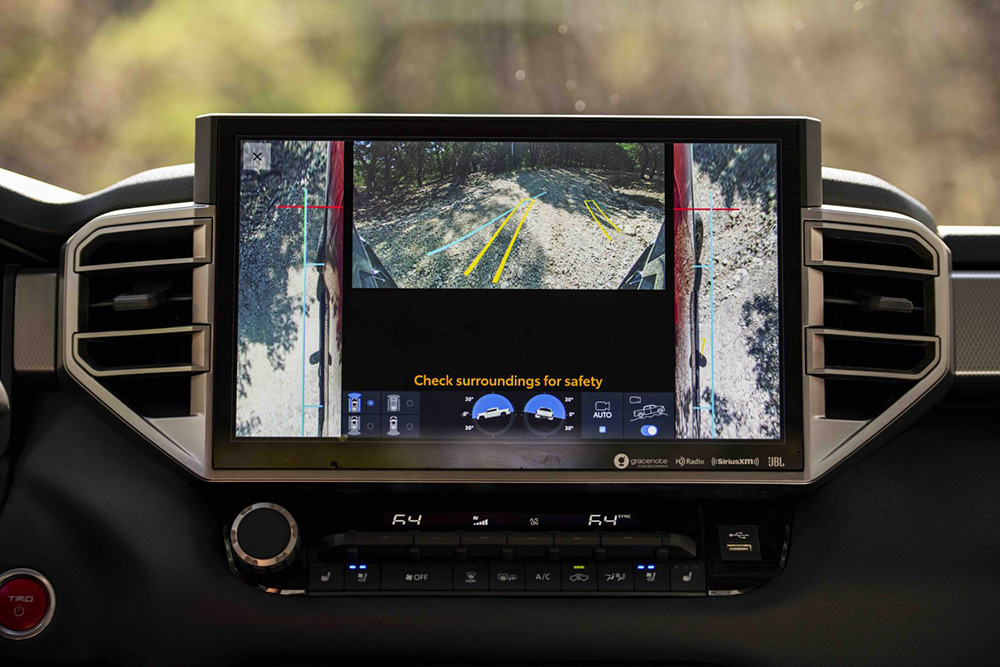
Surround-view system developed by Magna deployed in 2022 Toyota Tundra. (Image: Magna)

And one of the more fascinating aspects of Magna is that not only does it supply components and systems for use by OEMs to produce vehicles, but it manufacturers complete vehicles for those OEMs, having built more than 3.7-million vehicles. The forthcoming Fisker Ocean? It will be built by Magna. (And Magna is deeply involved in the engineering for that EV, as well.)

On this edition of “Autoline After Hours” we are joined by Boris Shulkin, executive vp and Chief Digital & Information Officer, at Magna.

Shulkin, whose job ranges from identifying companies to work with (or invest in) to cybersecurity, has a broad view of the auto industry, given that Magna has operations that make everything from automotive seats to cameras.

He provides a fascinating look at a company that is involved in an array of facets of the auto industry.

Shulkin talks with “Autoline’s” John McElroy, Craig Cole of EV Pulse, and me.

And you can see it all here.

It is a started-in-a-garage company unlike those you’re probably more familiar with.