Of course you’re going to find a super car in London
By Gary S. Vasilash
There will be 150 Rimac Automobili Neveras produced. The car is all electric. The car is rated at 1,914 hp.
The Rimac Nevera in London. (Where are the other cars?) Because it is an electric vehicle, it can travel through the Ultra Low Emissions Zone without a problem. (Image: Master Krishan)
In this photo, the Nevera is in London. This outing is the first time the car has been outside of where it was designed, engineered and built, Croatia. It will be going to the Goodwood Festival of Speed later this week. Which is reasonable. It will be part of the hillclimb in the Supercar Run.
Given that its four electric motors power it to 60 mph in 1.85 seconds and up to 100 mph in 4.3 seconds and will hit 186 mph after 9.3 seconds, odds are it will do well.
The Nevera was in London because its official retailer in the country, H.R. Owen, is there.
The vehicle has a sticker of two-million Euro, which is 1,712,730.00 British pounds.
The Nevera will go on something of a world tour, making some 20 stops in Europe, Asia and the U.S.
Odds are the vehicle will be sold out before it gets much further.
Not exactly what you might think vis-à-vis a fuel-efficient vehicle
By Gary S. Vasilash
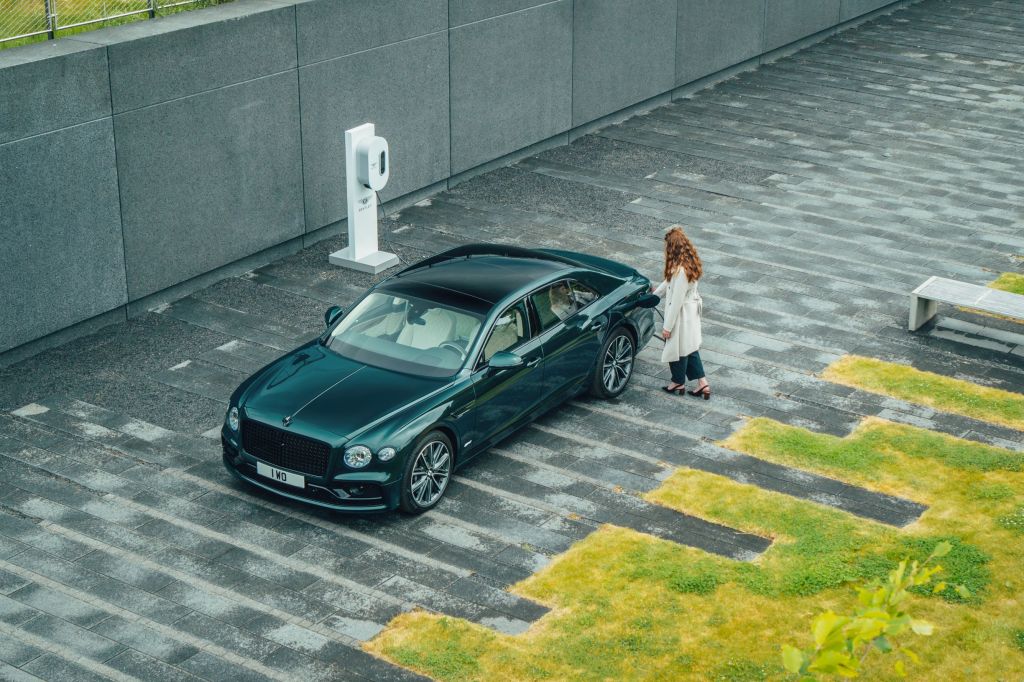
The Bentley Flying Spur is an imposing, stately sedan that is meant to go fast, thus its name.
The car is 209 inches long, 87 inches wide (mirror to mirror), 58 inches high, and when equipped with a V8 weighs 5,137 pounds. Large, solid and powerful.
It has a top speed of 198 mph.
The car has also been offered with a W12 engine (think of two V’s).
And now there is another variant, the Flying Spur Hybrid.
Yes, you can plug it in to charge the 14.1 kWh lithium-ion battery. (Image: Bentley)
It is part of Bentley’s “journey to electrification.”
The hybrid powertrain is based on a 2.9-liter V6 gasoline engine with an electric motor fitted between the engine and the transmission.
The turbocharged V6 engine produces 416 hp. The electric motor produces 134 hp. The system output is 543 hp.
While the V8 has more horsepower overall—549.5 hp—when looked at from a per liter metric, the Hybrid generates 152 hp per liter, more than the V8.
However, the V8’s 198 mph top speed bests the Hybrid, which is poking along at 177 mph.
What’s more, the V8 can go from 0 to 60 more quickly—in 4.0 seconds. 0.1 faster than the Hybrid.
When you get back to the point that these vehicles weigh more than two tons, even 4.1 seconds seems nearly impossible—especially for what the company describes as “the most efficient Bentley ever.”
An up-close look at bringing the clever small truck to the market
By Gary S. Vasilash
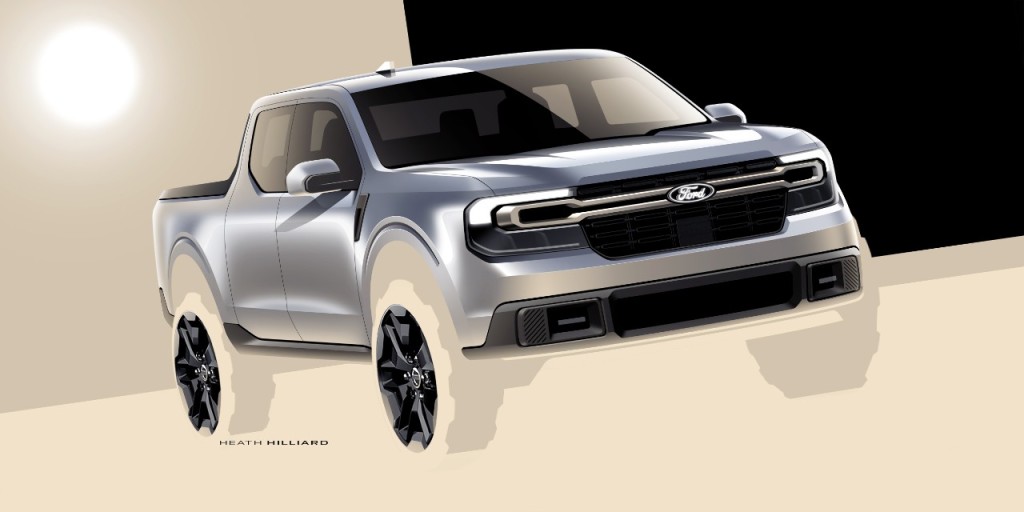
The Ford Maverick is what is being called a “white space” vehicle, a small—199.7-inch long—pickup truck with four doors and seating for five. As a point of reference, a Ford Ranger is 210.8 inches long and an F-150 is 231.7 inches long.
It will come standard with a hybrid powertrain that will provide an estimated combined fuel efficiency rating of 37 mpg. And the standard model has a payload capacity of 1,500 pounds and is capable of towing 2,000 pounds.
(Image: Ford)
The starting MSRP for the Maverick is $19,995.
And when asked whether this is some sort of artificially low price, both Chris Mazur, Maverick chief program engineer, and Trevor Scott, marketing manager for the Maverick (and Ranger), unambiguously maintain that this truck is the real deal.
It is, they say “Built Ford Tough.”
That claim is fairly bedrock for the Ford truck lineup so you can be confident that they’re not going to be using it unless there is confidence that they’re going to deliver with this pickup the same way that’s done for the other Ford trucks.
The interesting thing about the Maverick is how it was developed—done in a way unlike has been the case at Ford (as well as other companies that develop, well, anything). And this approach has not only led to the various innovations that are part of the Maverick, but also contributes to the cost-efficiency that the MSRP underscores.
One of the things about the truck is that the team, observing the way that real people use their trucks (not that the people on the team aren’t real people, too) is that many of them hack solutions, whether it is drilling holes in the sidewalls of the box to access electricity or jury-rigging the means to secure a mountain bike in the back. So Mazur says that they thought about that and have made power access simply available will provide CAD files that will allow owners to 3D print tooling for things like attachments.
It is almost that DIY ethos that is characteristic of the product development.
When the development started—pre-COVID—it was decided that there would be a cross-functional team consisting of representatives and participants from all functions that would be necessary to get the job done.
All of the participants wouldn’t just be in the same email group—they would be in the same room. Finance. Manufacturing engineering. Everyone was there. If there was a question to be answered, there was the person—right over there—who probably had the answer.
And they worked to be fast. Their “audacious goal” was to cut 25 months out of the development program.
They made quick models. They plastered the wall with documents and Post-It notes.
When it was time for the upper management reviews, it was there in the room, with the working documents and models and whatnot. Binders and PowerPoints were not on the schedule.
And when COVID hit and the people left the room for their own houses, they were still a team that knew one another, knew who to talk to to get answers, knew who was involved in what aspect of the development.
They were able to get things done.
They didn’t hit the 25-month goal, Mazur admits.
But they took 20 months out of the process.
Remarkable by any measure. And they had a pandemic to contend with.
Realize that as Ford has decided that things like trucks are important to its offering in a way that cars no longer are, the Maverick is a key vehicle in its product lineup.
Mazur and Scott are our special guests on this edition of “Autoline After Hours.”
John McElroy and I are joined by Mike Martinez of Automotive News, who covers Ford.
It is a full hour devoted to the Maverick.
If you have any interest in the truck or in an innovative approach to development, you’ve got to watch this show because you’re not likely to ever get a better sense of how the Maverick has been created.
Genesis, the luxury brand that is part of the Hyundai Group, wanted to make sure that its entry into the European market is well noted, so it went to a town in Switzerland, Lauterbrunnen, which is in the Swiss Alps, picked out a mountain, and created a lightshow that displayed the company’s logo.
Vehicle plants that make a million vehicles of one type are comparatively rare, so a nod to the folks at the Ford Kansas City Assembly Plant, who made the millionth Transit commercial van there this week.
Consider this: the Transit comes in various lengths, from 217.8 inches to 263.9 inches. So let’s take something about in the middle, 235.5 inches. A million Transits parked nose to tail would be about 3,800 miles long. That’s a lot of trucks. (Image: Ford)
The plant began production of the vehicle in 2014.
Undoubtedly as a result of their expertise (and the tooling on had probably plays a role, too), they’ll start building the E-Transit, an all-electric cargo hauler, later this year.
Turns out that police pursuit pickups are really quite quick
By Gary S. Vasilash
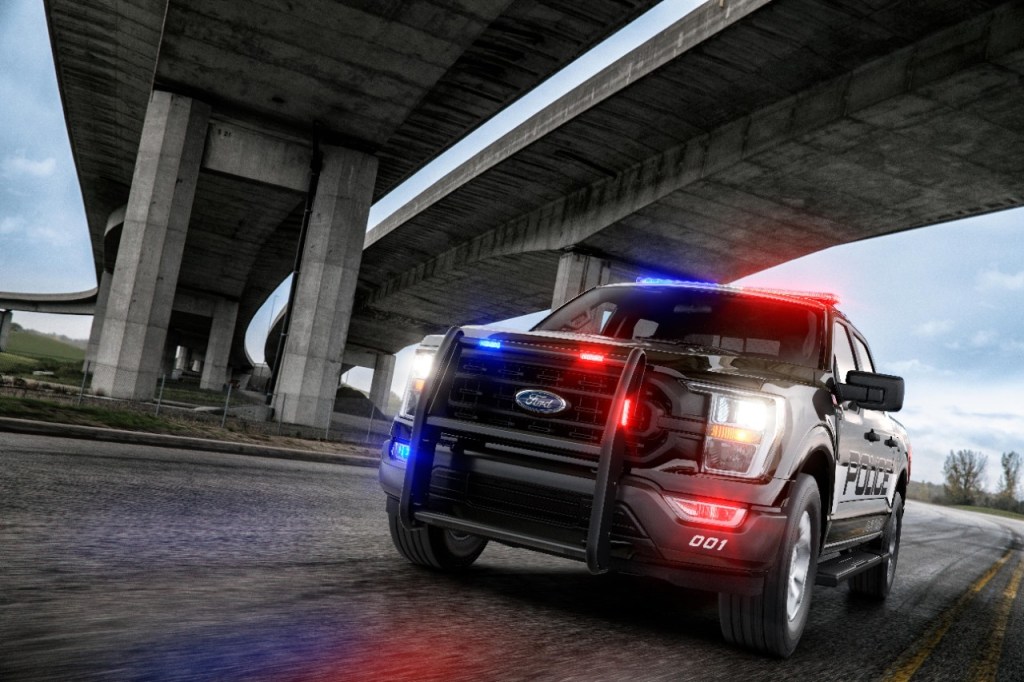
According to test data from the Los Angeles County Sheriff’s Department, the 2021 Ford F-150 Police Responder has the best acceleration of any pursuit-rated police vehicle tested.
You don’t want to see this in your rearview mirror, do you? (Image: Ford)
The tests show that the vehicle does a quarter mile in 14.4 seconds. That 0.4 is important because that is how much faster it is than its closest competitor.
The Michigan State Police are also running tests on the pickup. So far it has measured a 0 to 60 mph time of 5.4 seconds. Again, number-two is 0.4 seconds slower.
However, they’ve found the F-150 going from 0 to 100 mph in 13.1 seconds, which is 0.8 seconds faster than the runner up.
The top speed? The Michigan State Police say 120 mph, which is 15 mph faster than the 2020 model of the truck.
A big contributor to the performance?
A new torque-on-demand 4×4 transfer case.
This is the case because it gets the torque to the wheels faster.
It is also beneficial when cornering.
Both police departments run 32-lap vehicle dynamics test.
The improvements in cornering capability resulted in a 5.8-second reduction in the average lap time in Michigan and a 3.6-second reduction in LA.
No, it’s not that the LA cops are slower drivers than those in Michigan: They put 400 additional pounds of payload into the trucks during testing to simulate cargo.
Volvo cars were once widely known for two characteristics:
Their boxy design
The fact that they were built with safety foremost
The company essentially “owned” safety in the minds of consumers.
But in the mid- to late-90s the company wanted to be more than something that was the Official Car Builder for Tweed-Jacket-With-Suede-Elbow-Patch-Wearing and Pipe-Smoking East Coast Professors.
Style took over from safety.
The design team members were evidently given French curves to supplement the T-squares.
And while the engineers back in Gothenburg were still figuring out the materials and the structures and the systems that would make the Swedish vehicles safe, their laudable efforts were eclipsed by things like Val Kilmer’s character driving a C70 in The Saint.
But safety is back.
In 2022 Volvo will launch a fully electric SUV, the flagship model for the brand.
(Image: Volvo)
It will come standard with a LiDAR system, from Luminar, and an on-board supercomputer system, from NVIDIA.
“Volvo Cars is and always has been a leader in safety. It will now define the next level of car safety,” said Håkan Samuelsson, Volvo chief executive.
When it comes to autonomous driving, the thing is that there is little in the way of driving and a whole lot in the way of trusting.
As in trusting that the system is going to work because you are, even though behind the wheel, acting as a passenger.
Safety is huge when it comes to autonomy. Which means a need for plenty of sensors, including LiDAR, and the wherewithal to process that information so that the system will have the appropriate responses (e.g., braking, turning, accelerating).
By coming out and saying that this tech is going to be built in to its new vehicle, it seems as though that Volvo is ready to take that safety mantle back.
(Kilmer? He’ll be back this fall as Iceman in Top Gun: Maverick)
J.D. Power and LMC Automotive see solid figures for June ’21 sales
By Gary S. Vasilash
J.D. Power and LMC Automotive have come out with their prediction for how June 2021 sales will come in, and the prediction is that it will be a 12.4% increase over June 2020—which isn’t all that surprising, given that in June 2020 we were still in the midst of the pandemic—and even a smidge, as in 0.3%, better than June 2019 (taking into account available selling days).
However, looking at the second quarter of 2021 in its entirety, things are rather robust, as in a 44.2% increase over Q2 2020 and a 10.7% increase over Q2 2019.
But there are some other figures that need to be taken into account.
One of those numbers is $38,088. That’s the average price of a new vehicle, which is a first half record according to the two organizations. It is a 10.1% (or $3,497) rise compared to the same period in 2019 and a 14.1% (or $4,699) increase over the number in 2019.
The average transaction price—as in what people actually pay for a vehicle from a dealer—is expected to be $40,206, a record high.
The organizations see retailer profits rise from $1,310 in the first half of 2020 and $1,457 in the first half of 2019 to $2,844.
Explains Thomas King, president of the data and analytics division at J.D. Power, “Consumers are buying more expensive vehicles despite smaller discounts, which is dramatically increasing the profitability of those sales for both manufacturers and retailers.”
Although there is evident agitation on behalf of some of an economic bent regarding the rise in inflation, recognize that here are consumers who are buying big, which means that OEMs are going to make more expensive vehicles because they’re selling, which means that there will be a continued rise. . .
When you want to go very fast, you pay very close attention to how the air flows over, under and around a vehicle
By Gary S. Vasilash
The ’22 Cadillac CT4-V Blackwing has a 472-hp, 445 lb-ft of torque 3.6-liter twin-turbo V6 that propels the car at up to 186 mph.
But the car isn’t about straight-line speed as much as it is about track performance, so the engineering team took the Cadillac Racing Dpi-.R race car as a template, put the CT4-V Blackwing digital model in over 300 computational fluid dynamics simulations and put physical models in a five-belt rolling road wind tunnel at the GM Technical Center (it seems that the five-belt setup allows a more accurate assessment of what goes on beneath the vehicle than wind tunnels without five) and came up with aero packages to help its performance.
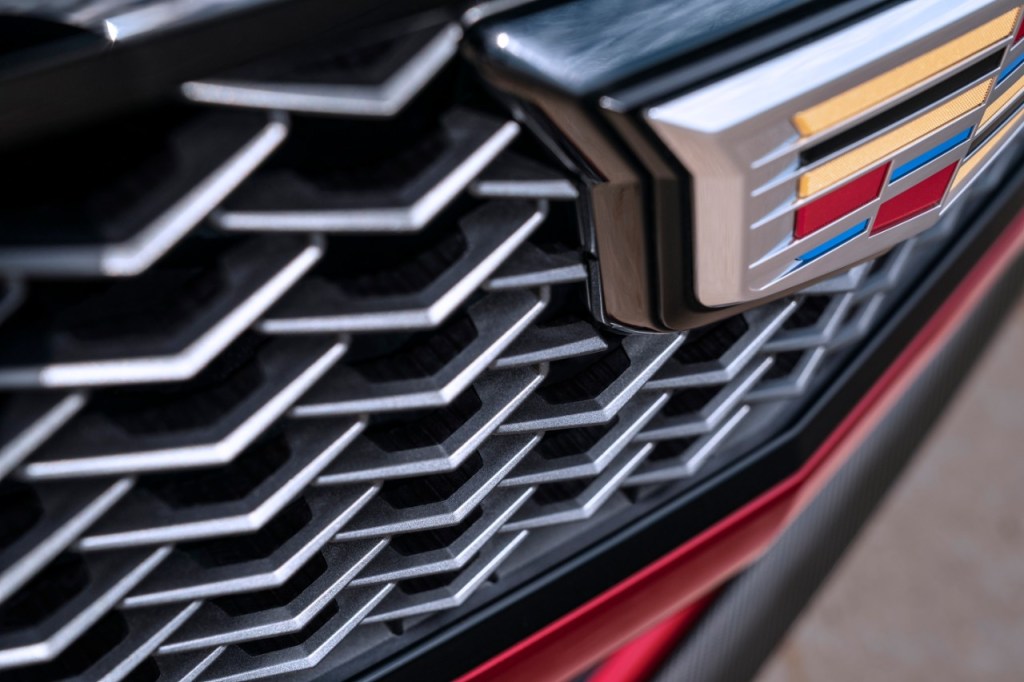
The radius of each V on the 2022 CT4-V Blackwing optimizes airflow. (Image: Cadillac)
As Tony Roma, Cadillac V-Series Blackwing chief engineer, puts it: “With the CT4-V Blackwing, we create net downforce that is incredibly rare in production vehicles. What this means is that the car gets pressed down into the road the faster you go, giving it more grip, greater stability and inspiring the driver to confidently explore its full capabilities. Not only have we produced our most track-capable sub-compact sedan ever, but we continue to work with our racing counterparts to explore the limits of physics to make better cars.”
So there is a front underwing with air strakes to control the airflow (Scott Sier, aerodynamics performance engineer at Cadillac: “Thanks to components like the underwing, we were able to work with design to generate downforce without the use of large wings that didn’t fit with the design.”).
Front dive planes to increase grip for the front tires by pushing the front down (see previous quote).
A rear spoiler with a functional 3-mm Gurney flap for more downforce.
Brake cooling ducts that are not only 3D printed (how techy is that?) but work to keep the rotors cool and direct air around the front control arms.
Front fender vents that exhaust built-up pressure in the wheel wells as well as remove hot air from the engine bay.
A front splitter, rocker moldings and extensions and a rear diffuser, all of which reduce lift and provide high-speed balance.
A flat underbody for airflow management.
Rear control arm covers, which minimize air buildup around the rear wheel wells and the control arms.
But the most remarkable one of all: the mesh on the grille has V-shaped inlets that have two different textures that work to control and direct air.
Sure, the grille makes a huge difference in air flow management, but the textures on each of those little elements?
If you look at the picture of this motorcycle—the WMC250EV from White Motorcycle Concepts (WMC), a British firm—you will notice a black spot where you might imagine a headlamp might be positioned:
(Image: WMC)
That is actually an air duct, or, in the parlance of WMC, an element of “V-Air,” one of the three “market disruptive technologies” that are being used on this electric motorcycle.
The duct channels air through the bike, not around it, thereby greatly reducing the aerodynamic resistance.
Another thing it does is keep the front wheel down, which then brings in the second disruptive tech, “D-Drive.” This is a drive motor. Turns out that generally bikes, because they are rear drive, tend to have lift in the front of the bike. D-Drive also provides regenerative braking.
Finally, there’s “F-Drive,” a final drive system. This, according to the company, is something that could actually be retrofitted onto existing motorcycle designs.
Why is any of this of interest?
WMC CEO Rob White plans to ride the WMC250EV within the next 12 months so that he will break both the British and world land speed records.
The motorcycle has a top speed in excess of 250 mph.